


In this article
- Why Home Service Businesses Need Better Call Handling
- What Is an AI Voice Agent?
- How an AI Receptionist for Home Services Works
- Best Use Cases for Home Service Call Automation
- AI Answering Service for Contractors vs Human Answering Service
- AI Voice Agent for Contractors: Real-World Examples
- Mini Case Study 1: Bill Joplin’s HVAC Books Over 90% of Calls
- Mini Case Study 2: Ottawa General Contractors Doubled Qualified Leads
- Key Features Your AI Voice Agent Should Include
- Step-by-Step: How to Implement an AI Voice Agent
- Build vs Buy: What Should Home Service Businesses Choose?
- Launch a White-Label AI Voice Agent Platform
- How OnGraph Can Help
- Key Takeaways
- Final Thoughts
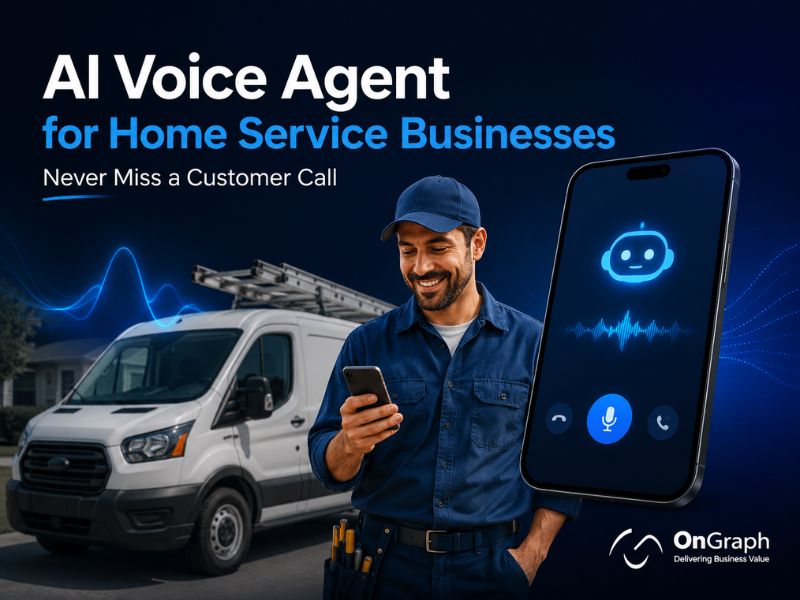
AI Voice Agent for Home Service Businesses helps contractors answer calls, qualify leads, and book service jobs 24/7.
- Answers calls when staff are busy.
- Books appointments and service visits.
- Routes urgent calls to the right person.
- Sends call notes to CRM tools.
- Reduces missed leads and manual follow-up.
Why Home Service Businesses Need Better Call Handling
An AI Voice Agent for Home Service Businesses solves a simple but expensive problem: missed customer calls.
A homeowner with a burst pipe will not wait long. Someone without cooling may call several HVAC companies. A roof leak customer may choose the first contractor who responds.
For home service businesses, speed often decides who wins the job.
The US home service market is large and still growing. Mordor Intelligence estimates the market at USD 842.04 billion in 2026. It also projects the market to reach USD 989.22 billion by 2031.
Demand is also rising for service professionals. Jobber’s 2026 Home Service Trends Report says nearly 60% of pros reported increased customer demand last year.
More demand creates more opportunity. At the same time, it creates more pressure on office teams.
Your team may be on job sites. Calls may arrive after business hours. Office staff may already be handling dispatch, quotes, and customer updates.
When calls go unanswered, leads often move to competitors. That is where voice automation can help.
Turn Missed Calls Into Booked Service Jobs
What Is an AI Voice Agent?
An AI voice agent is a phone-based assistant that speaks with callers naturally.
It can answer questions, collect job details, qualify leads, schedule appointments, and route urgent calls.
Unlike a basic phone menu, it does not only ask callers to press buttons. The system listens to the caller, understands the request, and follows a service workflow.
For home service businesses, it can handle calls like:
- “My AC stopped working.”
- “Can someone fix a leaking pipe today?”
- “I need a roof inspection.”
- “Can I reschedule my cleaning appointment?”
- “How much does a bathroom remodel cost?”
A good AI voice agent should not replace every human conversation. Instead, it should handle repeatable calls and escalate complex cases.
That gives your team more time for high-value customer conversations.
How an AI Receptionist for Home Services Works
An AI receptionist for home services follows a structured call flow.
First, it greets the caller in your brand tone. Then it asks what service they need. After that, it collects the address, urgency, preferred time, and contact details.
For simple calls, the agent can book an appointment. When the call is urgent, it can route the customer to your emergency team.
The system can also send a summary to your CRM, calendar, or field service platform.
| Step | What the AI Voice Agent Does |
| 1 | Answers the call instantly |
| 2 | Identifies the service request |
| 3 | Checks urgency and location |
| 4 | Collects caller details |
| 5 | Books or qualifies the job |
| 6 | Sends confirmation by SMS |
| 7 | Updates CRM or scheduling tool |
| 8 | Escalates urgent calls to staff |
OnGraph’s AI Voice Agent solution supports human-like voice, multilingual calls, 24/7 availability, custom prompts, and API integrations.
This makes it useful for companies that need more than a generic answering system.
Best Use Cases for Home Service Call Automation
Home service call automation works best when calls are repetitive, urgent, or time-sensitive.
Most contractors receive similar questions every day. Customers ask about availability, pricing, service areas, emergencies, and appointment times.
A trained voice agent can handle these calls with consistent answers.
1. After-Hours Call Answering
Many homeowners call after work, during weekends, or during emergencies.
An AI voice agent can answer those calls when your office is closed. It can collect job details, check urgency, and book available slots.
This is useful for HVAC, plumbing, electrical, pest control, garage door, and cleaning services.
2. Emergency Call Triage
Emergency calls need quick routing.
A plumbing company may treat burst pipes as urgent. HVAC teams may prioritize no-cooling calls during summer. Electricians may need to escalate safety-related issues.
3. Appointment Booking
AI appointment booking for home services helps customers schedule without waiting.
The agent can ask qualifying questions, check availability, and send confirmation messages.
For busy teams, this reduces back-and-forth calls. It also helps office staff focus on dispatch, quotes, and customer care.
4. Lead Qualification
Not every lead is ready to book.
Some callers need a small repair. Others may want a large renovation estimate. A few may only need pricing information.
The voice agent can ask about service type, location, timeline, budget, and urgency.
Better qualification helps sales teams focus on the right opportunities.
5. Follow-Up and Reactivation
Many leads do not book on the first call.
A voice agent can follow up with missed leads, old estimates, no-shows, and maintenance plan customers.
This can help recover revenue without adding more office workload.
Automate Your Home Service Call Workflow
AI Answering Service for Contractors vs Human Answering Service
Many contractors already use live answering services.
These services can help, but they may not always fit trade-specific workflows. Some providers follow generic scripts, while others may not update your CRM in real time.
An AI answering service for contractors can work 24/7 and follow your exact rules. A human answering service may handle emotional or complex calls better.
The best choice depends on call type, call volume, and customer expectations.
| Factor | AI Answering Service | Human Answering Service |
| Availability | 24/7 | Depends on provider |
| Cost scaling | Easier to scale | Can increase with volume |
| Call consistency | High | Varies by agent |
| Emergency routing | Rule-based | Human judgment |
| CRM updates | Automated | Manual or integrated |
| Complex objections | Limited | Stronger |
| Best for | Repeatable calls | Sensitive conversations |
A custom AI voice agent can be trained around your services, locations, emergency rules, and booking process.
For many home service teams, the best model is not AI versus humans. It is AI for routine calls and humans for complex conversations.
AI Voice Agent for Contractors: Real-World Examples
An AI voice agent for contractors can support many service categories.
Each trade has different call types. A strong voice agent should match those workflows.
HVAC Companies
The agent can book no-heat or no-cool appointments.
It can also ask about system type, issue, address, membership status, and urgency.
Plumbing Businesses
A plumbing agent can identify burst pipes, drain clogs, leaks, and water heater issues.
Emergency cases can be routed immediately.
Electricians
Electrical contractors can use voice agents to collect job details.
The system can separate urgent safety issues from standard installations or inspection requests.
Roofing Companies
Roofing businesses can qualify storm damage calls.
The agent may ask about leak location, property type, insurance status, and inspection timing.
Cleaning Companies
A cleaning company can use voice automation for recurring bookings.
It can also handle rescheduling, service details, and pricing questions.
Pest Control Providers
The agent can ask about pest type, property size, and service urgency.
Once qualified, it can book inspections or send details to a technician.
Landscaping Teams
Landscaping businesses can collect yard size, service type, preferred day, and seasonal requirements.
These workflows turn phone calls into structured service requests.
Mini Case Study 1: Bill Joplin’s HVAC Books Over 90% of Calls
ServiceTitan reported that Bill Joplin’s Air Conditioning and Heating used its AI Voice Agent during peak season.
According to ServiceTitan, the agent handled more than 1,300 calls in just over three months. More than 90% resulted in booked jobs, and 72% were completed without human intervention.
ServiceTitan also reported that the company estimated over $74,000 in incremental booked revenue. It also estimated about $23,000 in operating cost savings.
This case shows why call automation matters during peak demand.
Seasonal rush periods can overwhelm office teams. Voice agents can help protect booking capacity when call volume rises.
Mini Case Study 2: Ottawa General Contractors Doubled Qualified Leads
Karmaflow published a case study about Ottawa General Contractors.
The company deployed a 24/7 AI receptionist and renovation concierge across website, phone, and SMS. The system qualified leads, sent resource packs, shared soft estimate ranges, and booked consultations.
After 90 days, Karmaflow reported 2x qualified lead volume, 3x faster response, and 35% less manual triage.
This case is useful for renovation and remodeling businesses.
Large project leads often need more than basic call answering. They need qualification, education, fast response, and smooth consultation booking.
Key Features Your AI Voice Agent Should Include
Not every voice agent is ready for home service workflows.
A useful solution should handle real contractor calls, not just generic conversations.
1. Service-Specific Call Flows
The agent should understand your service categories.
Plumbing calls differ from roofing calls. HVAC emergencies need different questions than cleaning service bookings.
Clear call flows improve accuracy.
2. Emergency Routing
Urgent calls should never get stuck.
Your system should route emergencies to the right technician, manager, or dispatcher.
This matters for plumbing, HVAC, electrical, and restoration services.
3. Appointment Scheduling
The agent should book jobs into your calendar or field service platform.
This avoids manual re-entry. It also reduces missed follow-up.
4. CRM and Field Service Integration
Useful integrations may include ServiceTitan, Jobber, Housecall Pro, HubSpot, Zoho, Salesforce, or custom CRMs.
OnGraph’s AI Voice Agent service supports API integrations and real-time workflow automation.
The right integration turns calls into booked jobs, tasks, and follow-ups.
5. SMS Confirmation
Customers should receive appointment details after the call.
SMS confirmation improves clarity. It also reduces confusion around dates, time slots, and technician visits.
6. Call Summary and Recording
Your team should know what happened on each call.
A summary helps dispatchers, sales teams, and managers act faster.
7. Human Handoff
Some calls need people.
The agent should transfer emergencies, upset customers, special pricing requests, and high-value projects.
Launch a Custom Voice Agent for Your Service Business
Need call automation for HVAC, plumbing, roofing, or cleaning? Build a solution tailored to your workflow.
Step-by-Step: How to Implement an AI Voice Agent
Step 1: Map Your Call Types
Start with your most common call categories.
Examples include new job requests, emergencies, pricing questions, rescheduling, warranties, complaints, and quote follow-ups.
Step 2: Define Booking Rules
Decide what the agent can book.
Set rules for service areas, technician availability, job types, emergency calls, and minimum job value.
Step 3: Build Your Knowledge Base
Add your services, FAQs, pricing ranges, policies, service locations, and working hours.
Keep the content simple and updated.
Step 4: Connect Your Systems
Integrate the agent with your CRM, calendar, field service platform, or dispatch software.
This step turns conversations into real business actions.
Step 5: Create Human Handoff Rules
Set clear limits.
The agent should escalate emergencies, angry customers, special pricing requests, and high-value projects.
Step 6: Test With Real Call Scenarios
Test calls before going live.
Use real examples from your business. Include noisy calls, incomplete addresses, urgent issues, and confused callers.
Step 7: Track Performance Weekly
Measure answer rate, booked jobs, missed calls, escalations, and customer satisfaction.
Improve call flows based on real data.
Build vs Buy: What Should Home Service Businesses Choose?
Some companies need a ready-made AI receptionist.
Others need a custom platform with deeper integrations, custom rules, and white-label control.
| Option | Best For | Limitation |
| Ready-made AI receptionist | Small teams needing fast setup | Limited customization |
| AI answering service | Contractors needing call coverage | May not fit complex workflows |
| Custom AI voice agent | Agencies, enterprises, multi-location teams | Requires planning and development |
| White-label platform | Resellers and service providers | Needs product strategy |
Choose a ready-made tool if your workflow is simple.
Custom development is better when you need deep integrations, brand control, multi-location support, or white-label resale.
Launch a White-Label AI Voice Agent Platform
Some agencies and SaaS founders want more than one business use case.
They want to launch a white-label AI voice agent platform for multiple clients.
This model can serve:
- HVAC companies
- Plumbers
- Electricians
- Roofers
- Cleaning businesses
- Pest control providers
- Field service franchises
- Local marketing agencies
A white-label platform can include client accounts, usage tracking, call recordings, billing, analytics, custom prompts, and voice flows.
This option is useful if you want to sell voice automation as a product.
How OnGraph Can Help
OnGraph provides AI Voice Agent Solutions for startups, agencies, and enterprises.
The platform supports human-like voice, multilingual calls, 24/7 availability, custom prompts, and API-based workflows.
OnGraph can help with:
- AI voice agent development
- Contractor call automation
- Appointment booking workflows
- CRM and scheduler integrations
- Emergency routing logic
- White-label voice agent platforms
- Call analytics dashboards
- Custom voice prompts
- SMS and WhatsApp follow-ups
Key Takeaways
AI Voice Agent for Home Service Businesses helps answer calls, qualify leads, and book jobs faster.
Home service buyers often call when the need is urgent. Faster response can improve lead capture.
An AI receptionist for home services works best for repeatable calls, booking, triage, and follow-up.
Human teams still matter for complex, emotional, or high-value conversations.
Custom AI voice agent development is useful when your workflow needs deeper control.
Final Thoughts
Home service businesses win or lose jobs through speed, trust, and availability.
Customers often call when they need immediate help. If your team misses the call, another contractor may get the job.
An AI Voice Agent for Home Service Businesses can answer instantly, qualify callers, book jobs, and update your systems.
The best results come from clear rules and human escalation. Voice automation should support your team, not fully replace it.
For startups, agencies, and service businesses, the best approach is phased.
Start with call answering and booking. Then add follow-ups, dispatch logic, analytics, and white-label workflows.
When done well, voice automation becomes more than support. It becomes a lead capture and operations system.
FAQs
An AI Voice Agent for Home Service Businesses is a phone assistant that answers calls, qualifies leads, books jobs, and routes urgent requests. It helps contractors reduce missed calls and manage customer inquiries 24/7.
An AI receptionist for home services answers calls when office staff are busy. It collects customer details, checks urgency, books appointments, and sends call summaries to your team.
Yes, it can book jobs when connected to your calendar or field service software. The system must follow your service area, availability, and job-type rules.
HVAC, plumbing, roofing, electrical, cleaning, pest control, landscaping, and remodeling businesses can use voice agents. The best workflows involve repeatable calls and appointment booking.
It depends on the call. An AI virtual receptionist is better for routine calls and 24/7 coverage. Human receptionists are better for complex issues and sensitive conversations.
It can integrate with CRMs, calendars, dispatch tools, field service platforms, SMS systems, and payment workflows. Common examples include ServiceTitan, Jobber, Housecall Pro, HubSpot, and Zoho.
Buy a ready tool for simple call answering. Build custom if you need complex workflows, deeper integrations, white-label features, or multi-location support.
The biggest benefit is faster response. Call automation helps answer more calls, collect job details, book appointments, and reduce manual follow-up during busy hours.
Yes, it can identify emergency requests and route them to the right person. Clear escalation rules are important for urgent plumbing, HVAC, electrical, and restoration calls.
OnGraph can build custom voice workflows, CRM integrations, appointment booking flows, analytics dashboards, and white-label voice agent platforms for home service businesses.
About the Author

Let’s Create Something Great Together!
Latest Blog
Let’s have a conversation today!


India
ONGRAPH TECHNOLOGIES PRIVATE LIMITED,
SDF L-1, NSEZ,
Sector 81, Block L, Phase-2,
Noida, Uttar Pradesh-201305

USA
OnGraph Technologies,
120 Bethpage Rd, Suite 304,
Hicksville, NY 11801, USA

Canada
7-1039 CEDARGLEN GATE,
Mississauga, Ontario,
Canada L5C 3A7

UK
89 Banstead Road South,
Sutton, Surrey, SM2 5LH
United Kingdom

Malaysia
G-3A, Amaya Maluri, Jalan
Jejaka 2, Taman Maluri,
KL–55100, Malaysia

Singapore
10 Anson Road,#26-04
International Plaza,
Singapore (079903)