


In this article
- Why Businesses Are Looking for AI Voice Agents Now
- Why This Is a Big Opportunity for Resellers and Agencies
- What Is a White-Label AI Voice Agent Platform?
- How the Platform Works in Real Life
- Who Should Launch an AI Voice Agent Reseller Platform?
- Best Industries to Target First
- Key Features Your Platform Must Have
- Simple vs Advanced AI Voice Agent Use Cases
- How to Price Your AI Voice Agent Reseller Service
- Compliance and Risk Considerations
- Step-by-Step Roadmap to Launch
- Mini Case Study: Car Garage AI Receptionist
- Mini Case Study: Clinic Appointment Agent
- Build vs Buy: What Should You Choose?
- Common Mistakes to Avoid
- What Your First MVP Should Include
- Key Takeaways
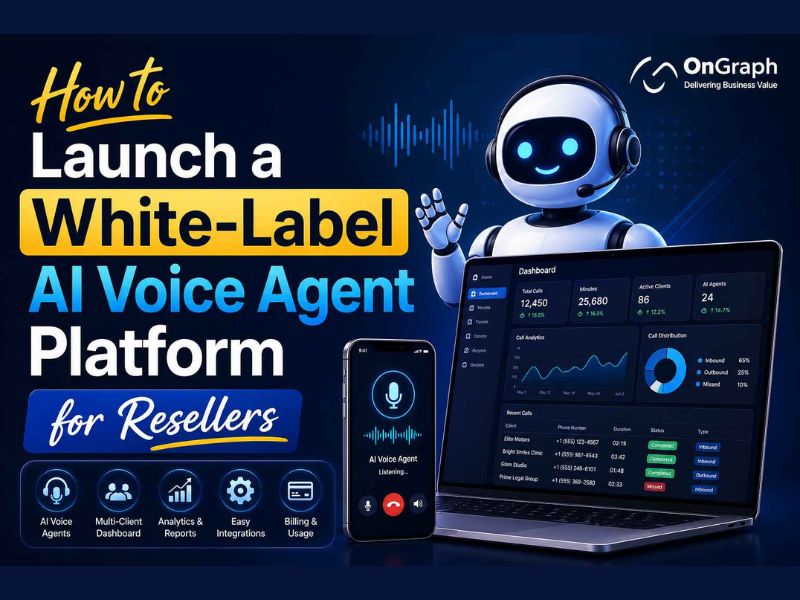
A white-label AI voice agent platform for resellers helps agencies, consultants, and entrepreneurs sell branded AI calling solutions to businesses without building the technology from scratch. It allows you to offer AI receptionists, appointment booking agents, lead qualification agents, and outbound calling agents under your own brand. The biggest opportunity is not just automation—it is building a recurring revenue business around AI voice services.
Why Businesses Are Looking for AI Voice Agents Now
Most businesses still lose customers on phone calls.
A customer calls for an appointment, quote, repair, consultation, or service update. But if the team is busy, the call is missed. If the receptionist is unavailable, the customer waits. If the sales team follows up late, the lead becomes cold.
This is a common problem for salons, clinics, car garages, law firms, real estate offices, home service businesses, fitness studios, and many other local businesses.
That is why AI voice agents are becoming more useful. They can answer calls, ask questions, collect details, book appointments, qualify leads, and send information to the business team.
But here is the bigger opportunity.
Many business owners do not want to understand AI tools, phone systems, CRM APIs, or automation workflows. They want a simple solution that works.
This creates a strong opening for agencies and resellers.
Launch Your Own AI Voice Agent Platform—Faster Than You Think
Why This Is a Big Opportunity for Resellers and Agencies
If you already sell websites, ads, CRM setup, automation, telecom, or business consulting, a white-label AI voice agent platform can become your next recurring revenue service.
Instead of building one custom voice bot for one client, you can sell the same base platform to many clients with small changes.
For example:
- A salon needs an AI appointment booking agent.
- A car garage needs an AI call answering agent.
- Law firm needs an AI intake agent.
- A clinic needs an AI appointment request agent.
- A real estate company needs an AI inquiry qualification agent.
The core platform remains the same.
Only the script, business name, workflow, integrations, and knowledge base change.
This is why a reseller model is powerful. You are not just selling software. You are selling a branded AI voice automation service that can scale across multiple industries.
What Is a White-Label AI Voice Agent Platform?
A white-label AI voice agent platform is a ready-made or customized software platform that you can sell under your own brand.
Your clients log in to your branded dashboard and create or use AI agents. They connect phone numbers. They view call logs, transcripts, leads, usage, and billing.
Behind the platform, the system usually includes:
- Speech-to-text to understand callers
- AI/LLM to process the conversation
- Text-to-speech to reply in a natural voice
- Phone number providers for inbound and outbound calls
- CRM/calendar integrations
- Billing and usage tracking
- Admin dashboards for clients and resellers
In simple words, it gives you the backend technology needed to sell AI calling services without starting development from zero.
How the Platform Works in Real Life
Let’s say your client owns a car garage.
A customer calls and asks, “Can I book a service for my car tomorrow?”
The AI voice agent answers the call, asks for the customer’s name, car model, issue, preferred time, and contact number. Then it sends the information to the garage team through CRM, Google Sheet, email, or dashboard.
Now imagine another client owns a salon.
The same platform can handle appointment requests, service questions, opening hours, pricing FAQs, and booking confirmation.
This is where the reseller advantage starts.
You do not need to rebuild the product for every business. You create reusable AI agent templates and customize them for each client.
Who Should Launch an AI Voice Agent Reseller Platform?
This model is ideal for people who already understand sales, client service, or business operations.
It is a good fit for:
Digital Marketing Agencies
Agencies can add AI voice agents as an upsell to websites, SEO, paid ads, landing pages, and CRM services.
CRM and Automation Consultants
If you already help businesses with HubSpot, Zoho, Salesforce, GoHighLevel, or custom CRMs, AI voice agents can become a natural extension.
Telecom and VoIP Resellers
Phone system providers can add AI agents to their existing calling and number management services.
Local Business Consultants
Consultants who work with salons, clinics, garages, lawyers, real estate firms, or service businesses can package AI voice agents as a practical business solution.
Sales-Led Founders
If you have strong business connections and can sell the value clearly, you can start with a focused niche and grow from there.
Ready to Build a Profitable AI Voice Agent Business?
Best Industries to Target First
Do not start by targeting every business.
That sounds attractive, but it makes your messaging weak.
Start with industries where calls are important, and workflows are easy to understand.
Good starting niches include:
- Salons and spas
- Car garages
- Dental clinics
- Healthcare appointment desks
- Real estate agencies
- Legal firms
- Fitness studios
- Home service businesses
- Restaurants
- Local repair businesses
For the first version, choose simple use cases like call answering, lead capture, appointment booking, and missed call recovery.
Avoid very complex workflows in the beginning unless you have the right compliance and integration support.
Key Features Your Platform Must Have
Once the reader understands the opportunity, the next question is simple:
“What features do I actually need?”
A reseller-ready AI voice agent platform should include these core modules.
1. Branded Client Dashboard
Your clients should log in to a dashboard with your brand.
They should be able to see calls, leads, transcripts, usage, and agent settings.
2. Reseller Admin Dashboard
You also need your own dashboard to manage all clients.
This helps you track:
- Total clients
- Active agents
- Call usage
- Billing
- Support issues
- Lead performance
- Client activity
Without this, managing multiple clients becomes difficult.
3. Pre-Built AI Agent Templates
Templates help you launch faster.
You can create ready-made agents for:
- Salon booking
- Garage inquiries
- Legal intake
- Healthcare appointment requests
- Real estate inquiries
- Restaurant reservations
- Home service quote requests
Each template should be editable.
4. Script and Prompt Editor
Your team should be able to update agent scripts without depending on developers every time.
This improves speed and reduces support costs.
5. Knowledge Base Upload
Every business has its own FAQs, services, pricing, policies, and working hours.
The platform should allow clients or your team to upload this information so the AI agent can answer better.
6. CRM and Calendar Integrations
This is where the AI voice agent becomes truly useful.
It should connect with:
- Google Calendar
- Outlook Calendar
- HubSpot
- Zoho
- Salesforce
- GoHighLevel
- Google Sheets
- Custom CRMs
7. Inbound and Outbound Calling
Inbound calling is useful for support, appointment booking, and call answering.
Outbound calling is useful for reminders, lead follow-ups, surveys, and confirmations.
8. Billing and Usage Tracking
As a reseller, you need to know how much each client is using.
Your platform should track:
- Call minutes
- Cost per call
- Billing history
- Client payments
- Wallet balance
- Usage reports
9. Call Logs and Transcripts
Clients should be able to review conversations.
This helps them understand customer needs, missed opportunities, and lead quality.
10. Human Handoff
AI should not handle everything.
If the caller asks something complex or urgent, the system should transfer the call or notify a human.
Simple vs Advanced AI Voice Agent Use Cases
| Use Case | Complexity | Best For |
| Call answering | Low | Local businesses |
| Lead capture | Low | Service businesses |
| Appointment request | Medium | Salons, clinics, garages |
| CRM update | Medium | Sales teams |
| Calendar booking | Medium | Appointment-based businesses |
| Outbound campaigns | Medium/High | Sales and reminders |
| Healthcare/EHR integration | High | Clinics and hospitals |
| Custom workflow automation | High | Larger businesses |
This table helps readers understand what to sell first.
The best strategy is to start with low-complexity, high-demand use cases. After that, you can move into advanced integrations.
How to Price Your AI Voice Agent Reseller Service
Pricing is one of the most important parts of this business.
You need to cover your platform cost, calling cost, AI model cost, support cost, and your profit margin.
Common pricing models include:
Setup Fee
Charge a one-time fee for onboarding, script setup, testing, and integration.
Monthly Subscription
Charge a fixed monthly fee for platform access and support.
Usage-Based Billing
Charge based on call minutes or usage volume.
Hybrid Model
This is often the best model.
Example:
- Setup fee
- Monthly platform fee
- Usage-based call billing
- Extra charges for custom integrations
This gives you predictable revenue and protects your margin.
Compliance and Risk Considerations
Before selling AI voice agents, you must understand that compliance depends on industry and location.
For example:
- Healthcare may require HIPAA compliance in the US.
- UK and EU businesses need GDPR consideration.
- Outbound calls may require consent.
- Call recording rules may vary by region.
- Sensitive customer data must be protected.
You should not promise that your platform is automatically compliant for every business.
Instead, use a clear approach:
- Ask the client what data will be collected.
- Identify the country and industry.
- Confirm whether calls are inbound or outbound.
- Define call recording and consent requirements.
- Check if sensitive data will be processed.
- Add human review for risky workflows.
This builds trust and protects your reseller business.
Step-by-Step Roadmap to Launch
Step 1: Choose One Niche
Pick one target market first.
For example, start with car garages or salons instead of targeting every SMB.
Step 2: Create One Clear Offer
Do not sell “AI automation.”
Sell a clear result.
Example:
“AI receptionist that answers missed calls and captures appointment requests for salons.”
Step 3: Build One Strong Agent Template
Create a script, FAQs, lead capture form, and follow-up workflow for that niche.
Step 4: Connect One Integration
Start simple.
Use Google Sheets, Google Calendar, or a basic CRM integration.
Step 5: Test Real Calls
Test with different accents, background noise, interruptions, and unclear questions.
Step 6: Create Your Pricing Package
Build a simple plan with setup fee, monthly fee, and usage cost.
Step 7: Sell to 5–10 Businesses
Use early clients to improve your template, onboarding, and sales pitch.
Step 8: Automate Repeated Work
Once you repeat the same task many times, automate it inside the platform.
Stop Planning. Start Building Your AI Voice Platform
Skip months of development. Launch your white-label AI voice agent platform with pre-built modules, integrations, and full support.
Mini Case Study: Car Garage AI Receptionist
A car garage gets calls for service booking, repair estimates, MOT appointments, and opening hours.
The team often misses calls because mechanics are busy.
With an AI voice agent, the garage can:
- Answer every call
- Capture customer details
- Ask about the vehicle issue
- Collect preferred appointment time
- Send the request to the team
- Mark urgent cases for human callback
For a reseller, this is a strong use case because it is simple, repeatable, and easy to explain.
The same template can be sold to multiple garages with small changes.
Mini Case Study: Clinic Appointment Agent
A clinic receives calls for new appointments, rescheduling, cancellation, and doctor availability.
A simple AI agent can collect appointment requests and forward them to the front desk.
An advanced AI agent can connect with a calendar or healthcare system.
However, clinics may involve sensitive data. So the reseller must be careful with compliance, consent, and data handling.
This is why healthcare can be profitable but should be handled with more planning.
Build vs Buy: What Should You Choose?
| Option | Best For | Pros | Cons |
| Build from scratch | Funded SaaS startups | Full control | Expensive and slow |
| Use no-code AI tools | Solo consultants | Fast testing | Limited scalability |
| Buy a white-label platform | Agencies/resellers | Faster launch | Needs the right support partner |
| Custom white-label development | Serious founders | Flexible and scalable | Needs planning and budget |
For most resellers, a white-label or semi-custom platform is the best path.
It gives you speed, branding, and control without the high cost of building everything from zero.
Common Mistakes to Avoid
Selling Too Broad Too Early
A focused niche converts better than a generic AI pitch.
Ignoring Voice Quality
If the voice sounds robotic or slow, clients will not trust it.
Underpricing Usage
AI calls have real costs. Always calculate your per-minute cost and margin.
Depending on Developers for Every Change
Use editable templates and dashboards to reduce manual work.
Overpromising Compliance
Always check compliance based on country, industry, and data type.
Skipping Human Handoff
AI should support humans, not block them.
What Your First MVP Should Include
Your first MVP should be simple but complete enough to sell.
Include:
- Branded dashboard
- Reseller admin panel
- 3–5 agent templates
- Inbound calling
- Basic outbound calling
- Script editor
- Knowledge base upload
- Google Calendar or Google Sheets integration
- Call logs
- Transcripts
- Usage tracking
- Basic billing report
- Human handoff
After this, you can add advanced CRM integrations, payment automation, analytics, and industry-specific workflows.
Key Takeaways
A white-label AI voice agent platform is not just another AI tool. It is a reseller business opportunity.
Businesses need faster call response, better lead capture, appointment automation, and lower manual workload. Agencies and entrepreneurs can package these needs into a branded AI voice service.
Start with one niche. Build reusable templates. Keep the first offer simple. Track usage carefully. Add integrations only where they create real business value.
With the right platform and technical support, you can launch faster, reduce development risk, and build a recurring revenue business around AI voice automation.
FAQs
A white-label AI voice agent platform for resellers is a ready-made software solution that allows agencies or consultants to sell AI-powered calling services under their own brand. Instead of building the technology from scratch, resellers get a customizable platform with dashboards, AI agents, integrations, and billing systems. They can onboard multiple clients, configure agents for different industries, and generate recurring revenue through subscriptions and usage-based pricing.
To start an AI voice agent reseller business:
- Choose a niche (e.g., salons, clinics, garages)
- Define a clear offer (e.g., AI receptionist or appointment booking agent)
- Use a white-label platform to avoid building from scratch
- Create reusable agent templates
- Set up pricing (setup + monthly + usage)
- Test real call scenarios before selling
- Start with 5–10 clients and refine your system
The key is to start simple and scale after validating demand.
Costs depend on multiple factors:
- Call cost (usually per minute via telephony + AI models)
- Platform cost (white-label software or development)
- Hosting and infrastructure
- Support and maintenance
Typical voice AI call costs can range from $0.10 to $0.15 per minute for high-quality voice. As a reseller, you add your margin on top of this cost through subscription or usage-based pricing.
AI voice agents work best in industries where calls are frequent and repetitive:
- Salons and spas
- Car garages and repair shops
- Clinics and appointment-based healthcare
- Real estate agencies
- Legal firms (intake calls)
- Home service businesses (plumbing, HVAC, etc.)
- Restaurants and reservations
These industries see immediate ROI because AI helps reduce missed calls and improves lead capture.
Yes, and this is the core advantage of a reseller model.
You can create one base agent (e.g., appointment booking agent) and reuse it across multiple clients by:
- Changing the business name
- Updating services and FAQs
- Modifying workflows
- Connecting different calendars or CRMs
This allows you to scale quickly without rebuilding from scratch for each client.
A strong platform should support:
- CRM systems (HubSpot, Zoho, Salesforce, etc.)
- Calendar tools (Google Calendar, Outlook)
- Telephony providers (Twilio, Plivo, etc.)
- Webhooks and APIs for custom workflows
- Google Sheets or databases for lead tracking
Integrations make the AI agent actionable, not just conversational.
Compliance depends on:
- The country where the business operates
- The type of data collected
- The industry (e.g., healthcare, legal)
For example:
- Healthcare may require HIPAA compliance (USA)
- UK/EU businesses must consider GDPR
- Outbound calls may require consent
Resellers should clearly define compliance boundaries and confirm requirements with each client instead of assuming universal compliance.
About the Author

Let’s Create Something Great Together!
Latest Blog

Let’s have a conversation today!


India
ONGRAPH TECHNOLOGIES PRIVATE LIMITED,
SDF L-1, NSEZ,
Sector 81, Block L, Phase-2,
Noida, Uttar Pradesh-201305

USA
OnGraph Technologies,
120 Bethpage Rd, Suite 304,
Hicksville, NY 11801, USA

Canada
7-1039 CEDARGLEN GATE,
Mississauga, Ontario,
Canada L5C 3A7

UK
89 Banstead Road South,
Sutton, Surrey, SM2 5LH
United Kingdom

Malaysia
G-3A, Amaya Maluri, Jalan
Jejaka 2, Taman Maluri,
KL–55100, Malaysia

Singapore
10 Anson Road,#26-04
International Plaza,
Singapore (079903)