


In this article
- Why Integrations Matter in Market Research
- Core Components of Market Research Software Integrations
- Real-World Integration Examples
- Mini Case Study 1: Coca-Cola
- Mini Case Study 2: Netflix
- Integration Architecture: How It Works
- Step-by-Step: How to Implement Market Research Software Integrations
- Integration Approaches
- Common Challenges in Market Research Integrations
- How a Market Research Software Development Company Helps
- When You Need Custom Market Research Software Development Services
- Key Takeaways
- Final Thoughts
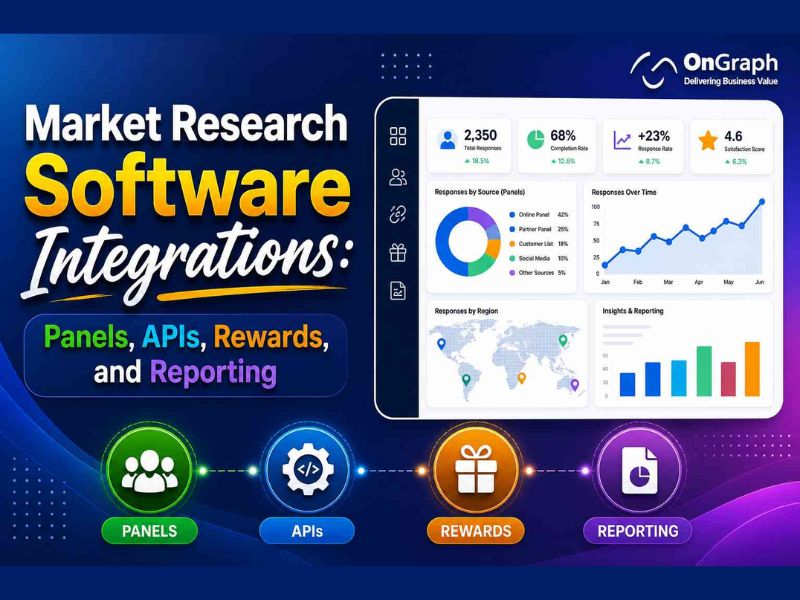
Market Research Software Integrations connect panels, APIs, rewards, and reporting tools into one unified system.
- Combine survey, CRM, and analytics tools in one workflow
- Use APIs to automate data flow and reduce manual work
- Integrate panel providers for faster respondent access
- Add rewards systems to improve response rates
- Use dashboards for real-time insights and reporting
It helps businesses connect different tools into one system. These integrations improve speed, accuracy, and decision-making.
Today, companies rely on multiple tools for surveys, CRM, and analytics. Without integration, data stays scattered and hard to use.
This guide explains how integrations work and how you can implement them effectively.
Why Integrations Matter in Market Research
Modern research is not done using a single tool. It requires multiple systems working together.
- Surveys collect responses
- Panels provide participants
- CRM stores customer data
- Analytics tools generate insights
Without integration, teams waste time moving data manually.
According to Salesforce, 73% of companies use multiple data sources for decision-making.
Disconnected systems create delays and errors. This directly impacts research quality.
Core Components of Market Research Software Integrations
1. Panel Management Software Integrations
Panels give you access to real respondents.
Platforms like Cint and Dynata offer API-based integrations.
Benefits:
- Faster participant recruitment
- Better audience targeting
- Global reach
Example: A research team connects its survey platform with Cint to launch global surveys instantly.
2. Market Research Software API Integration
APIs connect different systems automatically.
They allow:
- Real-time data transfer
- Automated workflows
- Reduced manual errors
According to MarketsandMarkets, the API market is growing rapidly and expected to exceed $13 billion.
APIs act as the backbone of modern research platforms.
3. CRM Integration for Market Research Software
CRM integration connects customer data with research insights.
Benefits:
- Better audience segmentation
- Personalized surveys
- Improved targeting
According to Salesforce, 91% of companies report better insights with CRM integration.
Popular CRM tools:
- Salesforce
- HubSpot
- Zoho
4. Survey Software Integrations
Survey platforms like SurveyMonkey and Qualtrics support multiple integrations.
They connect with:
- CRM tools
- Email platforms
- Analytics dashboards
This reduces manual work and improves tracking.
5. Rewards and Incentive Integrations
Rewards improve participation rates.
According to SurveyMonkey, incentives can increase survey response rates by up to 30%.
Common reward integrations include:
- Gift cards
- Digital wallets
- Points-based systems
Example: A user completes a survey and instantly receives a reward.
6. Data Analytics Integration Tools for Market Research
Analytics tools convert raw data into insights.
Popular tools include:
- Tableau
- Power BI
- Google Data Studio
According to Deloitte, companies using analytics integrations improve ROI by around 20%.
Real-World Integration Examples
Example 1: Survey + CRM + Analytics
A company integrates:
- SurveyMonkey
- Salesforce
- Tableau
Result:
- Feedback flows directly into CRM
- Data is visualized automatically
- Decisions become faster
Example 2: Panel + API + Rewards
A research agency connects:
- Cint (panel provider)
- Custom API system
- Reward engine
Result:
- Participants are recruited instantly
- Rewards are distributed automatically
Mini Case Study 1: Coca-Cola
Coca-Cola uses integrated data systems to improve customer insights.
They combine data from multiple channels into one system.
Result:
- Better customer targeting
- Faster marketing decisions
(Source: McKinsey)
Mini Case Study 2: Netflix
Netflix uses integrated analytics systems to guide content decisions.
They combine user behavior data with feedback.
Result:
- Data-driven content strategy
- Improved user engagement
(Source: Netflix Tech Blog)
Integration Architecture: How It Works
A typical integration system includes four layers:
1. Data Collection Layer
- Surveys and panel tools
2. Integration Layer
- APIs and middleware
3. Storage Layer
- Databases and CRM
4. Analytics Layer
- Dashboards and BI tools
This structure ensures smooth data flow across systems.
Step-by-Step: How to Implement Market Research Software Integrations
Step 1: Define Your Goals
Start by identifying your objectives.
Examples:
- Faster data collection
- Better reporting
- Automation
Step 2: Choose Core Tools
Select your main platforms.
Examples:
- Survey tool
- CRM
- Analytics system
Step 3: Use APIs or Middleware
Connect tools using APIs or automation tools like Zapier.
Step 4: Integrate Panel Providers
Connect panel platforms to access respondents instantly.
Step 5: Add Reward Systems
Enable automated incentives to improve participation.
Step 6: Build Dashboards
Use analytics tools to track insights in real time.
Step 7: Test and Optimize
Continuously monitor performance and improve integrations.
Integration Approaches
| Approach | Pros | Cons | Best For |
| Manual Integration | Low cost | Time-consuming | Small teams |
| API Integration | Scalable | Needs technical expertise | Growing companies |
| Custom Platform | Fully flexible | Higher cost | Enterprises |
Common Challenges in Market Research Integrations
- Data silos
- API limitations
- Security risks
- Integration complexity
According to IBM, 80% of enterprise data is unstructured and hard to integrate.
How a Market Research Software Development Company Helps
Building integrations requires technical expertise.
A professional market research software development company can:
- Build custom APIs
- Connect multiple tools
- Ensure scalability
- Improve data security
When You Need Custom Market Research Software Development Services
You should consider custom development if:
- You use multiple disconnected tools
- Need advanced integrations
- You want a unified platform
Custom solutions provide better control and long-term scalability.
Key Takeaways
- Market Research Software Integrations connect tools into one system
- APIs enable automation and scalability
- Panel and CRM integrations improve targeting
- Rewards increase response rates
- Analytics tools drive better insights
Final Thoughts
Market research today depends on connected systems.
Disconnected tools slow down decisions and reduce accuracy.
Integrated platforms deliver faster, smarter insights.
If you want to scale your research operations, integration is the key step.
A strong integration strategy can transform how your business understands customers.
FAQs
Market Research Software Integrations connect different tools like survey platforms, CRM systems, panel providers, and analytics dashboards into one system. This allows data to flow automatically between platforms. It reduces manual work, improves accuracy, and helps teams make faster decisions based on real-time insights.
Integrations are important because modern research uses multiple tools. Without integration, data remains scattered across systems. This creates delays and errors. With proper integration, businesses can centralize data, automate workflows, and generate insights quickly.
Common integrations include:
- Panel management integrations for respondent sourcing
- API integrations for system connectivity
- CRM integrations for customer data
- Survey software integrations for data collection
- Rewards integrations for incentives
- Analytics integrations for reporting
Each integration plays a key role in building a complete research ecosystem.
APIs act as connectors between systems. They allow different tools to communicate with each other. For example, survey responses can automatically move into a CRM or analytics dashboard. APIs enable real-time data transfer, reduce manual work, and improve scalability.
Panel management integrations connect your research platform with panel providers. This allows you to access verified respondents quickly. It helps in targeting specific demographics and running surveys at scale without manual recruitment efforts.
Rewards integrations automate the distribution of incentives like gift cards or digital payments. When users know they will receive rewards, they are more likely to complete surveys. This increases response rates and improves data quality.
A business should consider custom integrations when:
- It uses multiple disconnected tools
- It needs advanced automation
- It requires real-time reporting
- It wants a scalable and flexible system
Custom development ensures better control, performance, and long-term growth.
About the Author

Let’s Create Something Great Together!
Latest Blog

Let’s have a conversation today!


India
ONGRAPH TECHNOLOGIES PRIVATE LIMITED,
SDF L-1, NSEZ,
Sector 81, Block L, Phase-2,
Noida, Uttar Pradesh-201305

USA
OnGraph Technologies,
120 Bethpage Rd, Suite 304,
Hicksville, NY 11801, USA

Canada
7-1039 CEDARGLEN GATE,
Mississauga, Ontario,
Canada L5C 3A7

UK
89 Banstead Road South,
Sutton, Surrey, SM2 5LH
United Kingdom

Malaysia
G-3A, Amaya Maluri, Jalan
Jejaka 2, Taman Maluri,
KL–55100, Malaysia

Singapore
10 Anson Road,#26-04
International Plaza,
Singapore (079903)