


In this article
- What Generic Proposal and RFP Management Software Gets Right
- What Makes a Research Bid Different
- Where Bids Leak Time and Margin
- Winning: Qualification, Speed, and Price Discipline
- Delivering: Carrying the Quote Into Fieldwork
- How to Evaluate Bid Management Software: 8 Questions
- How OnGraph Builds Bid Management Into Research Platforms
- Bid Management Is About Pricing, Not Just Proposal Documents
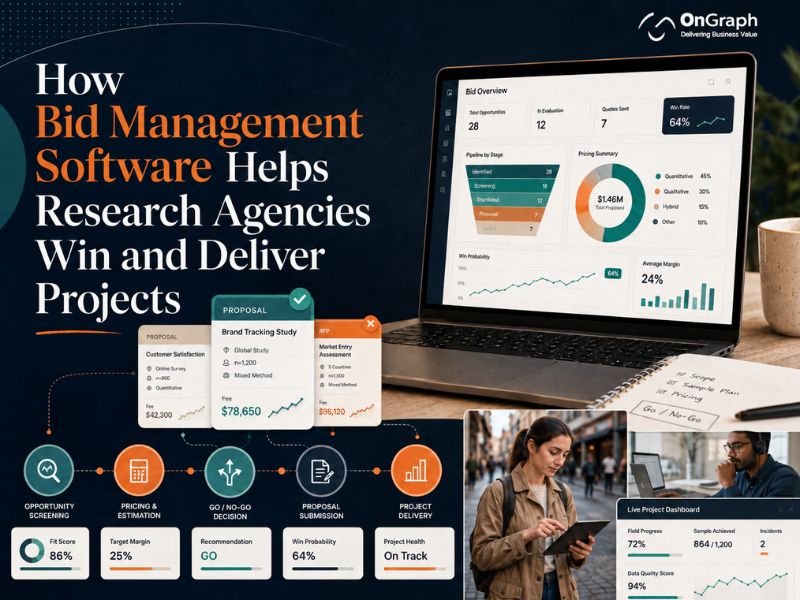
Bid management software for a research agency turns an incoming brief or RFP into a properly priced bid. It helps calculate feasibility, apply margin rules, record go/no-go decisions, and convert a won bid into a fieldwork project without entering the same information again.
This is different from how bid management software works in many other industries. Most tools focus on preparing documents, reusing approved answers, formatting proposals, and sending them quickly.
For research agencies, the difficult part is often the pricing behind the proposal.
Generic bid and proposal software is commonly built for construction, public-sector tenders, and general B2B sales. Research-specific factors such as feasibility, incidence rate, cost per interview, and quota requirements are usually missing. Most market research content about RFPs is also written for the buyer issuing the brief rather than the agency pricing and responding to it.
Build a Smarter Bid Management System for Your Research Agency
What Generic Proposal and RFP Management Software Gets Right
Generic proposal tools still solve several useful problems.
Answer libraries, version control, approval workflows, and deadline tracking can save research teams a lot of time. Enterprise procurement packs often ask the same questions about information security, data processing, insurance, and diversity. Rewriting these answers for every RFP creates unnecessary work.
Proposal management software and RFP management software handle this part well.
The category also provides useful benchmarks.
Loopio’s 2026 RFP Response Trends report, based on more than 1,500 response teams worldwide, puts the current average RFP win rate at 39%. Its widely quoted 45% figure represents a multi-year average from 2019 to 2026.
Teams spend an average of 33 hours on each response and submit around 166 RFPs per year. They also decline roughly 45% of the opportunities they receive.
Bandwidth became the top challenge for the first time, cited by 50% of respondents. Submission volumes increased by 9% while headcount remained flat.
Responsive and APMP’s 2026 report, based on more than 1,100 respondents, found another common issue. More than four in five organizations reported tighter buyer budgets and pressure to respond faster.
One finding is especially relevant for research agencies.
Loopio respondents have named price as the top reason for losing RFPs since 2021. Competition was cited by 55%, while proposal quality was mentioned by only 13%.
That figure needs some context. Buyers may mention price because it is the easiest reason to give, while proposal quality may already be expected from every shortlisted vendor. A weak proposal can still lose a deal.
Even so, the data suggests that pricing deserves serious attention.
Research agencies often bid on the same specification against three or four competitors. ESOMAR’s Global Prices Study, which compares agency quotes against standardized briefs, also shows how widely prices can vary.
There is one important limitation in the available data.
There does not appear to be a published benchmark specifically for market research agency win rates, bid volumes, or proposal-team staffing. ESOMAR, the Insights Association, Greenbook’s GRIT, and Quirk’s track many areas of the industry, but not these metrics.
The figures above therefore come from broader industry studies.
The closest comparisons include management consulting firms submitting around 229 RFPs per year in Loopio’s survey and professional services firms reporting a 48.1% bid win rate in SPI Research’s 2026 benchmark of more than 500 firms.
These numbers provide useful context, but they are not direct market research benchmarks.
What Makes a Research Bid Different
Sample is usually the most variable cost in a research bid.
Its final cost per complete depends on factors that generic proposal software normally does not track.
Other cost areas such as programming, translation, hosting, data processing, tabulation, project management, and reporting are generally more predictable.
Sample cost can change between the time a quote is prepared and the time the project is delivered. This is often where agencies either protect or lose margin.
Cint defines feasibility as:
“the predicted number of respondents who would complete the survey for this specific target group”
Factors affecting feasibility include incidence rate, length of interview, time in field, seasonality, target difficulty, and current supply and demand.
Incidence rate is particularly important.
Published agency pricing shows how wide the range can be. Drive Research estimates sample costs at roughly $4 to $50 per complete for studies with a similar length of interview in the same market, depending on how difficult the target audience is to reach.
Sample-vendor guidance also shows that costs often increase more quickly when incidence drops below about 20%.
Specialist audiences can cost even more. Healthcare-professional incentives, for example, are sometimes priced by minute rather than by completed interview.
Feasibility can also change quickly.
It reflects live supply at a particular time. It is not a reservation. A feasibility estimate generated on Monday may no longer be accurate when the project is awarded on Friday.
The good news is that much of this process can now be automated.
PureSpectrum provides a feasibility endpoint that returns estimated feasibility and a recommended CPI without creating a survey.
Cint offers a similar endpoint that returns a suggested price, price range, and achievable-completes range in one request.
A process that once required several supplier emails can now be handled through an API call.
That only works, however, when the research platform is connected to those APIs. The broader workflow is explained in OnGraph’s guide to market research workflow automation.
Need Bid Management Software Built Around Your Workflow?
Where Bids Leak Time and Margin
There are five common areas where agencies lose time or margin.
Manual Feasibility Chasing
A 2021 Quirk’s practitioner article described the problem before feasibility APIs became widely available.
Standard projects may only require checking a price sheet. Custom, multinational, or multi-phase projects often require several emails, conversations, and supplier negotiations.
That time is usually not billable. On competitive bids, it can also slow the response.
Undisciplined Qualification
Not every RFP is worth pursuing.
Loopio found that 81% of top-performing teams, defined as teams winning more than half of their submissions, use a formal go/no-go process. The figure is 75% across teams overall.
Responsive and APMP’s 2025 report showed a similar pattern.
Its “Leaders,” defined as teams with revenue growth above 25% and win rates above 40%, were more likely to use go/no-go processes than novice teams: 37% versus 26%.
They were also more likely to run win/loss analysis: 37% versus 18%.
Choosing not to pursue a poor-fit RFP can protect both time and margin.
Inconsistent Pricing
Spreadsheet-based quoting can create pricing inconsistencies.
Two team members may calculate different prices for the same brief because they use different rate cards, supplier estimates, or margin assumptions.
Keeping country-level costs, supplier pricing, rate cards, and margin floors inside the software creates a more consistent pricing process.
Re-Keying Between Quote and Project
The bid already contains important project information such as audience, quotas, CPI, and margin.
If these values have to be entered again after the project is won, there is a risk of transcription errors. It also becomes harder to confirm whether the fieldwork setup matches what was originally sold.
No Link Between Delivery and the Original Quote
This problem is especially important in market research.
A project may be quoted based on a 25% incidence rate but actually field at 12%.
That changes the economics of the project.
Suppliers may increase CPI during fieldwork. Some quota cells may become harder to fill, and the last completes can cost much more than expected.
If the platform does not compare actual fieldwork performance with the original quote, the problem may only become visible during final reconciliation.
By then, it may be too late to adjust scope or discuss the change with the client.
Winning: Qualification, Speed, and Price Discipline
Bid management software can help research agencies win in three main ways.
First, it helps teams qualify opportunities faster.
If feasibility and pricing can be checked through an API instead of several days of supplier emails, the bid team can reject poor-fit opportunities sooner and spend more time on stronger ones.
Second, it helps agencies respond faster.
Proposify analyzed 742,137 proposals sent through its platform in 2025. It found that winning proposals were viewed within 34 minutes of being sent and closed within 2.5 days of the first view.
Third, it helps agencies price more consistently.
This matters because price remains one of the most commonly reported reasons for losing proposals.
There is also a capacity benefit.
Loopio found that RFP volumes increased by 9% while team headcount stayed flat. That becomes difficult when every incoming brief requires manual work from the bid team.
A DIY market research tool with bid management, audience estimation, cost calculation, and supplier API integrations can allow clients to scope and launch simpler studies themselves.
The bid team can then focus on larger or more complex opportunities where human input is more valuable.
OnGraph’s market research project management software supports this stage through smart bidding. Teams can manage bids, define different bid requirements for each client, assign won projects to the appropriate manager, and send project details and notes through automated notifications.
Delivering: Carrying the Quote Into Fieldwork
The value of the bid does not end when the project is won.
The same variables used during pricing also control fieldwork:
- target audience
- quota structure
- CPI
- supplier mix
- margin
A platform that carries these values directly into the project removes the need to enter them again. It also makes it easier to compare delivery against what was originally promised.
Three practices are especially important.
Use the Soft Launch to Check the Quote
A soft launch should not only test survey logic.
The first completes can also show whether actual incidence and length of interview match the assumptions used in the quote.
If there is a major difference, the agency can respond early rather than absorbing the additional cost later.
Keep Quotas Aligned With the Original Bid
Fieldwork should use the quota structure that was priced.
If a new quota structure is created separately in the survey tool, the delivered sample may differ from what was originally costed.
Reprice Client Changes
Changes during fieldwork should be treated in the same way as the original bid.
If the client adds a market, increases questionnaire length, or makes the screener more restrictive, the cost model should be run again.
These changes should not automatically be absorbed into the original price.
The process ends with reconciliation.
Delivered completes and supplier invoices should be compared with the original quote so that margin changes are visible while the project is still active rather than much later.
OnGraph’s supplier management software guide explains this part in more detail.
Its guide on how project management software improves research operations covers the broader workflow.
How to Evaluate Bid Management Software: 8 Questions
These questions can help agencies evaluate the parts of a bid platform that directly affect cost and margin.
1. Does it use live supplier feasibility or only stored rate cards?
Both can be useful, but only live feasibility reflects current supply.
2. Can it request feasibility and CPI without creating a project?
This is important for fast quoting.
3. Are margin floors and approval thresholds enforced by the software or only shown as recommendations?
4. Can a won bid become a configured project without re-entering audience, quota, and cost information?
5. What happens when actual incidence is lower than the quoted incidence?
Does the platform flag the difference during fieldwork or only during reconciliation?
6. Does it compare delivered completes and supplier costs with the original quote?
Also ask when those differences become visible.
7. Does it support multi-currency and multi-country pricing from quote through delivery and invoicing?
8. Does it record go/no-go decisions and final outcomes?
Without this data, meaningful win/loss analysis is difficult.
How OnGraph Builds Bid Management Into Research Platforms
OnGraph builds bid management into the wider research workflow rather than treating it as a separate proposal tool.
Its market research solutions support bid management for CAWI, CATI, and hybrid projects.
Project requirements can be configured based on client methodology, geography, and sample needs. Once a bid is won, those details can move into project assignment, fieldwork, supplier integrations, and invoicing within the same system.
The broader platform selection process is covered in OnGraph’s guide to market research project management tools.
Agencies that need custom or white-label development can also explore OnGraph’s market research software development services.
Turn Winning Bids Into Ready-to-Run Research Projects
Bid Management Is About Pricing, Not Just Proposal Documents
Generic proposal software mainly improves how the proposal is created and managed.
For research agencies, pricing is just as important as the document itself.
Research-focused bid management software can use live feasibility, apply margin rules consistently, and carry the agreed quote into fieldwork.
That helps the agency not only prepare and win the project, but also deliver it without losing track of the margin that was originally planned.
About the Author

Let’s Create Something Great Together!
Latest Blog


Let’s have a conversation today!


India
ONGRAPH TECHNOLOGIES PRIVATE LIMITED,
SDF L-1, NSEZ,
Sector 81, Block L, Phase-2,
Noida, Uttar Pradesh-201305

USA
OnGraph Technologies,
120 Bethpage Rd, Suite 304,
Hicksville, NY 11801, USA

Canada
7-1039 CEDARGLEN GATE,
Mississauga, Ontario,
Canada L5C 3A7

UK
89 Banstead Road South,
Sutton, Surrey, SM2 5LH
United Kingdom

Malaysia
G-3A, Amaya Maluri, Jalan
Jejaka 2, Taman Maluri,
KL–55100, Malaysia

Singapore
10 Anson Road,#26-04
International Plaza,
Singapore (079903)