


In this article
- What Is Research Panel Fraud?
- Why Duplicate Respondents Are a Serious Problem
- Common Types of Fraud in Research Panels
- Fraud Prevention Should Start Before the Survey
- Comparison Table: Fraud Type, Red Flags, and Prevention Methods
- How to Prevent Fraud and Duplicate Respondents
- A Layered Fraud Prevention Framework for Research Panels
- Why Manual Fraud Checks Are Not Enough
- How OnGraph Can Help
- Final Thoughts
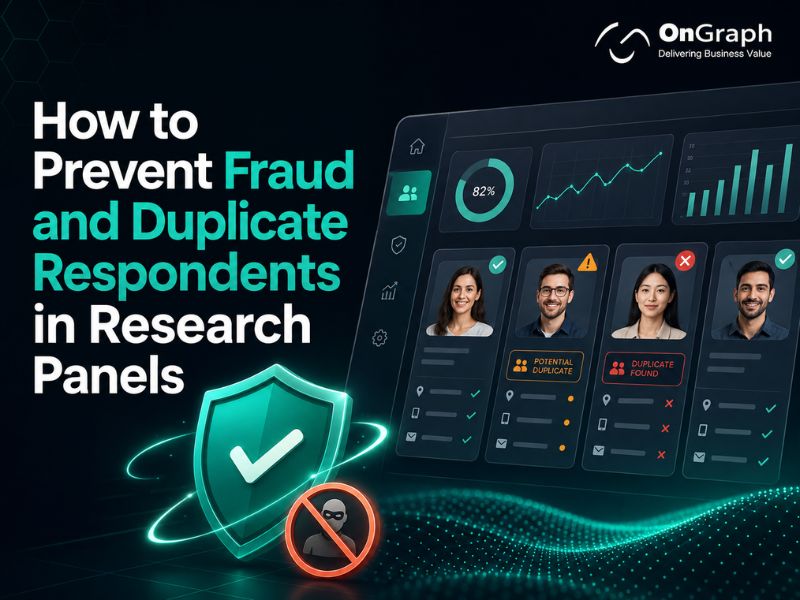
Fraud and duplicate respondents can quietly damage a research panel. The survey may look complete, the dashboard may show enough responses, and the report may seem ready. But if the same person has entered multiple times, fake profiles have passed screeners, or careless respondents have rushed through surveys, the final insights can become unreliable.
This is not a small issue for research teams. Kantar reported that, in Q4 2022, researchers were discarding up to 38% of collected survey data because of quality concerns and panel fraud. That means poor respondent quality can waste budget, delay projects, and reduce trust in the final report.
For market research agencies, panel companies, and enterprise insight teams, fraud prevention should not be treated as a final data-cleaning step. It should be built into the full panel lifecycle: recruitment, onboarding, profiling, screening, survey access, response review, reward approval, and long-term panel health.
What Is Research Panel Fraud?
Research panel fraud happens when a respondent gives false information, enters a study more than once, uses fake or duplicate profiles, rushes through surveys, or tries to qualify for studies they do not genuinely match.
Fraud can be intentional or careless. Some respondents may create multiple accounts to earn more rewards. Some may lie about their age, income, job role, location, or product usage to qualify. Others may not be trying to cheat, but still provide weak data by straight-lining answers, skipping questions, or completing the survey too quickly.
Fraud matters because research decisions depend on real people and honest responses. If low-quality responses enter the dataset, teams may make decisions based on distorted findings.
Stop Fraud Before It Reaches Your Research Data
Why Duplicate Respondents Are a Serious Problem
Duplicate respondents are people who complete the same survey more than once, usually through multiple accounts, repeated links, shared devices, or changed identity details.
At first, duplicates may look harmless. But they can create serious data problems:
- They inflate sample size.
- They overrepresent one person’s opinion.
- They distort quota balance.
- They waste incentives.
- They reduce client trust.
- They increase manual review time.
- They can make a study look valid when it is not.
Pew Research Center found that online opt-in sources in one study contained about 4% to 7% bogus respondents, while address-recruited panels had only trace levels of bogus cases at about 1%. The same study reviewed more than 60,000 interviews across six online sources.
The lesson is simple: source quality, recruitment method, and validation process can directly affect data quality.
Common Types of Fraud in Research Panels
1. Duplicate Accounts
This happens when the same person registers more than once using different email addresses, phone numbers, or profile details. Duplicate accounts are often created to access more surveys and earn more incentives.
2. False Profile Information
Some respondents may misrepresent their location, profession, household income, industry, product usage, or decision-making authority. This is especially risky in B2B, healthcare, finance, and niche audience studies.
3. Speeding
Speeding happens when respondents complete surveys much faster than the expected time. A short completion time may indicate that the respondent did not read questions properly.
4. Straight-Lining
Straight-lining means choosing the same answer repeatedly across a grid or rating scale. It often shows low attention or poor engagement.
5. Bot or Script-Based Entries
Some survey links can attract automated or scripted responses, especially when links are openly shared and incentives are attached.
6. Location Mismatch
A respondent may claim to be from one market but show signals from another location. Time zone, IP location, device language, and stated country can help identify mismatches.
7. Reward-Driven Fraud
Incentives are important, but they can also attract people who only want rewards. Without proper checks, fake or low-quality participants may complete surveys only to claim payouts.
Fraud Prevention Should Start Before the Survey
Many teams try to catch fraud after fieldwork is complete. That is risky. By that time, the wrong respondents may have already consumed quota, received rewards, and affected the data.
A better approach is to stop fraud at multiple points:
- Before registration
- During onboarding
- During profile creation
- During survey screening
- While the survey is being completed
- Before reward approval
- During panel health review
AAPOR’s disclosure standards mention several validity checks that researchers may use, including attention checks, logic checks, straight-lining exclusions, time-based exclusions, screening for bots or fabricated profiles, re-contacting respondents, and measures to prevent more than one completion.
This shows why fraud prevention should be a structured workflow, not a one-time filter.
Comparison Table: Fraud Type, Red Flags, and Prevention Methods
| Fraud Type | Common Red Flags | Prevention Method | Best Stage to Control |
| Duplicate respondents | Same IP, device, phone, reward account, or similar profile details | Device fingerprinting, mobile verification, dedupe rules, account review | Registration and survey entry |
| Fake profiles | Inconsistent age, income, job role, location, or category answers | Profile validation, logic checks, progressive profiling | Onboarding and screening |
| Speeding | Survey completed much faster than expected | Time checks, minimum duration rules, review before reward release | During and after survey |
| Straight-lining | Same answer pattern across grid questions | Attention checks, response pattern review, quality scoring | During response review |
| Location mismatch | Claimed country differs from IP, time zone, or language signals | Location checks, time zone checks, market-level access rules | Survey entry |
| Bot-style entries | Repeated patterns, unusual timestamps, low-quality open responses | Link controls, access limits, hidden checks, behavior review | Survey access and response review |
| Incentive abuse | Multiple accounts linked to same reward details | Reward holds, payout review, transaction history checks | Before incentive approval |
Need Cleaner Respondent Data? Let’s Build It Right
How to Prevent Fraud and Duplicate Respondents
1. Use Controlled Recruitment Sources
Open recruitment can bring volume, but it also increases risk. If a survey link is widely shared, it can attract people who are not part of the target audience.
Use controlled recruitment wherever possible. This may include owned panels, verified communities, client-approved lists, trusted partners, or invite-only survey links.
AAPOR notes that initial recruitment methods, panel freshening, respondent attrition, and missing data can affect online sample quality. This means recruitment quality should be part of the data-quality plan from the beginning.
2. Verify Respondents During Registration
A strong registration process should confirm that the respondent is a real person and not a repeated entry. Basic checks can include email verification, mobile verification, IP review, device checks, and location validation.
For B2B panels, additional verification may be needed. Work email, company domain, job role, LinkedIn-style profile review, or manual approval can help reduce false professional profiles.
3. Build Strong Respondent Profiles
A weak profile makes fraud easier. If the panel only stores name, email, age, and country, it becomes difficult to judge whether the person is a good fit for future studies.
A stronger profile may include:
- Demographics
- Location
- Language
- Occupation
- Industry
- Product usage
- Purchase behavior
- Study history
- Reward history
- Device history
- Consent status
- Quality score
This is where research panel management software helps. It gives teams one place to manage respondent profiles, survey participation, rewards, and quality signals.
4. Add Logic Checks in Screeners
Screeners should filter respondents, not guide them toward the correct answer. Avoid questions that make the qualification criteria too obvious.
For example, instead of asking “Are you a senior software buyer?” ask about role, team size, buying involvement, tools used, budget ownership, and recent purchase activity. Cross-checking these answers can help identify fake profiles.
Use logic checks to compare:
- Stated age and life stage
- Job title and decision-making authority
- Location and language
- Product usage and purchase frequency
- Industry and company size
- Past responses and current screener answers
5. Limit One Completion per Respondent
Every survey should have controls to prevent multiple completions. This is especially important when rewards are involved.
You can reduce duplicate respondents by using:
- Unique survey links
- Login-based access
- Token-based participation
- Device checks
- IP review
- Mobile verification
- Reward account matching
- Completion history checks
ESOMAR and GRBN’s online sample quality guideline specifically includes survey fraud prevention to ensure the same person does not complete a survey more than once to receive more incentives.
6. Monitor Survey Completion Time
Completion time is one of the simplest quality signals. If a survey is designed to take 12 minutes and a respondent finishes it in 2 minutes, the response should be reviewed.
Do not use timing as the only rule. Some genuine respondents may be fast readers. But when speeding appears with other signals such as straight-lining, weak open-ended answers, or inconsistent profile data, the risk is higher.
7. Use Attention and Consistency Checks
Attention checks help identify respondents who are not reading properly. Consistency checks help identify respondents who change answers to qualify or move quickly.
Examples include:
- Instructional attention checks
- Repeated questions asked in different ways
- Category knowledge questions
- Open-ended validation
- Contradictory answer checks
- Grid response pattern checks
These checks should feel natural and should not frustrate genuine respondents. The goal is to protect quality without making the survey experience poor.
8. Review Open-Ended Answers
Open-ended responses can reveal poor-quality respondents quickly. Weak answers often include gibberish, copied text, irrelevant comments, repeated phrases, or answers that do not match the question.
Reviewing open-ended answers is especially useful for high-value studies, product feedback, concept testing, and niche B2B research.
9. Hold Rewards Until Quality Checks Are Complete
Instant rewards can improve panelist experience, but they should be linked to valid participation. If rewards are released before review, fraud becomes harder to control.
A better process is:
- Respondent completes survey.
- Response goes through quality checks.
- Suspicious cases are flagged.
- Valid completions are approved.
- Rewards are released.
OnGraph’s panel management software supports reward and incentive workflows, profiling, survey assignment, and fraud-reduction controls such as fingerprinting validation and mobile verification.
10. Track Panel Health Over Time
Fraud prevention is not only about one survey. It is also about long-term panel quality.
Track these panel health metrics:
- Duplicate account rate
- Rejection rate
- Speeding rate
- Straight-lining rate
- Survey completion rate
- Reward hold rate
- Inactive panelist count
- Profile freshness
- Source-wise quality
- Repeat participation frequency
- Complaint or support history
A healthy panel should have active, verified, reachable, and well-profiled respondents. If a recruitment source keeps sending poor respondents, reduce or pause that source.
Launch a Fraud-Ready Panel Management Platform
A Layered Fraud Prevention Framework for Research Panels
A strong research panel should use layered protection. One check is not enough because fraud patterns keep changing.
Layer 1: Source Control
Track where respondents come from. Compare source quality by signup rate, completion rate, duplicate rate, and rejection rate.
Layer 2: Identity and Device Checks
Use email verification, mobile verification, device review, location checks, and duplicate detection during registration and survey entry.
Layer 3: Profile Validation
Use profiling questions, logic checks, consent records, and category-specific screeners to confirm whether the respondent is truly relevant.
Layer 4: Survey Behavior Review
Review speeding, straight-lining, open-ended answers, completion patterns, and drop-off behavior.
Layer 5: Reward Approval
Hold rewards for suspicious cases. Approve payouts only after quality checks are complete.
Layer 6: Panel Health Monitoring
Review panel quality regularly. Remove inactive, duplicate, or repeated low-quality respondents before they affect future studies.
Why Manual Fraud Checks Are Not Enough
Manual review is useful, but it becomes difficult when your panel grows. A team may manage a few hundred respondents in spreadsheets, but once the panel grows across regions, studies, suppliers, and reward systems, manual review becomes slow and inconsistent.
Manual processes can also create these problems:
- Duplicate profiles are missed.
- Poor-quality respondents keep entering studies.
- Rewards are approved too early.
- Panel health is not reviewed regularly.
- Teams rely on scattered spreadsheets.
- Fraud patterns are discovered too late.
A modern survey panel management software setup can help teams centralize respondent profiles, survey activity, rewards, reporting, and quality checks.
For companies building deeper research operations, market research automation software can connect panel workflows with survey setup, dashboards, quality review, and reporting.
How OnGraph Can Help
OnGraph builds custom and white-label software for market research agencies, panel companies, and enterprise insight teams.
Our solutions can help you manage:
- Respondent registration
- Panelist profiles
- Survey matching
- Screening workflows
- Duplicate respondent checks
- Mobile verification
- Device-level validation
- Reward approval workflows
- Consent and access controls
- Admin dashboards
- Panel health reports
- Third-party integrations
OnGraph’s panel management software features page highlights important modules such as respondent profiles, segmentation, sampling, incentives, fraud checks, dashboards, and compliance workflows. It also explains why panel quality directly affects research quality.
If your workflow requires custom rules, branded dashboards, supplier integrations, or full ownership of respondent data, custom panel management software can be built around your exact process. OnGraph’s custom panel software guide also lists fraud detection, client dashboards, reward logic, and third-party integrations as advanced platform capabilities.
Build a Research Panel Your Clients Can Trust
Final Thoughts
Fraud and duplicate respondents can damage research quality before the team even notices. The best way to prevent this is to build quality checks across the full panel lifecycle.
Start with controlled recruitment. Verify respondents early. Use strong screeners. Monitor behavior during surveys. Hold rewards until responses are reviewed. Then continue tracking panel health over time.
A clean panel is not just a database. It is a trusted research asset. With the right software, research teams can reduce fraud, protect client confidence, and deliver insights that are easier to trust.
FAQs
Duplicate respondents are people who enter the same survey or panel more than once using repeated accounts, shared devices, different emails, or changed profile details.
Teams can use unique links, login-based access, email verification, mobile verification, device checks, IP review, reward account matching, and completion history checks.
Common signs include very fast completion, straight-lining, inconsistent profile answers, duplicate devices, mismatched locations, poor open-ended responses, and repeated reward account details.
About the Author

Let’s Create Something Great Together!
Latest Blog


Let’s have a conversation today!


India
ONGRAPH TECHNOLOGIES PRIVATE LIMITED,
SDF L-1, NSEZ,
Sector 81, Block L, Phase-2,
Noida, Uttar Pradesh-201305

USA
OnGraph Technologies,
120 Bethpage Rd, Suite 304,
Hicksville, NY 11801, USA

Canada
7-1039 CEDARGLEN GATE,
Mississauga, Ontario,
Canada L5C 3A7

UK
89 Banstead Road South,
Sutton, Surrey, SM2 5LH
United Kingdom

Malaysia
G-3A, Amaya Maluri, Jalan
Jejaka 2, Taman Maluri,
KL–55100, Malaysia

Singapore
10 Anson Road,#26-04
International Plaza,
Singapore (079903)