


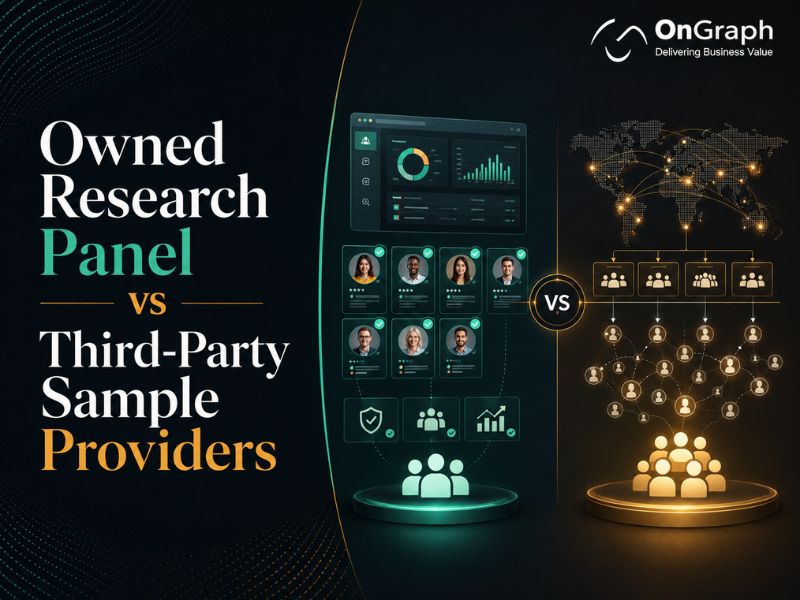
Neither option is better in every situation. An owned research panel gives you a stable respondent base, richer profiles, and lower per-complete costs when used regularly. Third-party sample providers offer immediate feasibility, wider geographic reach, and no fixed recruitment costs.
The right choice mainly depends on three things: how often you run studies, how repeatable your target audiences are, and the CPI of those audiences.
Industry behavior also shows that many research companies do not choose only one model. Kantar, which operates one of the industry’s largest proprietary panels through Kantar Profiles, expanded its Cint Exchange partnership in July 2025. This suggests that owned panels and marketplace sample often work better together than as separate alternatives.
This guide compares both models across cost, quality, speed, reach, and control. It also explains when each approach works best and why many agencies eventually use a hybrid model.
The Two Models, Defined
An owned research panel, usually managed as an online research panel, is a pool of verified and profiled respondents that a research company recruits and manages directly. These members can be invited to participate in multiple studies over time.
A third-party sample provider supplies respondents when a project requires them. These respondents may come from the provider’s own managed survey panel or from a programmatic marketplace that combines several sample sources.
Dynata states that its panel includes 70 million members across 82 countries, while Toluna reports more than 79 million members. Cint says its exchange covers 130 countries and connects more than 800 supply partners. Third-party sample is usually priced per complete.
The difference between the two models is not always as clear as it first appears.
When you buy sample from a managed provider, you are effectively paying to access someone else’s established market research panel. That panel may have much deeper respondent profiles than a newly built owned panel. Marketplace sample, on the other hand, can combine respondents from many different sources.
This is one reason ESOMAR’s 37 Questions framework asks market research sample providers to explain how much of their delivered sample is proprietary, exclusive, or sourced from third parties. Using a mix of sample sources is already common across the industry.
Head-to-Head: Six Dimensions
| Dimension | Owned Research Panel | Third-Party Sample Providers |
| Cost structure | Fixed recruitment, platform, and incentive costs; per-complete cost falls as usage increases | Variable CPI with no fixed recruitment cost; pricing rises with audience difficulty |
| Data quality & fraud | Respondents can be verified at recruitment and studies distributed through closed lists; quality still depends on panel management | Quality varies by provider; well-screened platforms can perform as well as managed panels |
| Speed to field | Fast for audiences already in the panel, but new audiences take time to recruit | Can reach new audiences within minutes because respondents are already available |
| Reach & feasibility | Limited to the people and markets already recruited | Access to millions of respondents across 100+ countries, including specialist audiences |
| Control & consistency | Stable panel composition, rich profiles, recontact, and longitudinal research | Sample composition may change between waves unless sources are controlled |
| Operational burden | Requires ongoing recruitment, engagement, and replacement of roughly 1–2% monthly attrition | Little ongoing panel-management work beyond project and quality management |
Cost: Variable Versus Fixed
Third-party pricing is straightforward. General-population completes typically cost around 2–15, while one vendor-published 2026 CPI guide puts audiences with incidence below 5% at roughly 8–15 times the base CPI.
Owned panels work differently.
The agency pays upfront and ongoing costs for recruitment, the platform, incentives, and panel replenishment. Published panel-cost benchmarks start at around 15–60 for each consumer panelist. AAPOR-cited task-force data also puts monthly panel attrition at roughly 1–2%.
Whether an owned panel becomes cheaper depends mainly on volume and how often the same audiences are needed.
The full break-even calculation, including situations where purchasing sample remains cheaper, is covered in OnGraph’s guide to reducing third-party sample costs with an owned research panel.
Quality: The Difference Is Getting Smaller
Independent research provides evidence for both sides.
Pew Research Center’s 2023 benchmark study found that purchased opt-in samples had an average absolute error of 5.8 percentage points across 28 benchmarks. Probability panels averaged 2.6 points.
The study also found suspicious screening behavior. About 8% of opt-in respondents said yes to 10 or more of 16 unrelated screening questions. That increased to 15% among respondents aged 18–29 and 19% among Hispanic adults.
Another 2024 peer-reviewed study published in Frontiers in Research Metrics and Analytics found verified fraud rates of 36–39% from open recruitment links. Closed-list distributions produced no verified fraud in the same research.
These findings support the value of working with known and verified respondents.
At the same time, third-party providers have improved their quality systems.
Cint uses Trust Score, Dynata uses QualityScore, and PureSpectrum uses PureScore. Dynata reports that QualityScore reduced manual reconciliations by more than one-third for sample-only clients. PureSpectrum says PureScore removes more than 10% of marketplace transactions.
More than 250 organizations have also signed the industry’s Data Quality Excellence Pledge since it launched in March 2025.
A 2023 PLOS ONE study comparing five academic research platforms produced another important result. Quality-screened third-party platforms such as Prolific and CloudResearch delivered the highest-quality responses at the lowest cost per high-quality respondent, around 1.90–2.00. The managed Qualtrics panel cost $8.17 per high-quality respondent.
The main takeaway is that sample quality depends heavily on how respondents are verified and screened. Ownership alone does not guarantee better data.
Speed and Reach: Where Providers Have the Advantage
Third-party providers have a clear advantage when an agency needs an audience it has never recruited before.
Marketplace respondents are already recruited, profiled, and available through APIs. Specialist providers can also reach audiences that would be expensive or difficult for most agencies to build themselves.
M3, for example, reports relationships with more than two million physicians and healthcare professionals across 70+ countries.
Building an owned panel of that size or recruiting highly specialized healthcare audiences with very low incidence rates would not make financial sense for most research companies.
Owned panels have the advantage in the opposite situation.
If the required audience is already recruited and profiled, a study can begin as soon as it is approved. There is no need to negotiate feasibility or source a new audience for every project.
Control and Consistency: Where Owned Panels Are Stronger
Owned panels give research teams more control over who participates and how panel members are managed over time.
Pew’s methodology research notes that opt-in vendors may combine respondents from several different panels. Providers may also merge panels or change recruitment sources without buyers always knowing.
That can create problems for tracking studies.
If the mix of respondents changes between waves, the resulting difference can look like a change in the market even when the real cause is a change in sample sourcing.
Morning Consult reviewed more than 300,000 responses and found that among repeat respondents, 40% from one supplier had already entered its data through another source. The study also found that professional respondents completing nearly 11 surveys per week tended to be older, whiter, and more likely to be retired.
With an owned panel, agencies can keep panel composition, respondent profiles, and research participant recruitment standards more consistent. They can also recontact respondents and conduct longitudinal studies more easily.
There is still one limitation to consider.
Any standing panel can experience conditioning when the same members are surveyed repeatedly. A smaller owned panel can increase that risk if members receive too many similar studies. Common ways to reduce this include spacing repeated topics and rotating panelists across projects.
When Each Model Wins
An Owned Research Panel Works Best When:
- Fieldwork runs at least a few times each month against similar or repeatable audiences.
- Target audiences have high CPIs, such as niche consumer, B2B, or healthcare groups.
- Tracking and longitudinal studies require consistent panel composition.
- First-party respondent data and clear GDPR consent records matter to clients.
- The business has the resources to manage ongoing recruitment and engagement.
For the operational side, see OnGraph’s guide to building and managing an owned research panel.
Third-Party Sample Providers Work Best When:
- Research projects are occasional, one-off, or target very different audiences each time.
- Studies require countries, quotas, or specialist respondents outside the owned panel’s coverage.
- Reaching a new audience quickly matters more than lowering long-term cost per complete.
- The team does not have the resources to run ongoing panel operations.
- The research requires probability-grade sample that a standard owned opt-in panel cannot provide.
KnowledgePanel-class options are available through providers, although at a much higher cost. A 2024 peer-reviewed comparison put that premium at roughly nine times incentive-only marketplace costs.
The Hybrid Model: What Many Agencies Use
In practice, many research agencies already combine owned and third-party sample.
ESOMAR’s updated 37 Questions framework notes that online samples are increasingly built from several sources rather than one panel. Question 10 also asks providers to explain sample blending and how much control buyers have over those sources.
A common workflow is simple.
The agency sends the study to its owned panel first. This gives it lower costs, faster access, and greater sample consistency for audiences it already knows.
If some quota cells cannot be filled, external market research sample providers are used to complete them.
This approach also requires strong deduplication across sources. Device fingerprinting and global lockouts can help prevent the same respondent from entering through multiple suppliers. Morning Consult’s research shows why this matters.
At this point, technology becomes just as important as methodology.
A market research survey panel tool can connect owned-panel fieldwork with supplier APIs so both sample sources can be managed through the same workflow.
Switching Without Breaking Your Trackers
Agencies moving tracking studies from purchased sample to an owned panel should avoid changing sources all at once.
Kantar’s guidance recommends running the old and new methods in parallel for one to two months to establish a baseline. For studies where greater confidence is required, that overlap may run from three months to a year.
Calibration weights can then be used to connect the old and new series.
TRC Insights’ 2026 guidance makes the same point. Even small changes in sample sourcing can look like market movement if they are not documented and adjusted properly.
Running parallel waves adds cost, but it gives teams a much clearer way to identify whether changes in results come from the market or from the new sample source.
Where OnGraph Fits
OnGraph builds technology for both approaches.
For firms developing their own panels, white-label panel management software development can support recruitment, profiling, rewards, fraud prevention, and ongoing respondent management.
According to OnGraph’s published figures, its research technology has supported more than 8M completed surveys and helped reduce field time by 25% on owned-panel infrastructure.
Through custom market research software development, owned panels can also be connected with more than 65 supplier integrations in one fieldwork system.
This allows agencies to manage owned respondents and third-party sample through the same workflow instead of maintaining separate tools for each source.
The Bottom Line
Owned panels give agencies more control, consistent respondent profiles, and better long-term economics when the same audiences are used repeatedly.
Third-party providers give them wider reach, flexibility, and fast access to audiences they do not already have.
For many research businesses, the best approach is not choosing one and rejecting the other. It is knowing which source makes sense for each project and having the technology to manage both efficiently.
FAQs
An owned research panel is a respondent pool that a research company recruits, verifies, profiles, and manages directly. Those respondents can be invited to multiple studies over time.
A third-party sample provider supplies respondents for individual projects, either from its own managed panels or through aggregated marketplaces. Pricing is usually based on cost per complete.
The main difference is control. With an owned panel, the research company controls panel composition, profiling data, and recontact rights.
It depends on the number of studies and the audiences being targeted.
One-off general-population studies with CPIs of around 2–15 often make more financial sense with third-party sample.
Owned panels become more attractive when the same audiences are used repeatedly, especially for niche consumer, B2B, and healthcare studies where incidence rates are low and CPI can rise significantly.
OnGraph’s cost guide puts the practical threshold at around a few projects per month targeting similar audiences.
Not in every case.
Pew’s 2023 research found that purchased opt-in samples had more than twice the benchmark error of probability panels, with average error of 5.8 versus 2.6 percentage points.
However, a 2023 PLOS ONE comparison found that some well-screened third-party platforms delivered high-quality respondents for only 1.90–2.00 each.
Major providers have also introduced fraud-detection systems such as Trust Score, QualityScore, and PureScore.
Overall, strong verification and screening processes matter more than whether the respondents come from an owned or third-party panel.
Yes. This hybrid approach is already common across the industry.
ESOMAR’s 37 Questions framework recognizes the use of multiple sample sources.
A typical approach is to field studies to the owned panel first and use external providers to fill quota gaps that the panel cannot cover.
When multiple sources are used, device fingerprinting and global lockouts help prevent respondents from entering the same study more than once.
Run the old and new sample sources in parallel before making the full switch.
Published guidance ranges from one to two months for establishing a baseline to as much as 12 months for high-stakes trackers.
Once enough comparison data is available, calibration weights can be used to connect the two series.
Documenting the change is important because a shift in sample sourcing can otherwise appear to be a genuine change in the market.
About the Author

Let’s Create Something Great Together!
Latest Blog
Let’s have a conversation today!


India
ONGRAPH TECHNOLOGIES PRIVATE LIMITED,
SDF L-1, NSEZ,
Sector 81, Block L, Phase-2,
Noida, Uttar Pradesh-201305

USA
OnGraph Technologies,
120 Bethpage Rd, Suite 304,
Hicksville, NY 11801, USA

Canada
7-1039 CEDARGLEN GATE,
Mississauga, Ontario,
Canada L5C 3A7

UK
89 Banstead Road South,
Sutton, Surrey, SM2 5LH
United Kingdom

Malaysia
G-3A, Amaya Maluri, Jalan
Jejaka 2, Taman Maluri,
KL–55100, Malaysia

Singapore
10 Anson Road,#26-04
International Plaza,
Singapore (079903)