

In this article
- Why Monetization Planning Comes Before App Development
- How Do Food Delivery Apps Make Money?
- Mini Case Study 1: DoorDash Revenue Growth
- Mini Case Study 2: Uber Delivery Ecosystem
- Food Delivery App Development Cost and Revenue Model
- Step-by-Step Framework to Choose the Right Revenue Model
- Best Revenue Model Combinations for Different Business Types
- Build a Food Delivery App Like Zomato
- Where Food Delivery App Development Services Help
- Common Mistakes to Avoid
- Key Takeaways
- Final Thoughts
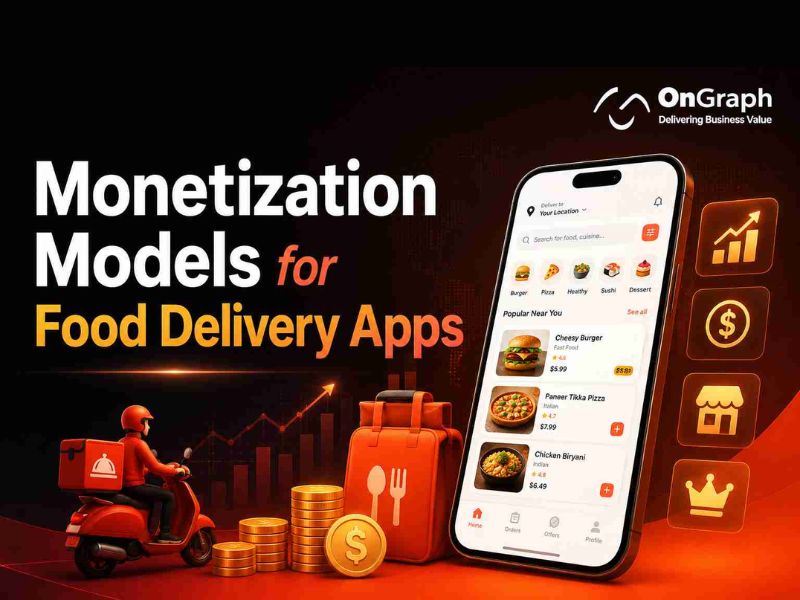
Monetization Models for Food Delivery Apps help food delivery platforms earn revenue from restaurants, customers, delivery operations, subscriptions, ads, and merchant tools. The best model depends on your target market, order volume, delivery setup, restaurant margins, and growth stage.
- Commission is the most common revenue stream.
- Delivery fees help cover logistics costs.
- Subscriptions improve repeat orders.
- Sponsored listings create ad revenue.
- Merchant tools add B2B income.
- White-label apps reduce launch time.
Monetization Models for Food Delivery Apps should be planned before development starts because the revenue model directly affects your features, pricing, customer experience, and long-term profitability. A food delivery app is not just a mobile ordering platform. It is a marketplace where customers, restaurants, drivers, and admins must all get value from the same system.
A food delivery app should make ordering simple with fast delivery, fair pricing, and easy repeat orders. Restaurants should get more sales without losing too much margin. Delivery partners need smooth order assignment, accurate route tracking, and timely payouts. At the same time, the platform owner should earn from every order through a clear and sustainable food delivery app revenue model.
The global online food delivery market reached USD 288.84 billion in 2024 and is projected to reach USD 505.50 billion by 2030. This shows strong market demand, but demand alone does not guarantee profit. A strong monetization strategy is what turns food orders into sustainable business revenue.
That is why founders, product managers, agencies, and enterprises should decide the revenue model before finalizing the food delivery app development roadmap.
Launch a Food Delivery App Built for Revenue Growth
Why Monetization Planning Comes Before App Development
Many founders start by asking, “What features do I need in a food delivery app?” That is a useful question, but it should not be the first question. The better first question is, “How will this food delivery app make money?”
Your monetization model decides which features are necessary from day one. For example, if you want to earn through restaurant commissions, your admin panel must support flexible commission settings. If you want to earn through subscriptions, your customer app needs membership plans, recurring billing, and benefit tracking. If you want to earn through ads, your restaurant dashboard needs sponsored listing controls.
Without this clarity, the app may look attractive but fail commercially. It may also require expensive rework later. A clear food delivery app monetization model helps your development team build the right modules from the beginning.
This is especially important for startups and non-technical founders. When you connect features with revenue, every development decision becomes easier. You know what to build first, what to delay, and what to avoid.
How Do Food Delivery Apps Make Money?
Food delivery apps make money through several revenue streams. Most successful platforms do not depend on only one source. They combine commission, delivery fees, subscriptions, advertising, surge fees, merchant tools, and sometimes cloud kitchen partnerships.
This layered approach makes the business more stable. If one revenue stream slows down, another can support growth. For example, commission may bring core income, while subscriptions improve repeat orders. Sponsored listings can add extra restaurant revenue once the platform has enough traffic.
The best food delivery business model depends on your target audience. A local restaurant app may depend mainly on direct food sales. A multi-vendor marketplace may depend on commissions and delivery fees. An enterprise platform may add merchant SaaS tools, loyalty programs, and B2B delivery services.
Below is a simple comparison of the main models.
| Monetization Model | Who Pays | Best For | Main Benefit | Key Risk |
| Commission | Restaurants | Multi-vendor marketplaces | Scales with orders | Can reduce restaurant margins |
| Delivery Fee | Customers | Delivery-led platforms | Covers logistics cost | Can increase cart abandonment |
| Subscription | Customers | Frequent users | Builds recurring revenue | Needs strong customer loyalty |
| Sponsored Listings | Restaurants | High-traffic apps | Adds ad revenue | Can hurt user experience |
| Surge Pricing | Customers | Peak-hour demand | Protects margins | Can feel unfair |
| Merchant Tools | Restaurants | Mature platforms | Builds B2B revenue | Needs advanced features |
| Cloud Kitchen | Platform or partners | High-demand cities | Improves margin control | Requires operations expertise |
| White-Label Licensing | Businesses | Agencies and enterprises | Creates B2B income | Needs strong product reliability |
1. Commission-Based Revenue Model
The commission-based model is one of the most common Monetization Models for Food Delivery Apps. In this model, the platform charges restaurants a percentage of every successful order. The restaurant pays only when it receives an order through the platform.
This model is popular because it is easy to understand. Restaurants do not need to pay a large upfront fee. They join the platform, receive orders, and share a percentage of the order value. For the platform owner, revenue grows as order volume grows.
DoorDash uses flexible merchant pricing with 15%, 25%, and 30% delivery commission options. It also applies a lower pickup commission on pickup orders. This shows how large platforms use tiered commission plans to balance restaurant value and platform revenue.
Uber Eats also uses tiered marketplace pricing for merchants. Its marketplace plans include different fee levels depending on visibility and benefits offered to restaurants.
For a startup, this model works well when restaurants receive clear value. If your platform brings new customers, better visibility, and reliable delivery, restaurants are more likely to accept commission charges.
How to Structure Commission Plans
A good commission model should not be one-size-fits-all. You can create different plans for different restaurant needs.
| Plan Type | Commission Level | Best For | Restaurant Benefit |
| Basic Plan | Low | New restaurants | Listing and order management |
| Growth Plan | Medium | Active restaurants | Better visibility and promotions |
| Premium Plan | High | High-volume restaurants | Sponsored placement and analytics |
This structure gives restaurants a choice. Smaller restaurants can start with a lower plan, while larger restaurants can pay more for visibility and growth tools.
2. Delivery Fee Revenue Model
Delivery fees are paid by customers to cover delivery costs. This model is important when the platform manages its own delivery network or works with delivery partners. The fee can be fixed, distance-based, time-based, or dynamic.
For example, a nearby delivery can have a lower fee, while a far-distance delivery can have a higher fee. During peak hours, the delivery fee may increase to balance demand and driver availability.
This model directly supports the online food delivery app business model because logistics is one of the highest operating costs. Driver payouts, fuel, route delays, refunds, and customer support all affect delivery margins.
However, delivery fees must be handled carefully. If the final checkout price feels too high, customers may abandon the order. This is why many platforms offer free delivery above a minimum order value or reduce delivery fees for subscription members.
Best Ways to Use Delivery Fees
Food delivery apps can use delivery fees in different ways. A startup can begin with a simple flat fee. As the app grows, the platform can move to distance-based or dynamic delivery pricing.
The best approach is to keep pricing transparent. Customers should know why they are paying a delivery fee. Hidden charges reduce trust and hurt repeat orders.
3. Subscription-Based Revenue Model
The subscription model creates recurring revenue. Customers pay a monthly or yearly fee to receive benefits such as free delivery, lower service fees, special discounts, or priority support.
This model works best when users order frequently. If customers order food several times a month, a subscription plan can feel valuable. It also encourages users to stay loyal to your platform instead of switching to competitors.
DoorDash reported strong growth in its subscription ecosystem, including DashPass, Wolt+, and Deliveroo Plus members. This shows how subscriptions can become a major loyalty and retention tool for food delivery platforms.
Subscriptions also help improve order frequency. Once users pay for a membership, they are more likely to order again to maximize the value of their plan.
Common Subscription Benefits
| Benefit | Customer Value | Business Impact |
| Free delivery | Saves money on repeat orders | Improves order frequency |
| Exclusive discounts | Makes users feel rewarded | Improves retention |
| Priority support | Adds premium value | Improves satisfaction |
| Lower surge fees | Reduces peak-hour friction | Encourages busy-hour orders |
| Partner rewards | Adds extra benefits | Builds ecosystem value |
A subscription plan should be simple. Customers should understand the savings quickly. If the value is unclear, they will not subscribe.
4. Sponsored Listings and In-App Advertising
Sponsored listings are another strong food delivery app revenue model. Restaurants pay to appear higher in search results, category pages, or home screen sections. This helps them get more visibility and more orders.
Advertising works best when the app already has good traffic. A new app with limited users may not earn much from ads. But once order volume increases, restaurants may pay for better placement.
Sponsored listings can include featured restaurants, promoted dishes, banner ads, cuisine-based promotions, and location-based offers. Food brands can also promote packaged items, beverages, desserts, and combo meals.
This model benefits restaurants that want faster growth. It also benefits the platform because ad revenue does not depend only on completed orders.
How to Keep Ads User-Friendly
Ads should feel useful, not disruptive. If users search for pizza, sponsored pizza restaurants can appear naturally. If users search for healthy meals, relevant promoted restaurants can appear.
Avoid showing unrelated ads. Poorly placed ads can reduce user trust and app engagement.
5. Surge Pricing and Peak-Hour Fees
Surge pricing helps platforms manage peak demand. During busy hours, bad weather, weekends, festivals, or special events, delivery demand can rise sharply. At the same time, driver availability may become limited.
Surge fees help balance this situation. Customers pay a little extra during high-demand periods. The platform can use this fee to support driver incentives and protect delivery margins.
This model can be useful, but it must be handled with care. Customers may feel frustrated if they see sudden price increases without explanation. That is why clear communication is important.
For example, the checkout screen can show a message like, “Peak-hour fee applied due to high demand in your area.” This helps customers understand the reason.
Surge pricing should not be used aggressively. It should protect service quality, not exploit users.
6. Cloud Kitchen and Virtual Brand Revenue
Cloud kitchens are delivery-only kitchens. They do not need dine-in space, front-desk staff, or expensive restaurant interiors. This makes them useful for delivery-first food businesses.
A food delivery platform can partner with cloud kitchens or launch virtual food brands. This model gives the platform more control over menu pricing, supply, food availability, and margins.
For example, if your app data shows high demand for burgers in one area, you can partner with a kitchen to launch a virtual burger brand. If demand for biryani is strong in another location, you can create a delivery-only biryani brand.
This model is more advanced than commission or delivery fees. It requires operations, kitchen partnerships, quality checks, and supply chain planning.
Cloud kitchen monetization works best when the platform already has order data. That data helps identify which cuisines and locations have the highest demand.
7. Merchant Tools and SaaS Revenue
Merchant tools can turn your food delivery app into a B2B revenue platform. Restaurants do not only need orders. They also need insights, reports, promotions, customer feedback, and loyalty tools.
A platform can offer basic tools for free and charge for advanced features. This creates an additional revenue stream beyond commissions.
Useful merchant tools include sales analytics, menu performance reports, customer review insights, offer management, loyalty campaigns, and inventory integrations.
This model is especially valuable for enterprise food delivery platforms. It helps restaurants grow while creating recurring income for the platform.
A strong Food Delivery App Development Company can build these merchant features into the admin and restaurant panels from the start.
Example Merchant Tool Packages
| Package | Features | Revenue Type |
| Basic | Orders, menu, payouts | Free or included |
| Growth | Offers, reports, reviews | Monthly fee |
| Pro | Loyalty, analytics, ads | Premium monthly fee |
| Enterprise | Integrations and custom reports | Custom pricing |
This model works well when restaurants see real business value from the tools.
8. Delivery-as-a-Service Revenue Model
Delivery-as-a-Service allows your platform to deliver orders for restaurants, grocery stores, pharmacies, or other local businesses. In this model, the customer may place the order outside your marketplace, but your delivery network handles fulfillment.
This model is useful when your platform has a strong driver network. It helps you earn from logistics even when the order does not come through your app.
For example, a restaurant may receive an order from its own website. Instead of managing delivery itself, it can use your delivery network. Your platform charges a delivery or service fee for handling that order.
Large platforms have expanded into this area because it increases delivery volume and improves driver utilization. Uber has also built local delivery solutions for businesses through its broader delivery ecosystem.
For startups, this model is better as a second-stage revenue stream. First, build your marketplace and delivery operations. Then offer delivery services to external partners.
9. Data Insights and Reporting Revenue
Food delivery platforms generate useful business insights. These insights can show popular cuisines, high-demand locations, peak ordering times, repeat purchase behavior, and menu performance.
Restaurants may pay for these insights if they help improve sales. For example, a restaurant can use demand reports to adjust pricing, menu items, and promotional offers.
However, this model requires strict privacy protection. Platforms should not sell personal user data. Insights should be aggregated, anonymized, and compliant with local privacy rules.
This model is best for mature platforms with strong data volume. It should be used carefully because customer trust is more important than short-term revenue.
Mini Case Study 1: DoorDash Revenue Growth
DoorDash is a strong example of layered monetization. The company does not rely only on delivery fees or restaurant commissions. It also uses subscriptions, merchant services, advertising, and expanded local commerce categories.
In Q4 2025, DoorDash reported 903 million total orders, up 32% year over year. Its marketplace GOV reached USD 29.7 billion, up 39% year over year. Revenue reached USD 4.0 billion in the same quarter.
This case shows an important lesson for founders. A food delivery app can start with a simple marketplace model, but long-term growth often comes from multiple revenue layers.
First, the platform grows order volume. Then it adds subscriptions to improve retention. After that, it adds ads, merchant services, and category expansion.
Founders building a food delivery app like Zomato or DoorDash should follow the same logic. Start simple, validate demand, and then add advanced revenue models.
Ready to Build Your Own Food Delivery App?
Mini Case Study 2: Uber Delivery Ecosystem
Uber’s delivery business shows how a food delivery platform can grow beyond restaurant orders. Uber has built delivery revenue across restaurant delivery, grocery, retail, memberships, and business delivery services.
In Q4 2025, Uber reported total gross bookings of USD 54.1 billion and revenue of USD 14.4 billion across its platform. Its delivery segment continued to grow as part of its wider marketplace ecosystem.
Uber’s model is useful for enterprises because it shows how delivery infrastructure can support multiple categories. A platform can start with food delivery, then expand into grocery, pharmacy, convenience, or local retail.
The key lesson is that delivery capability itself can become a business asset. Once your driver network, routing system, and order management process are strong, you can monetize more than food orders.
Food Delivery App Development Cost and Revenue Model
Many founders ask about food delivery app development cost and revenue model together. That is the right way to think because every feature should support a business outcome.
A basic food delivery MVP usually includes a customer app, restaurant panel, driver app, admin panel, payment system, order management, delivery tracking, offers, and reports.
An advanced platform may include subscriptions, sponsored listings, wallet management, loyalty programs, surge pricing, merchant analytics, cloud kitchen support, and third-party integrations.
The more monetization models you add, the more complex the development becomes. That is why you should not build every revenue feature at once. Start with the features that support your primary model.
Feature-to-Revenue Mapping
| Feature | Revenue Role |
| Commission settings | Supports the restaurant commission model |
| Delivery fee rules | Supports logistics revenue |
| Subscription plans | Supports recurring customer revenue |
| Sponsored listings | Supports restaurant ad revenue |
| Wallet system | Supports repeat orders |
| Promo code engine | Supports customer acquisition |
| Restaurant analytics | Supports merchant SaaS revenue |
| Driver payout module | Supports delivery operations |
| Admin reports | Supports business decisions |
This mapping helps founders avoid unnecessary development costs. It also helps product managers prioritize the roadmap.
Step-by-Step Framework to Choose the Right Revenue Model
Choosing the right model can feel confusing. The best way is to follow a simple decision framework.
Step 1: Define Your Platform Type
Start by identifying what type of food delivery app you want to build.
You may be building a single restaurant app, a multi-vendor marketplace, a cloud kitchen platform, a local delivery app, or a white-label food delivery solution.
Each platform type has different revenue needs. A single restaurant app earns mostly from direct orders. A marketplace earns from commissions and delivery fees. A white-label platform may earn from licensing, setup fees, and monthly support.
Step 2: Choose One Primary Revenue Stream
Do not start with too many models. Choose one primary revenue stream first.
For most marketplace apps, commission is the best starting point. For restaurant-owned apps, direct order revenue is the core model. B2B platforms, subscription or licensing fees may work better.
Your primary model should be easy to explain and easy to manage.
Step 3: Add Two Supporting Revenue Streams
Once your primary model is clear, add two supporting models.
For example, a marketplace can use commission as the primary model, then add delivery fees and sponsored listings. A local restaurant app can use direct orders, then add subscriptions and loyalty programs.
This keeps the platform simple while improving revenue potential.
Step 4: Protect Restaurant Profitability
Restaurants are the supply side of your marketplace. If they do not earn enough, they will leave the platform.
Keep commission rates fair. Offer visibility, analytics, and customer acquisition support. Show restaurants how the platform helps them grow.
A healthy restaurant network improves customer choice and platform trust.
Step 5: Improve Customer Retention
Retention is critical in food delivery. Acquiring a new customer is usually more expensive than retaining an existing one.
Use reorder options, loyalty points, personalized offers, push notifications, and subscriptions to bring users back.
The best online food delivery app business model depends on repeat orders, not one-time discounts.
Step 6: Track Unit Economics
Unit economics show whether each order is profitable.
Track average order value, commission revenue, delivery cost, discount cost, payment charges, driver payout, refund cost, and net margin.
If you do not track these numbers, the app can grow while losing money.
Best Revenue Model Combinations for Different Business Types
Different businesses need different monetization combinations. A startup should not copy an enterprise model blindly.
| Business Type | Best Primary Model | Best Supporting Models |
| Local food delivery startup | Commission | Delivery fee and promotions |
| Restaurant-owned app | Direct order revenue | Loyalty and subscriptions |
| Multi-vendor marketplace | Commission | Delivery fee and sponsored listings |
| Enterprise delivery platform | Commission | Merchant tools and subscriptions |
| Cloud kitchen platform | Direct food margin | Delivery fee and virtual brands |
| Cloud kitchen platform | Licensing | Setup fees and monthly support |
This table helps founders choose the right path based on business type.
Build a Food Delivery App Like Zomato
Many founders want to Build a Food Delivery Apps Like Zomato because Zomato-style apps are familiar to customers and restaurants. However, building a similar platform is not only about the app design.
A Zomato-like platform needs strong business logic. It must manage restaurant listings, menus, search, filters, offers, payments, delivery tracking, driver assignments, customer reviews, and admin reports.
It also needs monetization controls. The admin should be able to set commission rates, delivery charges, restaurant plans, sponsored placements, coupons, and subscription benefits.
A scalable platform should also support multiple cities, delivery zones, restaurant categories, and payout cycles.
If you are planning this type of product, work with a Food Delivery App Development Company that understands both technology and revenue planning. The goal is not just to launch an app. The goal is to launch a profitable delivery business.
Where Food Delivery App Development Services Help
Food Delivery App Development Services can help founders convert business goals into a practical product roadmap. This is useful when you are not sure which features are required for your monetization model.
For example, if your main model is commission, the development team should prioritize commission settings, restaurant onboarding, payout reports, and order tracking. If your model includes subscriptions, the team should add plan management, recurring billing, and membership benefits.
A good development partner can also help you avoid overbuilding. You do not need every advanced feature in the first version. You need the right features for launch, testing, and revenue validation.
For your business, the better approach is to launch with a clear MVP, test real orders, understand user behavior, and then expand monetization features.
Build a Food Delivery App Like Zomato or DoorDash
Launch a powerful food delivery app with restaurant panels, driver apps, payments, tracking, and monetization features.
Common Mistakes to Avoid
Many food delivery startups fail to monetize properly because they focus only on app launch. They forget that the business model must work after launch.
One common mistake is charging restaurants too much too early. New platforms must first prove value. If order volume is low, high commission can discourage restaurant partners.
Another mistake is offering too many discounts. Discounts can bring users, but they can also destroy margins. Every offer should have a purpose, such as first order activation, repeat order recovery, or subscription conversion.
A third mistake is ignoring delivery cost. Delivery cost can quietly reduce profit. Track driver payout, distance, waiting time, failed delivery, and refund cost.
A fourth mistake is adding ads too early. Ads work only when the platform has traffic. Before that, focus on supply, demand, and repeat orders.
Key Takeaways
Monetization Models for Food Delivery Apps work best when they are planned around users, restaurants, drivers, and platform margins.
Commission is the most common model for marketplace apps. Delivery fees help cover logistics costs. Subscriptions improve repeat orders and customer loyalty. Sponsored listings create extra restaurant revenue once the app has traffic.
Merchant tools can create B2B revenue for mature platforms. Cloud kitchens can improve margin control but need stronger operations. Delivery-as-a-Service can add new business income when your logistics network becomes reliable.
The best food delivery app revenue model is not one model. It is a smart mix of revenue streams that grows with your platform.
Final Thoughts
Monetization Models for Food Delivery Apps are not just pricing ideas. They shape your product features, admin controls, customer experience, restaurant onboarding, driver operations, and long-term growth.
If you are building a food delivery app, start with one clear revenue model. Then add supporting streams as your platform grows. This approach keeps development focused and reduces business risk.
A well-planned food delivery business model helps you launch faster, test smarter, and scale with better margins.
FAQs
The best Monetization Models for Food Delivery Apps include restaurant commissions, delivery fees, subscriptions, sponsored listings, surge pricing, merchant tools, and cloud kitchen partnerships. Most successful food delivery platforms use multiple revenue streams instead of depending on one model. For startups, commission and delivery fees are usually the best starting points. Once the app gains users and restaurant partners, you can add subscriptions, ads, loyalty plans, and advanced merchant tools to increase revenue.
Food delivery apps make money by charging restaurants, customers, and business partners. Restaurants usually pay a commission on every order. Customers may pay delivery fees, service fees, or subscription charges. Restaurants can also pay for sponsored listings to appear higher in search results. Some platforms earn from cloud kitchens, loyalty programs, merchant analytics, and delivery-as-a-service. The best food delivery app revenue model depends on your market, order volume, and delivery operations.
For startups, the best food delivery app monetization model is usually a combination of commission and delivery fees. Commission helps you earn from every restaurant order, while delivery fees help cover logistics costs. This model is easy to launch and simple for restaurants and customers to understand. Once your platform grows, you can add subscription plans, sponsored listings, and restaurant analytics to improve revenue without increasing customer friction too much.
Yes, subscription plans can be profitable when users order frequently. Customers pay a monthly or yearly fee to get benefits like free delivery, exclusive discounts, lower service fees, or priority support. This improves repeat orders and customer loyalty. However, subscriptions work only when the platform offers real savings. If customers do not order often, they may cancel the plan. So, subscription pricing should be based on user behavior, average order value, and delivery cost.
Food delivery apps usually charge restaurants a percentage of each successful order. The commission rate depends on the platform, delivery support, market, restaurant category, and visibility benefits. Some platforms offer different commission tiers, where restaurants pay more for better placement or additional services. For a new platform, it is better to keep commission flexible. High commission can discourage restaurants, while very low commission can reduce platform profitability.
A food delivery app can increase revenue after launch by improving repeat orders, adding subscription plans, offering sponsored listings, launching loyalty programs, and providing paid merchant tools. The platform should also track order value, delivery cost, commission revenue, discount cost, and customer retention. Once the app gets stable traffic, restaurants may pay for promotions and advanced analytics. Revenue growth should be planned step by step, not by adding too many charges at once.
A food delivery app needs strong admin and business features to support monetization. Important features include commission management, delivery fee settings, promo code management, restaurant subscriptions, sponsored listing controls, wallet management, payment tracking, driver payout reports, and analytics dashboards. These features help the platform manage revenue from restaurants, customers, and delivery operations. A scalable app should also allow admins to update pricing rules without changing the core code.
About the Author

Let’s Create Something Great Together!
Latest Blog
Let’s have a conversation today!


India
ONGRAPH TECHNOLOGIES PRIVATE LIMITED,
SDF L-1, NSEZ,
Sector 81, Block L, Phase-2,
Noida, Uttar Pradesh-201305

USA
OnGraph Technologies,
120 Bethpage Rd, Suite 304,
Hicksville, NY 11801, USA

Canada
7-1039 CEDARGLEN GATE,
Mississauga, Ontario,
Canada L5C 3A7

UK
89 Banstead Road South,
Sutton, Surrey, SM2 5LH
United Kingdom

Malaysia
G-3A, Amaya Maluri, Jalan
Jejaka 2, Taman Maluri,
KL–55100, Malaysia

Singapore
10 Anson Road,#26-04
International Plaza,
Singapore (079903)