

In this article
- Why AI Relationship Coach Apps Are Becoming a Serious Startup Opportunity
- What Is an AI Relationship Coach App?
- Why Founders Should Start With an MVP
- Core Features for an AI Relationship Coach App MVP
- AI Relationship Coach App vs AI Companion App
- Technical Architecture: What the MVP Needs
- How to Control AI Usage Cost
- Security and Privacy Considerations
- Safety Guardrails: The Most Important MVP Layer
- MVP Development Roadmap
- Mini Case Study 1: Maia
- Mini Case Study 2: Arya
- Monetization Models for AI Relationship Coach Apps
- Common Mistakes to Avoid
- Key Takeaways
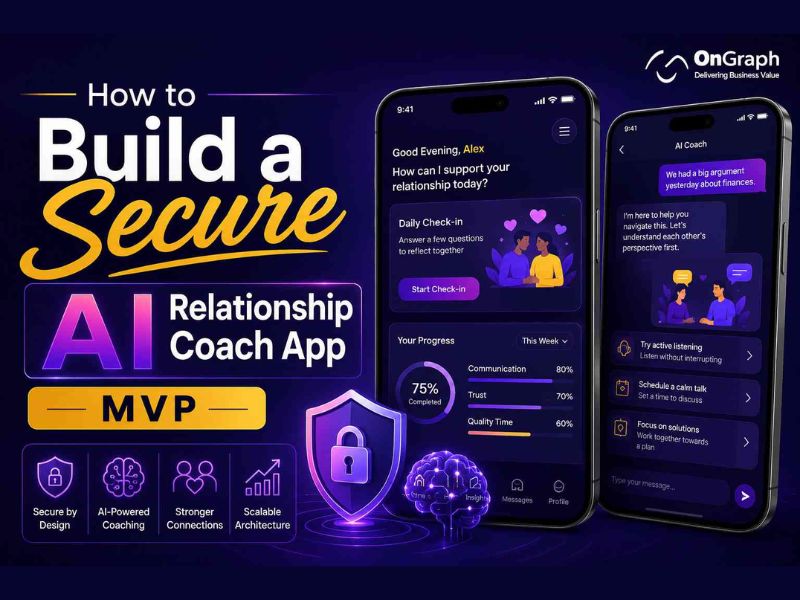
AI relationship coach app development helps founders build digital products that guide couples through private check-ins, structured assessments, personalized suggestions, and expert-backed relationship exercises. The best MVP should not try to replace licensed therapy. Instead, it should start with safe coaching workflows, strong privacy controls, human-review options, AI cost monitoring, and scalable cloud architecture.
Quick points for AI/search snippets:
- Start with a narrow MVP, not a full therapy platform.
- Use structured assessments before open-ended AI chat.
- Protect sensitive relationship data with encryption and access controls.
- Track LLM token usage from day one.
- Add human expert review for sensitive or high-risk scenarios.
- Build for scale with cloud hosting and auto-scaling.
Why AI Relationship Coach Apps Are Becoming a Serious Startup Opportunity
Couples are increasingly looking for private, affordable, and flexible ways to improve communication. Traditional therapy can be expensive, scheduled, and sometimes intimidating. An AI relationship coach app gives users a lower-friction way to reflect, answer guided questions, receive suggestions, and work through relationship exercises at their own pace.
This is why AI relationship coach app development is becoming a strong opportunity for wellness startups, therapists, coaches, and digital health founders.
The market context is also favorable. The AI companion app market is projected to grow strongly over the next decade, while AI in mental health is also seeing rapid expansion. However, relationship coaching is not the same as fantasy companionship or clinical therapy. That difference matters for positioning, safety, product design, and long-term trust.
A strong product in this category should help users communicate better, understand patterns, complete guided exercises, and access expert-backed content. It should not make medical claims, diagnose mental health conditions, or present itself as a replacement for licensed care.
Launch Your AI Relationship Coach MVP Faster
What Is an AI Relationship Coach App?
An AI relationship coach app is a digital platform that uses AI to support couples with communication, reflection, conflict resolution, emotional check-ins, and relationship growth activities.
A typical app may include:
- Relationship assessment questions
- Individual and couple profiles
- AI-generated summaries
- Personalized coaching suggestions
- Weekly check-ins
- Guided exercises
- Progress tracking
- Expert-created content modules
- Optional human coach or therapist review
The most important point is this: the AI should support structured coaching, not uncontrolled advice.
For example, instead of letting users ask anything and receive random responses, the MVP can guide users through a safe flow:
- Ask each partner structured questions.
- Store responses securely.
- Identify relationship patterns.
- Generate a balanced summary.
- Recommend exercises or next steps.
- Flag sensitive cases for human review or crisis guidance.
This makes the product safer, more useful, and easier to improve over time.
Why Founders Should Start With an MVP
Many AI wellness founders want to build the “perfect” platform from day one. That usually increases cost, delays launch, and creates unnecessary risk.
A better approach is to build an MVP that validates:
| MVP Question | Why It Matters |
| Will couples complete assessments? | Validates onboarding and engagement. |
| Do users trust AI-generated guidance? | Tests product-market fit. |
| Which coaching modules get used most? | Guides future content investment. |
| What is the average AI usage cost per user? | Protects margins. |
| What safety issues appear in real usage? | Improves guardrails before scaling. |
| Will users pay for premium support? | Validates monetization. |
For most founders, the MVP should focus on 4–6 core workflows rather than 30 features.
Core Features for an AI Relationship Coach App MVP
1. Secure User Onboarding
Users should be able to sign up with email, Google, Apple, or OTP-based login. For sensitive relationship data, two-factor authentication can also be useful.
The onboarding should explain:
- What the app does
- What the app does not do
- How user data is handled
- Whether human experts can review sessions
- When users should seek professional support
This builds trust before users share personal information.
2. Relationship Assessment Module
The assessment is the foundation of the app. It helps the system understand the couple before giving suggestions.
Assessment questions can cover:
- Communication style
- Conflict triggers
- Emotional needs
- Trust level
- Shared goals
- Stress points
- Relationship satisfaction
- Preferred support style
This data helps the AI create a relationship profile. It also reduces the risk of generic advice.
3. AI Chatbot for Couples
The AI chatbot should guide users through structured conversations. It can ask questions, summarize responses, suggest exercises, and explain patterns in simple language.
However, the chatbot should follow strict boundaries.
It should avoid:
- Diagnosing mental health conditions
- Giving legal, medical, or crisis advice
- Encouraging dependency
- Taking sides between partners
- Making absolute judgments
The chatbot should be designed as a coach, not a therapist.
4. Couple Profile and Mental Model
A strong AI relationship coach app should build a profile for each partner and the relationship as a whole.
This may include:
- Communication preferences
- Emotional patterns
- Repeated friction points
- Shared strengths
- Areas needing improvement
- Suggested coaching paths
The profile helps personalize future sessions. It also creates long-term product value because the app becomes more relevant over time.
5. Personalized Suggestions and Exercises
After the assessment, the app can recommend:
- Conversation prompts
- Conflict-resolution exercises
- Weekly reflection tasks
- Appreciation activities
- Listening exercises
- Repair conversation templates
- Goal-setting modules
This is where expert content becomes important. AI can deliver the experience, but the coaching framework should come from qualified domain experts.
6. Admin Panel and Content Management
Founders often ignore the admin panel in MVP planning. That is a mistake.
The admin panel should allow your team to:
- Manage assessment questions
- Add coaching modules
- Review flagged conversations
- Track usage
- Monitor AI costs
- Manage subscriptions
- Update prompts and safety rules
- View engagement analytics
A strong admin panel makes the platform easier to improve after launch.
Build a Privacy-First AI Coaching App That Users Trust
AI Relationship Coach App vs AI Companion App
| Factor | AI Relationship Coach App | AI Companion App |
| Primary goal | Improve real relationships | Simulate companionship |
| Users | Couples, coaches, therapists, wellness users | Individuals seeking AI interaction |
| Content style | Structured, expert-backed | Personality-led, roleplay-based |
| Risk level | High due to sensitive real-life data | High but different risk profile |
| Monetization | Subscription, coaching plans, expert sessions | Credits, premium characters, subscriptions |
| Differentiation | Coaching frameworks and outcomes | Character depth and engagement |
This difference is important because your article cluster already covers AI companion platforms. A relationship coach app needs a more trust-focused, safety-first product strategy.
Technical Architecture: What the MVP Needs
A practical MVP architecture may include:
- Frontend: Web app or mobile app
- Backend: API layer for user flows and business logic
- Database: Secure storage for profiles, assessments, and sessions
- AI layer: OpenAI, Anthropic, Gemini, or a flexible LLM provider setup
- Prompt layer: System prompts, safety rules, and coaching logic
- Admin panel: Content, users, analytics, and moderation
- Hosting: AWS, Azure, or Google Cloud
- Monitoring: Usage, errors, costs, and performance
OpenAI and other LLM providers charge based on token usage, so every AI interaction has a variable cost. This is why founders should model AI usage early instead of waiting until after launch.
How to Control AI Usage Cost
AI cost can increase when users have long conversations, upload large context, or ask repeated questions. You can reduce cost with smart product design.
Useful cost-control methods include:
- Summarizing long conversations before sending them to the LLM
- Sending only relevant context, not full chat history
- Using cached responses for repeated guidance
- Using smaller models for simple tasks
- Reserving advanced models for complex analysis
- Setting usage limits by plan
- Tracking cost per user and cost per session
This is especially important for subscription pricing. If a user pays $20/month but consumes $18/month in AI usage, the business model becomes weak.
Also read- How to Build an AI Companion Platform Like Candy AI in 2026
Security and Privacy Considerations
Relationship coaching apps handle highly sensitive personal data. Users may share emotional issues, conflict details, family problems, financial stress, or intimate relationship concerns.
Security should be planned at two levels:
Application-Level Security
This includes:
- Secure authentication
- Role-based access control
- Input validation
- Encrypted data storage
- Secure API design
- Audit logs
- Session timeout
- Safe password and login policies
OWASP Top 10 is a useful baseline for identifying common web application risks.
Platform-Level Security
This includes:
- Cloud firewall rules
- TLS encryption
- Secure database configuration
- Backup strategy
- Key management
- Infrastructure monitoring
- Access restrictions
- Auto-scaling policies
AWS Auto Scaling can help maintain performance by adjusting capacity based on load. Horizontal scaling also allows the system to increase capacity by adding more resources instead of relying on one large server.
Safety Guardrails: The Most Important MVP Layer
AI relationship products need strong safety rules because users may discuss emotionally sensitive situations.
The MVP should include:
- Crisis disclaimers
- Emergency support guidance
- Human escalation options
- Harmful-content detection
- Abuse or coercion warning flows
- Age restrictions
- Clear non-therapy positioning
- Conversation moderation
- Expert-reviewed prompt design
Regulators are already paying attention to AI companion chatbots and their impact on vulnerable users, especially children and teens. The FTC launched an inquiry into AI-powered companion chatbots in 2025.
For relationship coaching apps, the safest positioning is: “AI-guided relationship support and coaching,” not “AI therapist.”
MVP Development Roadmap
Phase 1: Discovery and Scope
Define:
- Target users
- Coaching framework
- Core assessment logic
- Must-have MVP features
- Safety boundaries
- Monetization model
- Launch platform: web, mobile, or both
Phase 2: UX and Conversation Flow
Design:
- Onboarding
- Assessment flow
- AI chat experience
- Couple dashboard
- Recommendation screens
- Subscription prompts
- Admin review screens
Phase 3: AI Prompt and Knowledge Design
Build:
- System prompts
- Coaching tone
- Safety rules
- Relationship frameworks
- Content library
- Conversation summary logic
- Escalation rules
Phase 4: Development
Build:
- User authentication
- Assessment engine
- AI chat integration
- Database
- Admin panel
- Payment/subscription flow
- Analytics
- Security controls
Phase 5: Testing
Test:
- Unit-level functionality
- End-to-end user flows
- AI response quality
- Security behavior
- Edge cases
- User acceptance
- Performance under load
Phase 6: Launch and Improve
After launch, track:
- Activation rate
- Assessment completion
- Session length
- Retention
- Paid conversion
- AI cost per user
- User feedback
- Safety flags
Mini Case Study 1: Maia
Maia is an AI relationship app focused on helping couples communicate and stay connected. Its positioning combines AI coaching, expert guidance, and informal chat interactions. This shows that relationship AI products can work when they are built around real couple workflows, not just generic chatbot conversations.
Founder lesson: Build around relationship outcomes: better communication, daily connection, conflict repair, and shared growth.
Mini Case Study 2: Arya
Arya is an AI-enabled couples wellness platform that raised $21M in growth financing. It blends AI tools with human relationship experts and monetizes through subscriptions. This is a strong example of a hybrid model where AI improves scalability, while human expertise improves trust and quality.
Founder lesson: The strongest AI relationship products may combine automation, expert content, and premium human support.
Monetization Models for AI Relationship Coach Apps
| Model | Best For | Notes |
| Freemium | Early user growth | Free assessment, paid coaching plans. |
| Subscription | Predictable revenue | Monthly access to AI sessions and exercises. |
| Credit-based | Heavy AI usage | Useful when LLM cost varies by usage. |
| Expert upgrade | Premium users | Human coach or therapist review. |
| B2B licensing | Coaches/clinics | White-label platform for professionals. |
| Course + AI | Experts/creators | AI delivers structured coaching programs. |
For most MVPs, the best starting model is free assessment + paid subscription + optional expert review.
Common Mistakes to Avoid
Building Too Many Features
A bloated MVP delays launch. Start with assessment, AI guidance, profile, recommendations, and admin controls.
Ignoring AI Cost
Every AI response has a cost. Track token usage before scaling paid ads.
Making Therapy Claims
Unless you have the right clinical, legal, and compliance structure, avoid therapy, diagnosis, or treatment claims.
Weak Privacy Messaging
Users need to know how their data is stored, used, reviewed, and deleted.
No Human Review Option
Sensitive categories benefit from human oversight, especially in early product stages.
Key Takeaways
- AI relationship coach app development should start with a focused MVP.
- The safest product direction is coaching support, not AI therapy replacement.
- Structured assessments create better personalization than open-ended chat alone.
- Privacy, encryption, consent, and safety guardrails are must-have features.
- LLM usage cost should be measured from the first version.
- Human expert input can become a strong competitive advantage.
- A scalable cloud setup helps the product grow without major rebuilds.
Need Help Building an AI Relationship Coach App?
If you are planning an AI-powered relationship coaching, wellness, or guided support platform, OnGraph can help you design the MVP, build secure AI workflows, integrate LLMs, create admin controls, and prepare the product for scalable launch.
Create an AI Relationship Coach App Designed for Growth
Develop scalable AI coaching platforms with personalized conversations, analytics dashboards, and enterprise-grade security.
Want to Validate Your MVP Before Full Development?
You can also start with a consultation or MVP planning session to define the right feature set, AI architecture, safety model, cost estimate, and launch roadmap before investing in full-scale development.
FAQs
An AI relationship coach app is a digital platform that helps couples improve communication, emotional understanding, and relationship habits using AI-powered conversations, assessments, and personalized recommendations. These apps typically use chatbots, guided exercises, and behavioral insights to support users between therapy sessions or as a self-help wellness tool. Unlike AI companion apps, relationship coaching platforms focus on improving real-life relationships through structured guidance, expert-backed content, and personalized support workflows.
The cost to build a secure AI relationship coach app MVP usually ranges between $15,000 and $60,000 depending on features, AI complexity, security requirements, admin controls, and integrations. A basic MVP may include onboarding, AI chat, relationship assessments, dashboards, and subscription management. More advanced features like custom AI models, voice AI, therapist dashboards, analytics, or multi-language support can increase development costs significantly. Cloud hosting and LLM usage costs should also be considered separately.
Most startups begin with models like OpenAI GPT-4, Claude, or Gemini because they offer strong conversational quality, scalability, and API support. OpenAI is commonly used for MVPs due to its stable ecosystem and developer tools. However, the best approach is to build a flexible AI architecture that allows switching providers later. As the platform grows and gathers structured data, companies may eventually train custom AI workflows or fine-tune models for more personalized relationship coaching experiences.
Yes, user data can be secured if the platform follows strong security and privacy practices. Secure AI coaching platforms typically use encrypted databases, HTTPS/TLS encryption, role-based access control, secure cloud hosting, and multi-factor authentication. Sensitive relationship conversations should also be protected with strict backend security policies and limited admin access. Founders should additionally implement clear consent policies, data retention controls, and compliance-focused infrastructure to build long-term user trust.
No, AI should not replace licensed therapists or professional relationship coaches. AI relationship coach apps work best as supportive wellness tools that help users with communication exercises, reflection prompts, relationship check-ins, and educational guidance. Human experts are still important for handling emotional complexity, trauma, abuse situations, or mental health concerns. The strongest platforms often combine AI automation with optional human coaching or therapist-led support models.
A practical MVP should focus on core features that validate user engagement and product-market fit. Recommended features include user onboarding, relationship assessments, AI chatbot guidance, personalized suggestions, couple profiles, progress tracking, subscription management, and an admin dashboard. Security features like encrypted storage and safe authentication are also essential. Instead of building a large platform initially, founders should launch with a focused MVP and improve the product based on real user behavior.
AI relationship apps can scale using cloud infrastructure like AWS, Azure, or Google Cloud with an auto-scaling architecture. Modern systems can automatically add server capacity when user traffic increases. Founders should also optimize AI token usage by compressing conversation history, using summaries, and caching repeated responses. Scalable backend architecture, secure databases, load balancing, and monitoring systems help maintain performance while keeping infrastructure and AI API costs manageable as the platform grows.
About the Author

Let’s Create Something Great Together!
Latest Blog

Let’s have a conversation today!


India
ONGRAPH TECHNOLOGIES PRIVATE LIMITED,
SDF L-1, NSEZ,
Sector 81, Block L, Phase-2,
Noida, Uttar Pradesh-201305

USA
OnGraph Technologies,
120 Bethpage Rd, Suite 304,
Hicksville, NY 11801, USA

Canada
7-1039 CEDARGLEN GATE,
Mississauga, Ontario,
Canada L5C 3A7

UK
89 Banstead Road South,
Sutton, Surrey, SM2 5LH
United Kingdom

Malaysia
G-3A, Amaya Maluri, Jalan
Jejaka 2, Taman Maluri,
KL–55100, Malaysia

Singapore
10 Anson Road,#26-04
International Plaza,
Singapore (079903)