


In this article
- Why Businesses Ask About the Cost to Build an AI Voice Agent
- What Is an AI Voice Agent?
- How Much Does It Cost to Build an AI Voice Agent?
- AI Voice Agent Pricing: Development Cost vs Runtime Cost
- Key Factors That Affect AI Voice Bot Development Cost
- What Goes Into Custom AI Voice Agent Development?
- AI Calling Agent for Business: Common Use Cases
- Mini Case Study 1: Customer Support Agents at Nubank Scale
- Mini Case Study 2: Voice Agents in Healthcare Monitoring
- SaaS vs Custom vs White-Label AI Voice Agent Platform
- Cost Breakdown by Component
- Hidden Costs You Should Plan For
- Voice Agent Compliance and Call Recording Note
- Step-by-Step Framework to Estimate Your Cost
- How to Choose an AI Voice Agent Development Company
- How OnGraph Can Help
- Key Takeaways
- Final Thoughts
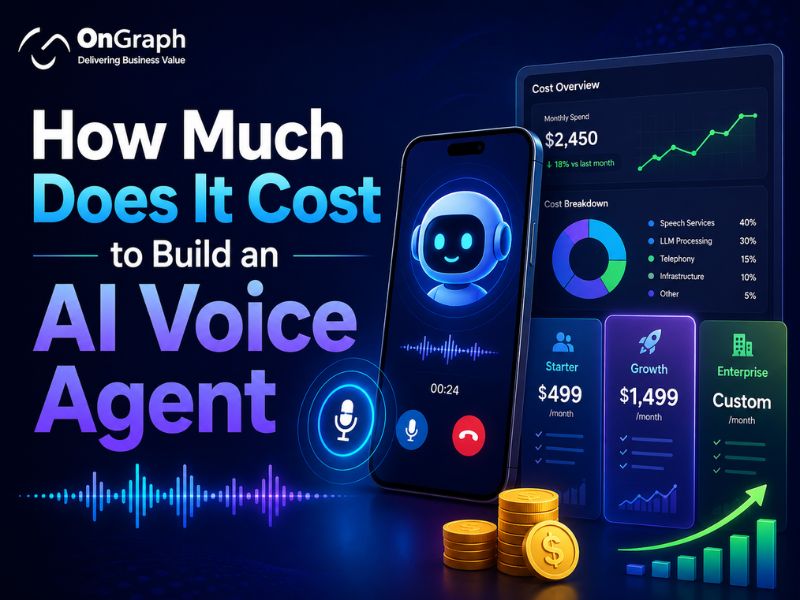
The cost to build an AI Voice Agent depends on features, call volume, voice quality, integrations, compliance, and launch model.
- Simple MVP agents cost less.
- Custom agents need deeper planning.
- Usage fees are often charged per minute.
- Telephony, STT, TTS, and LLM costs matter.
- CRM and workflow integrations increase cost.
- White-label platforms help agencies launch faster.
Why Businesses Ask About the Cost to Build an AI Voice Agent
The cost of building an AI Voice Agent is now a serious planning question for founders, agencies, and enterprises.
Businesses want to automate calls without losing customer experience. They also want to reduce missed leads, support delays, and manual follow-ups.
A few years ago, voice bots were mostly rigid IVR systems. Today, voice agents can answer calls, qualify leads, book appointments, update CRMs, and transfer calls.
That makes them useful for sales, support, healthcare, real estate, home services, logistics, and local businesses.
Market.us reported that the global voice AI agents market was worth USD 2.4 billion in 2024. It expects the market to reach USD 47.5 billion by 2034.
This growth shows clear business demand. Still, pricing can be confusing for buyers.
Some vendors charge per minute. Others charge monthly fees, setup fees, compliance add-ons, or enterprise contracts.
Custom development adds another layer. You may also pay for design, engineering, testing, integrations, and post-launch optimization.
Get a Clear AI Voice Agent Cost Estimate
What Is an AI Voice Agent?
An AI voice agent is software that speaks with callers using natural voice.
It can understand speech, identify caller intent, reply in real time, and trigger business actions.
A modern voice agent usually includes:
- Speech-to-text
- Language model
- Text-to-speech
- Telephony
- Call routing
- Business rules
- CRM integration
- Conversation analytics
- Human transfer logic
McKinsey notes that agent-based systems can connect multiple business tools and workflows.
That is why businesses now treat voice agents as workflow tools. They are not only call-answering bots.
How Much Does It Cost to Build an AI Voice Agent?
The Cost to build an AI Voice Agent can vary widely.
A simple MVP may cost less than a full enterprise system. A custom agent with CRM, compliance, analytics, and multilingual support costs more.
Based on public competitor cost guides, basic voice agents may start around USD 5,000 to USD 15,000. Mid-level agents can range from USD 15,000 to USD 50,000. Advanced enterprise agents can reach USD 100,000 or more.
Techzarinfo lists basic AI voice agents at USD 5,000 to USD 15,000. It lists advanced enterprise agents at USD 40,000 to USD 100,000+.
These are planning estimates, not guaranteed prices.
Your final budget depends on use case, industry, integrations, call volume, compliance, and support needs.
| AI Voice Agent Type | Best For | Cost Direction |
| Basic MVP | Lead capture and FAQs | Lower |
| Mid-level agent | Booking and CRM updates | Medium |
| Advanced agent | Multi-step workflows | Higher |
| Enterprise agent | High call volume and compliance | Highest |
| White-label platform | Agencies and resellers | Faster launch |
Cost Disclaimer
The pricing ranges in this guide are planning estimates based on public vendor pricing and competitor sources.
Final AI voice agent development cost depends on call volume, integrations, language support, voice quality, compliance needs, telephony setup, and post-launch support.
Always request a project-specific estimate before making a build decision.
AI Voice Agent Pricing: Development Cost vs Runtime Cost
Many buyers confuse development cost with runtime cost.
Development cost is what you pay to build the system. Runtime cost is what you pay when the agent handles real calls.
The AI voice agent development cost may include:
- Product planning
- Conversation design
- Prompt engineering
- Backend development
- Telephony setup
- CRM integration
- Testing
- Security work
- Admin dashboard
- Deployment
Runtime cost may include:
- Call minutes
- Phone numbers
- Speech-to-text
- Text-to-speech
- LLM usage
- Call recording
- Data storage
- Monitoring
- Analytics
These examples show why buyers must calculate total cost.
The cheapest visible rate may not include every layer.
Key Factors That Affect AI Voice Bot Development Cost
The AI voice bot development cost depends on technical and business factors.
A simple receptionist agent is easier to build. A multilingual outbound sales agent is more complex.
1. Use Case Complexity
A simple FAQ agent costs less.
A lead qualification agent needs questions, scoring, CRM updates, and call transfer logic.
Advanced workflows may include:
- Appointment booking
- Payment reminders
- Order status checks
- Customer support
- Sales follow-ups
- Patient triage
- Real estate lead qualification
- Multi-location routing
More workflows mean more planning, testing, and optimization.
2. Voice Quality and Latency
Good voice quality improves caller trust.
Low latency also matters because callers expect fast replies.
These features improve conversation flow. They can also affect platform or provider cost.
3. Business Integrations
Integrations are major cost drivers.
Your agent may need to connect with:
- CRM
- Calendar
- Helpdesk
- PMS
- EHR
- Payment system
- Spreadsheet
- Database
- SMS
Each integration needs mapping, testing, error handling, and security review.
4. Compliance and Security
Some industries need stronger controls.
Healthcare may need HIPAA-ready workflows. Finance may need audit logs and stricter access controls.
This shows how compliance can affect monthly cost.
5. Call Volume and Concurrency
Call volume affects runtime pricing.
Concurrency also matters. It decides how many calls your agent can handle at once.
A small clinic may need low concurrency. A national campaign may need hundreds of simultaneous calls.
Higher concurrency needs stronger infrastructure and closer monitoring.
Build a Custom AI Voice Agent for Your Business
What Goes Into Custom AI Voice Agent Development?
Custom AI voice agent development is not only about connecting an API.
A production-ready agent needs conversation design, business logic, testing, monitoring, and fallback handling.
A custom build may include:
- Call flow design
- Voice personality setup
- Knowledge base training
- Prompt design
- Tool calling
- CRM actions
- Human handoff
- Call summaries
- Admin dashboard
- Analytics
- Error handling
- Compliance controls
A custom voice agent may use multiple providers together.
AI Calling Agent for Business: Common Use Cases
An AI calling agent for business should solve a clear problem.
The strongest use cases are repeatable, high-volume, and rule-based.
Examples include:
- Missed call answering
- Lead qualification
- Appointment booking
- Real estate inquiry handling
- Clinic call routing
- Service business scheduling
- Customer support triage
- Payment reminders
- Feedback calls
- Sales follow-ups
For example, a home service company may use an agent to answer calls after hours.
A real estate company may use it to qualify buyers by budget and location.
A clinic may use it to book appointments and answer common questions.
The cost depends on how many tasks the agent must complete.
Mini Case Study 1: Customer Support Agents at Nubank Scale
A recent research paper described customer support AI agents at Nubank scale.
The paper says Nubank serves more than 100 million users. It studied five production deployments across support domains.
One card-delivery deployment improved AI transactional NPS by 37 percentage points. It also improved self-service rate by 29 percentage points.
This case shows why testing matters.
A voice or support agent needs evaluation before full rollout.
Note: This example shows how AI agents can improve support workflows. It is not a direct cost benchmark for building an AI voice agent.
Actual results depend on workflow design, call volume, implementation quality, and user adoption.
Mini Case Study 2: Voice Agents in Healthcare Monitoring
A 2025 paper studied Agent PULSE for digital health delivery.
The pilot included 33 patients with inflammatory bowel disease. The paper reported that 70% accepted AI-driven monitoring.
It also stated that 37% preferred it over traditional options.
This case shows how voice-based agents can support healthcare access.
It also highlights the need for privacy, bias, safety, and regulatory planning.
Note: This healthcare example is not a direct pricing benchmark.
Voice agents in healthcare need careful review before launch.
SaaS vs Custom vs White-Label AI Voice Agent Platform
You can launch an AI voice agent in three main ways.
1. Use SaaS.
2. Build custom.
3. Choose a White-Label AI Voice Agent Platform.
| Option | Best For | Advantage | Limitation |
| SaaS platform | Fast testing | Quick setup | Less control |
| Custom build | Unique workflows | Full flexibility | Higher planning effort |
| White-label platform | Agencies and resellers | Faster branded launch | Vendor-dependent flexibility |
A SaaS tool is good for pilot projects.
Custom development is better when workflows are unique.
White-label platforms help agencies sell branded voice automation faster.
Cost Breakdown by Component
The Cost to build an AI Voice Agent becomes clearer when split by component.
| Component | Why It Matters | Cost Impact |
| Conversation design | Controls call quality | Medium |
| STT | Converts speech to text | Usage-based |
| LLM | Understands and replies | Usage-based |
| TTS | Creates spoken response | Usage-based |
| Telephony | Connects phone calls | Usage-based |
| CRM integration | Updates business data | Medium to high |
| Admin dashboard | Adds security controls | Medium |
| Compliance | Adds security controls | High |
| Testing | Reduces call failures | Medium |
| Maintenance | Keeps agent reliable | Ongoing |
Hidden Costs You Should Plan For
Many businesses only budget for the first build.
That creates problems after launch.
Hidden costs may include:
- Phone number rental
- Call recording storage
- CRM API limits
- Compliance add-ons
- Human transfer fees
- Prompt updates
- Call monitoring
- Analytics dashboards
- Testing after model updates
- Multilingual tuning
- Support and maintenance
Voice agents need continuous improvement.
Caller behavior changes. Business rules also change.
A good budget should include post-launch optimization.
Voice Agent Compliance and Call Recording Note
AI voice agents may process phone numbers, call recordings, transcripts, customer details, and business data.
Depending on your target region, you may need call recording consent, GDPR, CCPA, HIPAA, TCPA, data retention rules, opt-out workflows, secure storage, and human escalation options.
Outbound calling may also require extra telecom and consent checks.
Always review legal, privacy, and telecom rules before launching inbound or outbound voice automation.
This is especially important for healthcare, finance, insurance, real estate, and debt collection workflows.
Step-by-Step Framework to Estimate Your Cost
Use this framework before asking for a quote.
Step 1: Define the Use Case
Choose one primary workflow first.
Examples include appointment booking, lead qualification, or support triage.
Step 2: Estimate Monthly Call Volume
Calculate expected calls and average call length.
This helps estimate runtime cost.
Step 3: Choose Required Integrations
List CRM, calendar, helpdesk, payment, and database needs.
Each integration adds planning and testing effort.
Step 4: Decide Voice Quality
Choose basic voice, premium voice, or branded voice.
Better voices can improve trust.
Step 5: Plan Compliance Needs
Check GDPR, HIPAA, TCPA, call recording consent, and data retention rules.
These requirements vary by region.
Step 6: Choose Build Model
Pick SaaS, custom development, or white-label platform.
Your choice affects cost, control, and launch speed.
Step 7: Budget for Maintenance
Set aside budget for monitoring, updates, and call quality improvements.
A voice agent is never fully “set and forget.”
How to Choose an AI Voice Agent Development Company
Choosing the right AI Voice Agent Development Company reduces project risk.
Look for a team that understands voice workflows, integrations, and business operations.
Ask these questions:
- Have they built voice agents before?
- Can they connect CRMs and calendars?
- Do they support inbound and outbound calls?
- Can they add human handoff?
- Do they test real call scenarios?
- Can they support compliance workflows?
- Do they explain runtime pricing clearly?
- Will they provide post-launch support?
A low quote may look attractive.
Poor testing can cost more later.
Launch a White-Label AI Voice Agent Platform
Build a branded voice automation platform for inbound calls, outbound calls, bookings, and lead qualification.
How OnGraph Can Help
OnGraph provides AI voice agent development for businesses that want smarter call automation.
The solution can support inbound calls, outbound calls, lead qualification, appointment booking, CRM updates, multilingual workflows, and call summaries.
OnGraph can help with:
- AI voice agent development
- AI calling agent setup
- Custom AI voice agent development
- Voice bot development
- CRM integration
- Calendar integration
- Call summary workflows
- Lead qualification flows
- White-label AI voice agent platform planning
- Post-launch support
Key Takeaways
Cost to Build an AI Voice Agent depends on features, integrations, compliance, and call volume.
Development cost and runtime cost are different.
Per-minute pricing can include multiple layers.
Custom agents work best for unique workflows.
White-label platforms are useful for agencies and fast launches.
Post-launch testing and monitoring are essential.
Final Thoughts
The Cost to build an AI Voice Agent is not only a development question.
It is a business planning question.
You need to think about use case, call volume, voice quality, integrations, compliance, and runtime cost.
A simple agent can launch quickly.
A custom enterprise agent needs deeper planning and testing.
The best approach is phased.
Start with one high-value workflow. Test it with real calls. Then expand into more use cases.
For many businesses, this reduces risk and improves ROI.
A strong voice agent should not only answer calls.
It should complete useful business actions and improve customer experience.
FAQs
The cost to build an AI voice agent depends on the use case, call volume, integrations, voice quality, and compliance needs.
A basic AI voice agent for FAQs, lead capture, or missed-call handling may cost less. A custom AI voice agent with CRM integration, appointment booking, call transfer, analytics, multilingual support, and compliance workflows will cost more.
Businesses should also plan for runtime costs. These may include call minutes, telephony, speech-to-text, text-to-speech, LLM usage, call recordings, storage, and post-launch monitoring.
The best way to estimate cost is to define one core workflow first. Then calculate expected call volume, integration needs, and support requirements.
Several factors affect AI voice agent development cost. The biggest cost drivers are use case complexity, call volume, voice quality, business integrations, compliance, and testing.
A simple inbound answering agent is easier to build. A sales or support agent that qualifies leads, books appointments, updates a CRM, sends summaries, and transfers calls requires more development effort.
Integrations also increase cost. Connecting the agent with a CRM, calendar, helpdesk, EHR, payment tool, or internal database needs planning, API work, and testing.
Compliance can also affect pricing. Healthcare, finance, insurance, and outbound calling workflows may require consent flows, call recording rules, secure storage, audit logs, and human escalation options.
Using an AI voice agent platform is usually cheaper and faster for testing a simple use case. It can be a good option for businesses that want to launch quickly with basic call automation.
Custom development is better when your workflow is unique. For example, you may need custom lead scoring, CRM updates, appointment booking, multilingual scripts, industry-specific rules, or branded call experiences.
A white-label AI voice agent platform can be a middle option. It helps agencies and businesses launch faster while keeping branding and some customization options.
The right choice depends on your budget, timeline, call volume, and control requirements.
After launch, you should plan for both usage-based and maintenance costs.
Usage-based costs may include phone numbers, call minutes, speech-to-text, text-to-speech, LLM usage, call recordings, and data storage. These costs usually increase as call volume grows.
Maintenance costs may include prompt updates, workflow improvements, bug fixes, analytics reviews, call quality monitoring, compliance updates, and integration support.
A voice agent is not a one-time setup. It needs regular optimization because customer questions, business rules, and call patterns change over time.
You can reduce the cost to build an AI voice agent by starting with one high-value use case.
For example, begin with missed-call answering, lead qualification, appointment booking, or support triage. Avoid building every workflow in the first version.
Keep the MVP simple. Add CRM integration, call summaries, multilingual support, analytics, and advanced automation after testing real calls.
You can also reduce cost by using existing APIs, ready-made telephony tools, and a phased development approach. A clear call script, defined business rules, and accurate knowledge base content will also reduce development and testing time.
About the Author

Let’s Create Something Great Together!
Latest Blog

Let’s have a conversation today!


India
ONGRAPH TECHNOLOGIES PRIVATE LIMITED,
SDF L-1, NSEZ,
Sector 81, Block L, Phase-2,
Noida, Uttar Pradesh-201305

USA
OnGraph Technologies,
120 Bethpage Rd, Suite 304,
Hicksville, NY 11801, USA

Canada
7-1039 CEDARGLEN GATE,
Mississauga, Ontario,
Canada L5C 3A7

UK
89 Banstead Road South,
Sutton, Surrey, SM2 5LH
United Kingdom

Malaysia
G-3A, Amaya Maluri, Jalan
Jejaka 2, Taman Maluri,
KL–55100, Malaysia

Singapore
10 Anson Road,#26-04
International Plaza,
Singapore (079903)