


In this article
- Why Telemedicine App Development Cost Matters in 2026
- What Is a Telemedicine App?
- How Much Does Telemedicine App Development Cost in 2026?
- Key Telemedicine App Features That Affect Cost
- HIPAA Compliant Telemedicine App Cost
- Healthcare Compliance and Security Note
- Telehealth App Development Cost vs Telemedicine App Development Cost
- Doctor Appointment App Development Cost
- Create Doctor On-Demand App Like Zocdoc
- White-Label Healthcare Marketplace App vs Custom Telemedicine App
- Cost by Development Region
- Hidden Costs to Plan Before Development
- Mini Case Study 1: Teladoc Health Technology Transformation
- Mini Case Study 2: Virtual Care Programs and ROI
- Step-by-Step Cost Planning Framework
- How to Choose a Telemedicine App Development Company
- How OnGraph Can Help
- Key Takeaways
- Final Thoughts
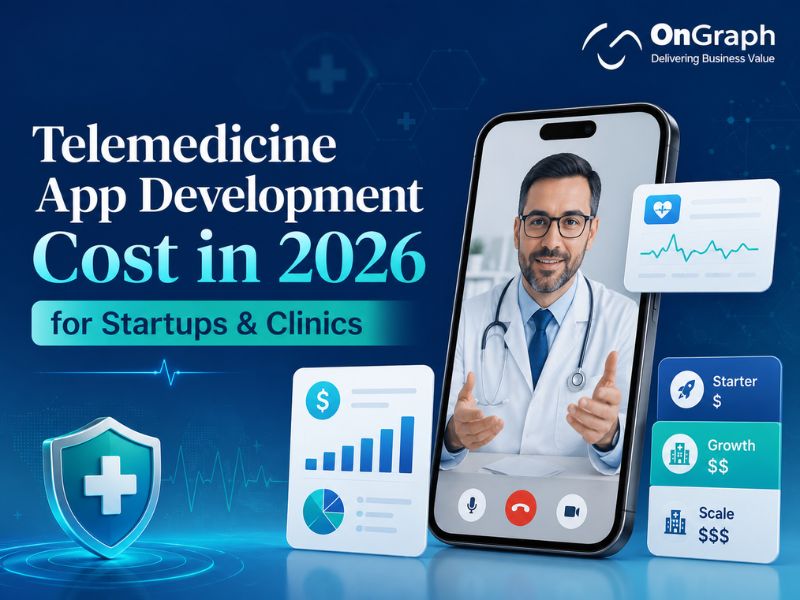
Telemedicine App Development Cost in 2026 depends on features, compliance, app type, integrations, and platform complexity.
- MVP apps cost less.
- HIPAA-ready apps need secure architecture.
- Video calls and EHR integrations increase cost.
- White-label apps launch faster.
- Custom apps offer stronger control.
- Marketplace apps need patient and doctor workflows.
Why Telemedicine App Development Cost Matters in 2026
Telemedicine App Development Cost is one of the first questions founders, clinics, hospitals, and healthtech teams ask before starting a project.
The answer is not one fixed number. Cost depends on what you want to build, who will use it, and how secure it must be.
A simple doctor appointment app may cost less. A HIPAA-ready telemedicine platform with video calls, e-prescriptions, EHR integration, admin dashboards, and payment workflows costs more.
The market opportunity is also growing. Grand View Research valued the global telemedicine market at USD 141.19 billion in 2024. It projects the market to reach USD 380.33 billion by 2030.
This growth explains why many businesses are planning virtual care platforms in 2026. For buyers, the bigger question is not only “how much will it cost?” The better question is “which features should we build first?”
Discuss Your Healthcare App Idea With Experts
What Is a Telemedicine App?
A telemedicine app helps patients connect with healthcare providers remotely.
It can support video consultations, doctor appointment booking, online payments, prescriptions, medical records, and follow-up care.
Johns Hopkins describes telemedicine as care through video or phone appointments between patients and healthcare practitioners.
A telemedicine app can serve many business models, including:
- Online doctor consultation apps
- Mental health consultation apps
- Chronic care platforms
- Doctor appointment booking apps
- Remote patient monitoring apps
- White-label healthcare marketplace apps
- Apps like Zocdoc for doctor discovery and booking
Each model has different features. That is why cost changes from project to project.
How Much Does Telemedicine App Development Cost in 2026?
The telemedicine app development cost in 2026 usually depends on complexity.
Based on publicly available competitor cost guides, a basic MVP may start around USD 25,000 to USD 80,000. Mid-level platforms often fall between USD 60,000 and USD 150,000. Enterprise-grade platforms may go beyond USD 300,000.
SparxIT lists a 2026 estimate of USD 25,000 to USD 80,000 for a basic MVP. It also lists USD 150,000 to USD 300,000+ for advanced platforms.
Netclues states that a 2026 telemedicine app may range from USD 50,000 for a basic MVP to over USD 300,000 for enterprise platforms.
| App Type | Best For | Estimated Cost Direction |
| Basic MVP | Startups and small clinics | Medium |
| Mid-level app | Clinics and growing providers | Medium |
| Advanced platform | Multi-specialty care providers | Higher |
| Enterprise system | Hospitals and healthcare networks | Highest |
| White-label app | Faster market launch | More predictable |
| Zocdoc-like marketplace | Doctor discovery and booking | Medium to high |
Cost Note: These ranges are planning estimates based on publicly available industry sources. Final development cost depends on features, compliance needs, integrations, design complexity, region, and post-launch support.
Launch a Doctor On-Demand App Faster
Key Telemedicine App Features That Affect Cost
Your feature list directly affects the final budget.
A basic app may only need patient login, doctor profiles, appointment booking, chat, and payments.
A more advanced platform may need video calls, e-prescriptions, EHR integration, insurance workflows, analytics, and multi-role dashboards.
| Feature | Why It Affects Cost |
| Patient app | Requires booking, profile, payments, and records |
| Doctor app | Needs availability, consultation, notes, and follow-ups |
| Admin panel | Controls users, doctors, services, payments, and reports |
| Video consultation | Needs secure real-time communication |
| E-prescription | Requires prescription workflow and regional rules |
| EHR/EMR integration | Needs secure data exchange |
| Payment gateway | Adds billing, refunds, and receipts |
| Notifications | Adds SMS, email, and push reminders |
| Analytics dashboard | Helps track visits, revenue, and usage |
| Compliance features | Adds security, audit logs, and access controls |
A smaller MVP should include only the features needed to launch safely. Advanced modules can be added after proving demand.
HIPAA Compliant Telemedicine App Cost
A HIPAA-compliant telemedicine app cost is higher because healthcare data needs stronger protection.
The HIPAA Security Rule protects electronic protected health information. HHS states that the rule establishes national security standards for certain health information stored or transmitted electronically.
A HIPAA-ready app may need:
- Secure authentication
- Role-based access
- Data encryption
- Audit logs
- Backup and recovery
- Secure video communication
- Consent management
- Access monitoring
- Secure cloud hosting
- Vendor compliance review
Security should not be treated as an optional add-on. It must be planned from the first architecture stage.
Healthcare Compliance and Security Note
Telemedicine apps may handle sensitive patient data, prescriptions, payments, consultation history, and medical records.
Depending on your target region, your app may need HIPAA, GDPR, local healthcare rules, consent flows, audit logs, access controls, secure hosting, and data retention policies.
Compliance requirements vary by business model and location. Always review legal, security, and healthcare regulations before launch.
This section is important because “HIPAA-ready” does not automatically mean legally certified. A proper review is required before handling real patient data.
Telehealth App Development Cost vs Telemedicine App Development Cost
Many users search for telehealth app development cost and telemedicine app cost together.
The terms are often used together, but they are not always identical.
Telemedicine usually refers to remote clinical care. Telehealth can include broader digital health services, such as education, monitoring, care coordination, and administrative communication.
The cost difference depends on scope.
| Type | Common Scope | Cost Impact |
| Telemedicine app | Remote clinical consultation | Medium to high |
| Telehealth app | Broader digital health workflows | Medium to high |
| Remote monitoring app | Device data and alerts | High |
| Appointment app | Search and booking | Lower to medium |
| Healthcare marketplace | Multi-provider discovery and booking | Medium to high |
Fortune Business Insights reported that the global telehealth market was valued at USD 186.41 billion in 2025.
This demand shows why businesses are planning both telemedicine and broader telehealth platforms.
Doctor Appointment App Development Cost
A doctor appointment app development cost may be lower than a full telemedicine app.
That is because booking apps usually focus on provider discovery, calendars, appointment slots, reminders, and reviews.
Common features include:
- Patient login
- Doctor profiles
- Specialty filters
- Location filters
- Insurance filters
- Real-time availability
- Appointment booking
- Reminders
- Ratings and reviews
- Admin approval
Zocdoc is a strong example of this model. Its Google Play listing says it connects patients to nearly 100,000 providers across more than 250 specialties.
A booking app becomes more expensive when it adds video visits, payments, EHR integration, and insurance eligibility.
Create Doctor On-Demand App Like Zocdoc
Many founders want to create a Doctor On-Demand App like Zocdoc because they see marketplace potential.
A Zocdoc-like platform needs more than booking. It must support patients, providers, admin teams, and sometimes clinics.
Core modules may include:
- Patient app
- Doctor app
- Admin dashboard
- Provider onboarding
- Doctor verification
- Specialty listing
- Insurance filters
- Real-time calendar sync
- Appointment booking
- Reviews and ratings
- Notifications
- Telemedicine visits
- Analytics
- Payment processing
Zocdoc states that it connects directly to provider scheduling systems to show real appointment times.
This type of real-time booking needs careful integration planning. A static directory costs less. A real marketplace with live availability costs more.
White-Label Healthcare Marketplace App vs Custom Telemedicine App
A White-Label Healthcare Marketplace App helps businesses launch faster.
A custom telemedicine app gives more control.
Both options can work. The right choice depends on your timeline, budget, and business model.
| Factor | White-Label Healthcare Marketplace App | Custom Telemedicine App |
| Launch speed | Faster | Slower |
| Customization | Moderate | High |
| Cost predictability | Higher | Depends on scope |
| Ownership | Depends on vendor | Stronger control |
| Integrations | Limited to available options | Fully custom |
| Best for | Faster launch | Unique workflows |
| Scalability | Vendor-dependent | Architecture-driven |
Choose white-label if speed matters most.
Pick custom development when you need unique workflows, full branding, or deeper integrations.
OnGraph offers Doctor On Demand App Development for businesses that want a healthcare marketplace or virtual consultation platform.
Cost by Development Region
Team location also affects Telemedicine App Development Cost.
Development rates vary across the US, UK, India, and other regions.
Indian development teams are often more cost-effective. US and UK teams usually have higher hourly rates.
Doccure’s 2026 India guide states that Indian development teams may charge ₹1,500 to ₹3,000 per hour. It also compares this with US and European rates of USD 80 to USD 150.
| Region | Cost Direction | Best For |
| US | Highest | Local compliance-heavy projects |
| UK | High | Regulated healthcare platforms |
| India | Lower to medium | Cost-effective development |
| Global hybrid | Flexible | Balanced cost and expertise |
Cost should not be the only factor. Healthcare experience, security knowledge, and integration skills matter more than hourly rate alone.
Hidden Costs to Plan Before Development
Some costs are easy to miss.
These hidden expenses can affect the total project budget.
Common hidden costs include:
- Cloud hosting
- SMS and email services
- Video API usage
- Maintenance and bug fixes
- App store accounts
- Security testing
- Compliance reviews
- Third-party API fees
- EHR integration support
- Ongoing feature upgrades
Maintenance is also important after launch.
Doccure notes that ongoing maintenance may cost 10% to 20% of the initial cost annually.
Budgeting only for development can create problems later. Plan for launch, support, and growth from the start.
Mini Case Study 1: Teladoc Health Technology Transformation
PwC published a case study about Teladoc Health’s technology transformation.
The project helped Teladoc modernize operations through unified ERP and CRM systems.
PwC reported that the new ERP reduced average accounts receivable invoice processing from several hours to just minutes.
This case shows why healthcare platforms need strong backend systems.
The patient app matters, but operations, billing, CRM, and data visibility also affect scale.
Mini Case Study 2: Virtual Care Programs and ROI
Teladoc Health’s 2025 benchmark survey reported that 85% of respondents said their virtual care programs were producing ROI.
It also reported that 20% said ROI was more than 10% annually.
This suggests that virtual care can deliver business value when implemented well.
Still, ROI depends on adoption, workflow design, patient access, and operational execution.
Step-by-Step Cost Planning Framework
Use this framework before asking for a quote.
Step 1: Define the Business Model
Decide whether you need consultation, booking, marketplace, remote monitoring, or clinic management.
This choice shapes the feature list.
Step 2: Choose MVP Features
Start with patient login, doctor profiles, booking, video call, payment, and admin panel.
Avoid building every advanced feature first.
Step 3: Plan Compliance Early
Add HIPAA, GDPR, consent, audit logs, encryption, and access control early.
Security changes later can become expensive.
Step 4: Decide Build vs White-Label
Choose white-label for speed.
Build custom when workflows, branding, and integrations are unique.
Step 5: Estimate Integrations
List video APIs, payment gateways, EHR systems, SMS tools, and CRM integrations.
Each integration affects time and cost.
Step 6: Plan Maintenance
Budget for updates, hosting, support, security, and new features.
A healthcare app needs long-term care after launch.
How to Choose a Telemedicine App Development Company
Choosing the right telemedicine app development company can reduce cost risk.
Look for a team that understands healthcare workflows, compliance, integrations, and scalable architecture.
Ask these questions:
- Have they built healthcare apps before?
- Can they support HIPAA-ready architecture?
- Do they understand EHR and API integrations?
- Can they build patient, doctor, and admin panels?
- Do they offer post-launch maintenance?
- Can they support white-label and custom models?
- Do they explain cost clearly?
A low quote may look attractive. Poor planning can cost more later.
How OnGraph Can Help
OnGraph provides Doctor On Demand App Development for businesses planning healthcare platforms.
The solution can support appointment booking, virtual consultations, doctor profiles, patient access, admin controls, and white-label healthcare marketplace workflows.
OnGraph can help with:
- Telemedicine app development
- Doctor appointment app development
- White-label healthcare marketplace apps
- Patient and doctor apps
- Admin panel development
- Video consultation workflows
- Appointment scheduling
- Payment integration
- Healthcare platform customization
- Cost and architecture planning
Turn Your Telemedicine Idea Into a Scalable App
From MVP to full healthcare marketplace, we help plan, build, and launch your app the right way.
Key Takeaways
Telemedicine App Development Cost depends on features, compliance, integrations, app type, and region.
A basic MVP costs less than an enterprise healthcare platform.
HIPAA-ready architecture increases planning, testing, and security effort.
Video consultation, EHR integration, and e-prescription are major cost drivers.
White-label apps are faster, while custom apps offer stronger control.
Final Thoughts
Telemedicine App Development Cost in 2026 depends on what you want to build.
A simple consultation MVP is very different from a full healthcare marketplace.
Compliance, integrations, video calls, and admin workflows all affect the budget.
The best approach is phased.
Start with the core patient, doctor, and admin workflows. Then add advanced features after launch.
For founders, clinics, and healthcare businesses, this reduces risk.
A good telemedicine app is not just a video call tool.
It is a secure care delivery platform that connects patients, providers, workflows, and data.
FAQs
Telemedicine App Development Cost in 2026 depends on features and complexity. A basic MVP may start lower, while enterprise platforms with video, EHR, and compliance can cost much more.
Major cost factors include video consultation, patient and doctor apps, admin panels, HIPAA-ready architecture, EHR integration, payments, prescriptions, analytics, and support.
The HIPAA-compliant telemedicine app cost is higher because the app needs encryption, access controls, audit logs, secure hosting, consent flows, and strong data protection.
Yes, sometimes. Telemedicine focuses on remote clinical care. Telehealth can include broader services like monitoring, education, and care coordination.
A telemedicine app should include patient login, doctor profiles, appointment booking, video calls, payments, notifications, prescriptions, admin controls, and security features.
Doctor appointment app development cost depends on search, booking, calendar sync, reviews, reminders, and admin workflows. Video consultation and integrations raise the cost.
Use white-label if you need faster launch. Build custom if your platform needs unique workflows, stronger control, custom branding, or deeper integrations.
A basic MVP may take a few months. A full-featured platform with compliance, integrations, and testing can take longer.
Yes. You can build a Zocdoc-like platform with doctor discovery, calendar sync, appointment booking, reviews, video visits, payments, and admin controls.
OnGraph can help plan, design, and develop doctor-on-demand apps, telemedicine platforms, healthcare marketplaces, and white-label healthcare app solutions.
About the Author

Let’s Create Something Great Together!
Latest Blog


Let’s have a conversation today!


India
ONGRAPH TECHNOLOGIES PRIVATE LIMITED,
SDF L-1, NSEZ,
Sector 81, Block L, Phase-2,
Noida, Uttar Pradesh-201305

USA
OnGraph Technologies,
120 Bethpage Rd, Suite 304,
Hicksville, NY 11801, USA

Canada
7-1039 CEDARGLEN GATE,
Mississauga, Ontario,
Canada L5C 3A7

UK
89 Banstead Road South,
Sutton, Surrey, SM2 5LH
United Kingdom

Malaysia
G-3A, Amaya Maluri, Jalan
Jejaka 2, Taman Maluri,
KL–55100, Malaysia

Singapore
10 Anson Road,#26-04
International Plaza,
Singapore (079903)