


In this article
- The Problem with Off-the-Shelf Market Research Tools
- What Are Custom Market Research Solutions?
- Key Benefits of Custom Market Research Solutions
- Cost Reality: Custom vs Off-the-Shelf Tools
- Custom vs Off-the-Shelf Market Research Tools
- When to Choose Off-the-Shelf Tools
- When to Transition to Custom-Built Solutions
- Why Custom Market Research Solutions Create Strategic Advantage
- Final Thoughts
As data-driven decision-making becomes mission-critical, businesses are re-evaluating how they gather, manage, and act on market insights. While off-the-shelf market research tools may appear convenient, they often fall short as organizations scale, diversify audiences, or demand deeper intelligence. This is why many growing businesses are now investing in Custom Market Research Solutions that align with their workflows, data ownership needs, and long-term growth strategy.
In 2026, forward-thinking companies are increasingly choosing to invest in custom market research solutions—platforms built specifically around their data, workflows, and long-term growth strategy.
This article explains why custom solutions outperform generic tools, where off-the-shelf tools still make sense, and when the right time is to transition.
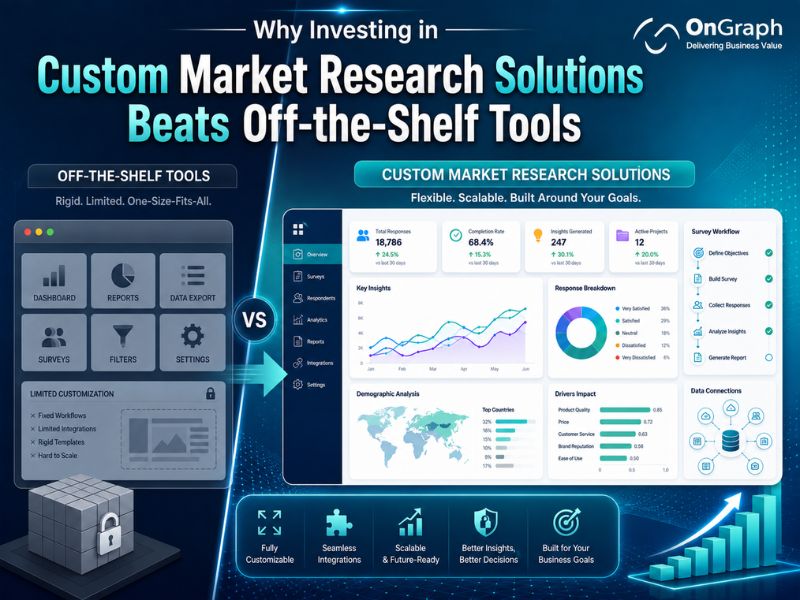
The Problem with Off-the-Shelf Market Research Tools
Off-the-shelf research platforms are designed for broad adoption, not business-specific depth. They work well for basic surveys, but limitations become more visible as research maturity increases.
Common challenges include:
- Rigid workflows and fixed survey logic
- Limited customization of dashboards and insights
- Dependence on third-party panels and external data
- Shallow integrations with internal systems
- Recurring license fees that grow with usage
Over time, teams end up adapting their research processes to the tool rather than the tool supporting their strategy. This creates operational gaps, reporting limitations, and missed opportunities for deeper insight.
Need a Custom Market Research Platform for Your Agency?
What Are Custom Market Research Solutions?
A custom market research solution is a bespoke platform built around an organization’s exact research needs and operating model. Unlike generic tools, these platforms are designed to support specific workflows, data structures, audiences, and decision-making needs.
These platforms typically include:
- Tailored survey logic and workflows
- Custom analytics and role-based dashboards
- First-party data and panel ownership
- AI-driven quality checks and automation
- Deep integration with internal systems
Instead of managing constraints, teams gain full control over how insights are collected, analyzed, and applied. This is why many growing companies now prefer market research software that is built around their long-term research strategy.
Key Benefits of Custom Market Research Solutions
1. Built Around Your Research Strategy
Custom platforms align directly with your research strategy and operating model. They are built to support how your team actually collects, manages, and uses insights.
A custom solution can align with your:
- Research methodologies
- Audience structure
- Insight consumption workflows
- Reporting needs
- Internal approval processes
This ensures insights are actionable, not just informational. Instead of forcing teams into fixed workflows, a custom platform supports the way the business already works.
2. Full Ownership of Data and Insights
Custom solutions allow businesses to control their respondent data, study history, and research intelligence. This is especially important for organizations that conduct continuous research or manage niche audiences.
With a custom platform, businesses can:
- Own respondent and study data
- Maintain long-term data continuity
- Reduce reliance on third-party vendors
- Build reusable research assets
- Improve control over compliance and governance
Data ownership improves reliability, transparency, and strategic value. It also helps teams reduce dependency on external tools or vendors for every research initiative.
3. Analytics Designed for Your KPIs
Off-the-shelf dashboards are usually built for generic reporting. They may show survey responses, charts, and basic summaries, but they rarely align perfectly with business-specific KPIs.
Custom platforms can provide:
- Business-specific metrics
- Industry-aligned reporting
- Real-time and historical trend analysis
- Role-based dashboards
- Custom visualization and export formats
Leadership teams get insights aligned with decision-making needs. This makes the platform more valuable because it connects research output with actual business goals.
4. Seamless Integration with Existing Systems
A major advantage of custom research platforms is integration flexibility. Instead of working as a standalone survey tool, a custom solution can connect with the systems your business already uses.
Custom research solutions can integrate with:
- CRM platforms
- Customer data platforms
- Product and usage analytics
- Internal BI systems
- Marketing automation tools
- Data warehouses
This creates a more connected research ecosystem. It allows teams to combine customer sentiment with actual behavior, enabling deeper insight loops.
For larger research teams, this can evolve into an end-to-end market research platform that connects survey creation, panel management, data collection, analytics, reporting, and decision-making workflows.
5. Long-Term Scalability Without Vendor Constraints
As research needs evolve, custom platforms can scale with the business. Teams are not limited by fixed vendor roadmaps, licensing tiers, or feature restrictions.
Custom platforms can scale across:
- New geographies and languages
- Larger or more niche audiences
- Advanced analytics and AI models
- Multiple research teams
- Custom panel workflows
- New reporting requirements
Growth is driven by strategy, not tool limitations. This makes custom development especially useful for enterprises, agencies, and research-led businesses that need long-term flexibility.
A custom market research operations platform can also help teams manage studies, audiences, panels, reporting, workflows, and integrations from one centralized system.
Discuss Your Custom Research Software Idea With Experts
Cost Reality: Custom vs Off-the-Shelf Tools
Off-the-shelf tools often look cost-effective initially. They usually require less setup time and may be suitable for simple survey needs.
However, long-term expenses can include:
- Rising license fees
- Per-response or per-user pricing
- Paid add-ons for advanced features
- Vendor lock-in
- Additional tools for missing workflows
- Higher dependency on external panels or services
Custom platforms require upfront investment, but they can create stronger long-term value when research becomes a core business function.
Custom solutions can help businesses:
- Reduce recurring license inflation
- Lower third-party dependency costs
- Improve workflow efficiency
- Deliver higher insight value per study
- Build reusable first-party research assets
Over time, custom solutions can offer a lower total cost of ownership when compared with managing multiple disconnected tools and vendor subscriptions.
Custom vs Off-the-Shelf Market Research Tools
| Factor | Off-the-Shelf Tools | Custom Market Research Solutions |
| Launch speed | Faster | Slower |
| Custom workflows | Limited | Requires planning and development |
| Data ownership | Vendor-dependent | Fully customizable |
| Integrations | Limited or predefined | Business-controlled |
| Dashboards | Generic | Deep and flexible |
| Scalability | Based on vendor plans | KPI-specific |
| Cost model | Recurring licenses and add-ons | Built around business growth |
| Best for | Basic or occasional research | Continuous, strategic research operations |
Off-the-shelf tools are useful when teams need speed and simplicity. Custom platforms become more valuable when research directly supports product, revenue, customer experience, or strategic decisions.
When to Choose Off-the-Shelf Tools
Off-the-shelf tools still make sense in some situations. Not every business needs custom software from the beginning.
Choose off-the-shelf tools when:
- Research needs are infrequent or one-off
- Surveys are simple and standardized
- Budget or timelines are limited
- Research is not a core business function
- The team does not need deep customization
- Generic dashboards are enough
Off-the-shelf tools are ideal for early-stage teams or lightweight validation. They help businesses collect quick feedback without investing in a full custom platform.
When to Transition to Custom-Built Solutions
The right time to move to custom development comes when research becomes frequent, strategic, or operationally complex.
Transition to custom-built solutions when:
- Research is conducted continuously
- You manage large, niche, or recurring audiences
- Insights directly impact product or revenue decisions
- Data ownership and compliance are critical
- Existing tools limit workflows or analytics depth
- You need deeper integrations with internal systems
- You want to reduce long-term vendor dependency
At this stage, custom platforms stop being an expense and start becoming strategic infrastructure.
For research agencies, a custom market research platform for agencies can support client projects, respondent panels, survey workflows, reporting dashboards, quality checks, and internal operations more effectively than disconnected tools.
Also read: Best Market Research Software for Agencies Guide in 2026
Why Custom Market Research Solutions Create Strategic Advantage
Custom market research solutions are not just about replacing survey tools. They help businesses build a stronger insight infrastructure.
A custom platform gives teams more control over:
- How data is collected
- How respondents are managed
- How insights are analyzed
- How reports are delivered
- How workflows are automated
- How research connects with business systems
This creates a stronger foundation for long-term decision-making. It also allows organizations to move faster when markets, customer behavior, or product priorities change.
The biggest advantage is alignment. A custom solution is built around the business, not the other way around.
Also read: Market Research Automation Software: Features, Cost & Benefits
Ready to Move Beyond Off-the-Shelf Research Tools?
Final Thoughts
Off-the-shelf tools are designed for convenience. Custom market research solutions are designed for competitive advantage.
For organizations that rely on insights to drive growth, product strategy, or customer experience, investing in a tailored research platform can deliver:
- Deeper insights
- Faster decisions
- Better long-term economics
- Stronger strategic control
- Improved data ownership
- More scalable research operations
The real question is not whether you should go custom, but when.
If research is becoming central to your business strategy, a custom platform can help you move from basic data collection to a more powerful, integrated, and scalable research ecosystem.
About the Author

Let’s Create Something Great Together!
Latest Blog

Let’s have a conversation today!


India
ONGRAPH TECHNOLOGIES PRIVATE LIMITED,
SDF L-1, NSEZ,
Sector 81, Block L, Phase-2,
Noida, Uttar Pradesh-201305

USA
OnGraph Technologies,
120 Bethpage Rd, Suite 304,
Hicksville, NY 11801, USA

Canada
7-1039 CEDARGLEN GATE,
Mississauga, Ontario,
Canada L5C 3A7

UK
89 Banstead Road South,
Sutton, Surrey, SM2 5LH
United Kingdom

Malaysia
G-3A, Amaya Maluri, Jalan
Jejaka 2, Taman Maluri,
KL–55100, Malaysia

Singapore
10 Anson Road,#26-04
International Plaza,
Singapore (079903)