

In this article
- Why TaskRabbit Clone App Development Cost Requires Careful Planning
- What Is a TaskRabbit Clone App?
- How Much Does It Cost to Build an App Like TaskRabbit?
- Development Cost Disclaimer
- What Factors Affect TaskRabbit Clone App Development Cost?
- Essential TaskRabbit Clone App Features
- Customer App Features
- Service Provider App Features
- Admin Dashboard Features
- Basic Versus Advanced TaskRabbit Clone App Features
- Task Marketplace Versus Home Services Marketplace
- Custom Development Versus White-Label Development
- Suggested TaskRabbit Clone App Development Timeline
- Hidden Costs Beyond Application Development
- Mini Case Study 1: Taskrabbit’s Marketplace Activity
- Mini Case Study 2: Taskrabbit and IKEA Integration
- Real-World Service Marketplace Models to Study
- Step-by-Step Framework to Build a TaskRabbit Clone App
- How TaskRabbit-Style Marketplaces Generate Revenue
- How to Choose an On-Demand Service App Development Company
- Build a TaskRabbit-Style Marketplace With OnGraph
- Key Takeaways
- Final Thoughts
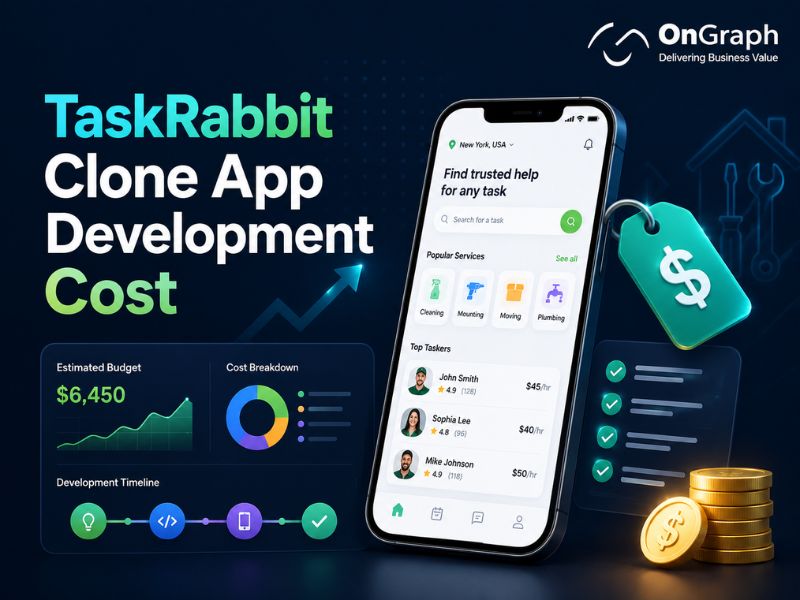
TaskRabbit Clone App Development Cost depends on app features, platforms, design, integrations, and marketplace complexity.
- An MVP usually requires a lower initial investment.
- Customer, provider, and admin applications increase scope.
- Payments, matching, maps, chat, and tracking affect cost.
- White-label platforms can support faster market entry.
- Custom development provides greater workflow flexibility.
- A detailed project scope is required for accurate pricing.
Why TaskRabbit Clone App Development Cost Requires Careful Planning
TaskRabbit Clone App Development Cost includes more than mobile application design.
A service marketplace connects customers with local professionals.
It also manages task requests, schedules, payments, communication, reviews, commissions, and customer support.
Every workflow increases design, development, testing, and maintenance requirements.
Founders must also build enough provider availability within each target location.
Without active providers, customers may face slow responses or limited service choices.
TaskRabbit’s published 2024 results demonstrate the potential scale of this marketplace model.
The United States Tasker community completed more than 1.6 million tasks during 2024.
Taskers also generated more than 936,000 five-star reviews and earned over $177 million.
These figures show the importance of completed bookings, service quality, and provider participation.
However, application development is only one part of marketplace growth.
Customer demand, provider onboarding, support, trust, and service fulfilment also need planning.
Build Your Service Marketplace With Experts
What Is a TaskRabbit Clone App?
A TaskRabbit clone app is an on-demand marketplace for local services and everyday tasks.
Customers can describe their requirements and find suitable service providers.
Providers can receive work requests, manage availability, communicate with customers, and track earnings.
The marketplace manages bookings, payments, reviews, commissions, notifications, and operational controls.
Common service categories include:
- Furniture assembly
- Cleaning services
- Moving assistance
- Handyman services
- Home repairs
- Mounting services
- Delivery support
- Yard work
- Personal assistance
- Local errands
TaskRabbit currently promotes services such as furniture assembly, moving help, mounting, cleaning, and home projects.
The word “clone” describes a similar business model.
It should not mean copying another company’s branding or proprietary product assets.
Your platform should use original branding, custom workflows, and an independent user experience.
Brand and Trademark Disclaimer
TaskRabbit is referenced only for educational and comparative purposes.
“TaskRabbit clone app” describes a similar on-demand service marketplace model.
It does not mean copying Taskrabbit’s trademarks, branding, interface, content, code, or proprietary technology.
AILancers is not affiliated with or endorsed by TaskRabbit.
How Much Does It Cost to Build an App Like TaskRabbit?
The cost to build an app like TaskRabbit varies because every marketplace has different requirements.
A simple application may support basic task posting, provider profiles, payments, and administration.
An advanced marketplace may include live tracking, intelligent matching, multi-region support, automated payouts, and detailed analytics.
Public estimates also vary because development companies use different assumptions.
One published estimate places development between $30,000 and $120,000.
The estimate changes according to features, platforms, integrations, and advanced capabilities.
These figures should be treated as external planning references.
They are not fixed prices or AILancers quotations.
| Development Option | Typical Scope | Best For | Relative Investment |
| Basic MVP | Core booking, provider profiles, payments, basic admin | Early validation | Lower |
| Growth Marketplace | Chat, maps, reviews, promotions, and detailed reporting | Growing startups | Medium |
| White-Label Platform | Prebuilt workflows with brand customization | Faster launch | More predictable |
| Custom Marketplace | Unique workflows and integrations | Differentiated business models | Higher |
| Enterprise Platform | Multi-region operations, automation, and advanced roles | Large businesses | Highest |
The final TaskRabbit clone app development cost depends on your exact product scope.
A detailed discovery process provides a more useful estimate than a broad online range.
Get Your TaskRabbit Clone App Cost Estimate
Development Cost Disclaimer
The cost references in this guide come from publicly available third-party estimates.
Actual development costs depend on features, platforms, integrations, design, security, testing, and post-launch support.
Team location and development approach may also influence pricing.
Third-party services can create additional setup and recurring charges.
Request a project-specific estimate before setting a final budget.
What Factors Affect TaskRabbit Clone App Development Cost?
Understanding a broad price range is useful.
However, founders also need to understand what changes the final budget.
The following factors usually have the greatest impact.
1. Number of Applications and Dashboards
A complete service marketplace may need several connected interfaces.
Core systems often include:
- Customer mobile application
- Service provider application
- Admin dashboard
- Customer website
Some businesses also require:
- Provider web portal
- Finance dashboard
- Customer support panel
- Operations dashboard
- Regional manager panel
Every additional interface requires design, development, access controls, testing, and maintenance.
An MVP can begin with essential customer, provider, and admin workflows.
Additional dashboards can be introduced after validating demand.
2. Customer Booking Workflow
The booking experience directly affects customer conversion.
A basic workflow may include:
- Service selection
- Task description
- Customer location
- Preferred date
- Preferred time
- Provider selection
- Price confirmation
- Payment
More advanced workflows may support:
- Instant bookings
- Scheduled bookings
- Recurring tasks
- Multiple service requests
- Service packages
- Custom task requirements
- Dynamic pricing
- Provider bidding
- Automated provider assignment
Each additional rule increases backend complexity.
Complex workflows also require more testing.
The booking journey should remain simple despite advanced functionality.
3. Provider Discovery and Matching
Customers expect relevant providers within their location.
Basic matching may use service category and distance.
Advanced systems may consider:
- Provider skills
- Service availability
- Distance
- Customer ratings
- Completion history
- Response rate
- Pricing
- Preferred working areas
Better matching can improve marketplace efficiency.
However, the system needs accurate provider data.
Advanced matching also increases development and testing requirements.
4. Payment, Commission, and Provider Payouts
A marketplace manages money between customers, providers, and the platform.
Payment workflows require careful planning.
Common features include:
- Customer payments
- Marketplace commissions
- Provider payouts
- Refund processing
- Customer tips
- Promotional discounts
- Cancellation fees
- Tax calculations
- Transaction records
- Digital invoices
Payment gateway fees are usually separate from development costs.
Payout requirements can also vary between countries.
Local financial rules may influence the final implementation.
5. Maps, Location, and Real-Time Tracking
Location features help customers find nearby professionals.
They can also improve arrival visibility.
Common capabilities include:
- Address search
- Map-based discovery
- Distance calculations
- Service areas
- Provider locations
- Estimated arrival times
- Route guidance
Live location features need mapping services and real-time infrastructure.
Third-party map providers may charge according to usage.
Start with location features that support your actual service model.
6. Communication and Notifications
Clear communication reduces booking uncertainty.
Customers and providers may need:
- In-app chat
- Push notifications
- Email updates
- SMS alerts
- Booking reminders
- Masked calling
Each communication channel may require an external service.
Usage-based charges can increase operating costs.
Your MVP may not need every communication option.
Prioritize channels that support reliable task completion.
7. Marketplace Security and Trust Features
Customers often invite service professionals into homes or workplaces.
Trust features therefore deserve careful attention.
Important capabilities may include:
- Identity verification
- Provider document review
- Profile approval
- Ratings and reviews
- Dispute management
- Account reporting
- Secure payments
- Role-based access
Verification requirements vary across regions.
Your legal and compliance teams should review local obligations.
Automated risk checks should also allow human review.
Essential TaskRabbit Clone App Features
The best feature set depends on your launch stage.
Building every possible feature can delay market validation.
Start with capabilities that support successful bookings.
Customer App Features
The customer application should make task discovery and booking simple.
Important features include:
- Email or mobile registration
- Social login
- Service category browsing
- Task posting
- Provider discovery
- Provider profiles
- Price visibility
- Booking schedules
- Secure payments
- Booking history
- In-app communication
- Notifications
- Ratings and reviews
- Customer support
Customers need clear information before confirming a booking.
Pricing, availability, and provider details should remain easy to understand.
A shorter booking journey may reduce unnecessary abandonment.
Service Provider App Features
The provider application manages work opportunities.
Important capabilities include:
- Provider registration
- Identity verification
- Skill selection
- Service area settings
- Availability management
- Task notifications
- Accept or reject options
- Route navigation
- Customer communication
- Earnings dashboard
- Payout history
- Ratings
- Support access
Provider experience affects marketplace supply.
Complicated workflows may reduce provider participation.
TaskRabbit completed more than 5,000 Tasker Success calls during 2024.
This example highlights the importance of provider guidance and operational support.
Admin Dashboard Features
The admin dashboard controls marketplace operations.
Core capabilities may include:
- Customer management
- Provider management
- Service category management
- Booking oversight
- Commission settings
- Payment tracking
- Provider payout monitoring
- Refund management
- Review moderation
- Dispute handling
- Promotion management
- Reports and analytics
- Customer support tools
- Role-based permissions
A weak admin system creates manual work.
Strong operational tools improve visibility and response times.
Enterprise marketplaces may need different permissions for regional teams.
Launch Faster With a Ready Marketplace Solution
Reduce development time with a customizable service marketplace platform built around your branding and business workflows.
Basic Versus Advanced TaskRabbit Clone App Features
| Feature | Basic MVP | Advanced Marketplace |
| User registration | Email or mobile signup | Social login and advanced account controls |
| Service categories | Standard categories | Regional and multi-level categories |
| Task posting | Basic task details | Dynamic forms and custom workflows |
| Provider profiles | Basic information | Verification, ranking, and detailed history |
| Payments | Standard payment gateway | Split payments and automated payouts |
| Communication | Basic messaging | Real-time chat and masked calling |
| Location | Address-based search | Live tracking and dynamic service areas |
| Reviews | Ratings and comments | Moderation and review analytics |
| Admin dashboard | Core controls | Multi-role operational workflows |
| Analytics | Basic reports | Advanced business dashboards |
| Smart matching | Optional | Rules-based or intelligent recommendations |
| Regional operations | Limited | Multi-city and multi-country support |
An AI-Powered Home Service App may use automation for specific workflows.
Practical use cases include:
- Provider recommendations
- Customer support assistance
- Fraud detection
- Demand forecasting
- Service suggestions
Advanced automation should solve a measurable business problem.
It should not be added only for marketing value.
Task Marketplace Versus Home Services Marketplace
A TaskRabbit-style marketplace supports flexible local tasks.
A home services platform may offer predefined service packages.
Both models share similar technical components.
Their customer journeys can still differ significantly.
| Marketplace Model | Customer Journey | Provider Workflow | Development Impact |
| Task marketplace | The customer describes a task | Provider accepts or responds | Flexible request management |
| Fixed-service marketplace | The customer chooses a package | Provider receives a defined job | Structured catalog and pricing |
| Bid-based marketplace | Providers submit offers | The customer selects an offer | Bidding and negotiation logic |
| Instant-service application | Customer requests immediate help | System assigns nearby providers | Real-time matching and availability |
| Enterprise service platform | Businesses manage multiple teams | Employees or partner providers | Advanced permissions and reporting |
The Home Services Marketplace App Development Cost depends heavily on the selected model.
A fixed-service platform may need detailed catalogs and package pricing.
A flexible task marketplace needs custom descriptions and provider matching.
Select one core model before planning advanced features.
Custom Development Versus White-Label Development
Founders often compare custom development with ready-made software.
Each approach supports different goals.
| Factor | White-Label Platform | Custom Development |
| Launch speed | Usually faster | Usually longer |
| Initial investment | Often lower | Usually higher |
| Branding | Customizable | Fully controlled |
| Workflow flexibility | Moderate | High |
| Unique integrations | May require extra work | Easier to plan deeply |
| Long-term control | Depends on the vendor | Greater |
| Best use | Market validation | Unique business requirements |
Choose white-label development when speed is the main priority.
Custom development may suit businesses with differentiated workflows.
A phased approach can also reduce early risk.
Launch essential capabilities first.
Then expand using customer and provider feedback.
Suggested TaskRabbit Clone App Development Timeline
Development time depends on project scope.
A basic MVP can launch faster than a complex marketplace.
| Project Stage | Typical Activities |
| Weeks 1–2 | Discovery, requirements, business rules, user flows |
| Weeks 3–5 | User experience and interface design |
| Weeks 5–11 | Customer and provider application development |
| Weeks 7–13 | Backend and admin dashboard development |
| Weeks 11–15 | Payments, maps, chat, and notification integrations |
| Weeks 14–17 | Testing, security checks, and issue resolution |
| Weeks 17–19 | Deployment and launch preparation |
| Post-launch | Monitoring, maintenance, and feature improvement |
This timeline is illustrative.
Your project may require less or more time.
Custom integrations and complex workflows can extend development.
White-label platforms may reduce initial implementation time.
Hidden Costs Beyond Application Development
Software development is not the complete marketplace budget.
Several operational costs begin before or after launch.
Provider Recruitment
A marketplace needs active providers within each service region.
Inactive profiles do not create customer value.
Recruitment may require:
- Local marketing
- Referral campaigns
- Service partnerships
- Provider onboarding support
Start with focused locations.
Concentrated supply can improve customer response times.
Provider Verification
Trust can influence booking decisions.
Verification may include:
- Identity checks
- Document validation
- Skill verification
- Background screening
Requirements differ by region.
Discuss legal obligations with qualified local professionals.
Customer Acquisition
A new marketplace needs local demand.
Marketing costs may vary by city and service category.
Potential channels include:
- Paid search
- Social advertising
- Local SEO
- Referral programs
- Business partnerships
Track customer acquisition by service category.
Not every category will generate equal demand.
Customer and Provider Support
Real bookings can create operational issues.
Support teams may handle:
- Delayed arrivals
- Cancellations
- Refund requests
- Failed payments
- Service complaints
- Provider disputes
Support tools should connect with booking records.
Clear workflows can reduce response times.
Third-Party Services
External technology may create recurring costs.
Common services include:
- Cloud hosting
- Maps
- Payment gateways
- SMS
- Push notifications
- Monitoring
- Analytics
Estimate these costs separately.
Usage can grow as marketplace activity increases.
Maintenance and Product Updates
Applications require continuous maintenance.
Mobile operating systems change regularly.
Third-party APIs can also update their requirements.
Plan for:
- Security updates
- Bug fixes
- Performance monitoring
- Compatibility updates
- Feature improvements
A post-launch roadmap helps manage these priorities.
Mini Case Study 1: TaskRabbit’s Marketplace Activity
TaskRabbit published several operational results for 2024.
The United States community completed more than 1.6 million tasks.
Taskers earned more than $177 million.
The platform also recorded more than 936,000 five-star reviews.
Clients reportedly saved more than 3.49 million hours. (TaskRabbit)
What Founders Can Learn
Marketplace activity should be measured through completed tasks.
User registrations alone do not prove product success.
Track service completion, customer satisfaction, and repeat bookings.
Provider earnings also affect supply quality and retention.
Mini Case Study 2: TaskRabbit and IKEA Integration
TaskRabbit expanded its IKEA integration in 2025.
Customers can book and pay for furniture assembly during the IKEA purchase journey.
The integration supports customers across major North American and European markets.
Retail coverage also reported availability in the United States, the United Kingdom, Canada, and Spain.
What Founders Can Learn
Integrated service booking can reduce customer journey friction.
Customers do not need a separate booking process.
Partnerships may also create predictable marketplace demand.
Your platform should allow future business integrations.
Real-World Service Marketplace Models to Study
Different marketplaces solve different customer problems.
Study their models without copying their branding or proprietary assets.
Taskrabbit
Study flexible task requests and local provider discovery.
Its marketplace demonstrates task-based booking and customer reviews.
IKEA Assembly Integration
Study service booking during product checkout.
This model connects retail purchases with fulfilment services.
Thumbtack
Study local professional discovery.
Its model helps customers compare providers across multiple categories.
Angi
Study homeowner-focused service discovery.
The platform connects customers with professionals for home projects.
Handy
Study structured cleaning and household service bookings.
Its model focuses on common home service requirements.
Urban Company
Study predefined service categories and packaged experiences.
Its customer journey differs from open task posting.
Each model offers useful lessons.
Your product should match your target audience and operational strengths.
Step-by-Step Framework to Build a TaskRabbit Clone App
Step 1: Choose One Launch Market
Begin with one city or a focused service area.
Local provider density matters.
Avoid spreading a limited supply across many regions.
Step 2: Select Initial Service Categories
Choose categories with clear local demand.
Start with three to five categories.
A focused launch reduces operational complexity.
Step 3: Define Your Provider Model
Decide who will complete customer tasks.
Providers may be freelancers, businesses, employees, or verified partners.
The model affects onboarding, pricing, payouts, and legal requirements.
Step 4: Select Your Booking Model
Choose between flexible task posting and predefined services.
Decide how providers receive work.
Document pricing, cancellation, and refund rules.
Step 5: Prioritize MVP Features
Build essential customer, provider, and admin workflows.
Avoid unnecessary features during initial validation.
Use real customer feedback for later development.
Step 6: Plan Marketplace Payments
Define your commission structure.
Set provider payout schedules.
Document refund and cancellation processes.
Step 7: Test Real Booking Scenarios
Test successful bookings first.
Then test difficult cases.
Include:
- Failed payments
- Customer cancellations
- Provider cancellations
- Delayed arrivals
- Refund requests
- Service disputes
Step 8: Launch With Controlled Provider Supply
Onboard providers before major customer promotion.
Confirm service availability in each target area.
Monitor task response times.
Step 9: Measure Marketplace Performance
Track:
- Booking requests
- Completed tasks
- Provider response rate
- Cancellation rate
- Repeat customers
- Average booking value
- Provider retention
- Customer ratings
Step 10: Expand After Validation
Add categories gradually.
Enter new regions after validating local demand.
Use real marketplace data before adding advanced features.
How TaskRabbit-Style Marketplaces Generate Revenue
Your revenue model affects application features.
Common options include:
- Commission per completed task
- Customer service fees
- Provider subscription plans
- Featured provider listings
- Lead fees
- Priority placements
- Cancellation charges
- Business partnerships
Start with a simple revenue model.
Avoid complicated pricing during the early launch stage.
Customers and providers should understand every fee.
Transparent pricing can support marketplace trust.
How to Choose an On-Demand Service App Development Company
The right development partner should understand marketplace operations.
Technical ability alone is not enough.
Ask these questions:
- Have you developed service marketplace applications?
- Can you build customer and provider workflows?
- Do you support custom admin dashboards?
- Can you integrate payments and provider payouts?
- How do you manage real-time communication?
- Can the platform support multiple regions?
- What post-launch support is available?
- How are third-party costs estimated?
- Who owns the application code?
- How do you approach security testing?
A reliable on-demand service app development company should explain trade-offs clearly.
The team should identify unnecessary features.
It should also connect technical decisions with business goals.
Build a TaskRabbit-Style Marketplace With OnGraph
OnGraph helps businesses build branded on-demand service marketplace applications.
Our solution can support customer, provider, booking, payment, and marketplace management workflows.
You can discuss:
- Customer application development
- Service provider application development
- Admin dashboard development
- Task booking workflows
- Service category management
- Payment integration
- Provider management
- Custom branding
- Marketplace customization
- Launch planning
Not Sure Which Development Model Fits Your Business?
Key Takeaways
- TaskRabbit Clone App Development Cost depends on the project scope.
- MVP development may reduce initial investment.
- Customer, provider, and admin systems form the core platform.
- Payments and provider matching require careful planning.
- White-label software may support faster market validation.
- Custom development provides greater workflow control.
- Provider availability can matter more than feature quantity.
- Marketplace operations require a separate budget.
- Trust depends on service quality and customer support.
- A detailed project scope provides the most useful estimate.
Final Thoughts
TaskRabbit Clone App Development Cost should be evaluated as a complete marketplace investment.
The platform connects customers with local service providers.
However, technology alone does not create marketplace success.
You also need active providers, customer demand, trust, support, and reliable fulfilment.
Start with focused services and one target market.
Build essential workflows before adding advanced capabilities.
Use actual booking data to guide future development.
A phased launch can reduce unnecessary spending.
It can also improve product decisions.
The strongest marketplace is not always the most complex.
It is the platform that helps customers book reliable services consistently.
FAQs
The TaskRabbit Clone App Development Cost depends on the number of applications, features, integrations, design complexity, and development approach.
A basic MVP usually includes:
- Customer application
- Service provider application
- Admin dashboard
- Task posting
- Booking management
- Payments
- Ratings and reviews
- Notifications
An advanced marketplace may also include live tracking, automated payouts, smart provider matching, multi-city operations, analytics, subscriptions, and custom integrations.
Public development estimates vary because every project uses a different scope. A white-label solution may reduce launch time, while custom development usually requires deeper planning and a larger budget.
The most accurate estimate comes after defining your service categories, target region, required platforms, and business workflows.
A TaskRabbit-style marketplace should include separate features for customers, service providers, and administrators.
Customer app features may include:
- User registration
- Service category browsing
- Task posting
- Provider discovery
- Booking schedules
- Secure payments
- In-app chat
- Booking history
- Ratings and reviews
- Notifications
Provider app features may include:
- Provider onboarding
- Identity verification
- Skill selection
- Availability management
- Task requests
- Job acceptance
- Navigation
- Earnings tracking
- Payout history
- Customer communication
Admin dashboard features may include:
- User management
- Provider management
- Service category control
- Booking monitoring
- Commission settings
- Payment and payout tracking
- Refund management
- Reports and analytics
- Dispute handling
Start with essential booking workflows. Advanced features can be added after validating demand.
The development timeline depends on app complexity, platforms, integrations, and customization requirements.
A basic MVP may take several months.
A custom marketplace with customer and provider applications, admin dashboards, payments, maps, chat, analytics, and advanced workflows can require more time.
A typical development process may include:
- Discovery and requirement planning
- User experience and interface design
- Customer application development
- Provider application development
- Backend and admin dashboard development
- Third-party integrations
- Quality testing
- Deployment and launch preparation
White-label platforms may support faster market entry because many core features are already available.
Custom development usually takes longer but provides greater control over workflows, branding, and integrations.
A white-label solution and custom development serve different business goals.
A white-label TaskRabbit clone app may be suitable when you need:
- Faster launch
- Lower initial development effort
- Standard marketplace features
- Custom branding
- Predictable implementation
Custom development may be better when you need:
- Unique booking workflows
- Special pricing rules
- Custom provider matching
- Complex integrations
- Multi-region operations
- Greater long-term flexibility
Startups often use white-label software to validate demand quickly.
Businesses with unique operating models may prefer custom development.
The right choice depends on your budget, timeline, customization needs, and growth strategy.
Several technical and business factors influence the final cost.
The most important factors include:
- Number of applications and dashboards
- Android, iOS, and web platform requirements
- Customer booking workflows
- Provider matching logic
- Payment gateway integration
- Provider payouts and commissions
- Maps and live tracking
- In-app chat and notifications
- Admin dashboard complexity
- Security and verification features
- Third-party integrations
- Post-launch maintenance
A single-city MVP with limited categories usually costs less than a multi-region marketplace.
Advanced features can also increase development and testing requirements.
Founders should define the launch scope before estimating the budget. This helps avoid unnecessary features and improves cost planning.
About the Author

Let’s Create Something Great Together!
Latest Blog

Let’s have a conversation today!


India
ONGRAPH TECHNOLOGIES PRIVATE LIMITED,
SDF L-1, NSEZ,
Sector 81, Block L, Phase-2,
Noida, Uttar Pradesh-201305

USA
OnGraph Technologies,
120 Bethpage Rd, Suite 304,
Hicksville, NY 11801, USA

Canada
7-1039 CEDARGLEN GATE,
Mississauga, Ontario,
Canada L5C 3A7

UK
89 Banstead Road South,
Sutton, Surrey, SM2 5LH
United Kingdom

Malaysia
G-3A, Amaya Maluri, Jalan
Jejaka 2, Taman Maluri,
KL–55100, Malaysia

Singapore
10 Anson Road,#26-04
International Plaza,
Singapore (079903)