


In this article
- Why Founders Are Choosing a White-Label Dating App Instead of Building From Scratch
- What a White-Label Dating App Actually Means
- Who Should Consider This Model
- Why This Approach Works Better in Niche Markets
- White Label vs Custom Dating App Development
- What Makes the Best White Label Dating Platform Worth Choosing
- The Biggest Mistake: Launching a Generic Dating App
- Features That Matter Most in Early Launches
- How AI Can Add Real Value Without Overcomplicating the App
- How to Launch Without Wasting Budget
- Mini Case Example 1: Diaspora Community Dating App
- Mini Case Example 2: Serious Relationship Platform
- How to Choose the Right Development Partner
- Signs You Are Ready to Move Forward
- Key Takeaways
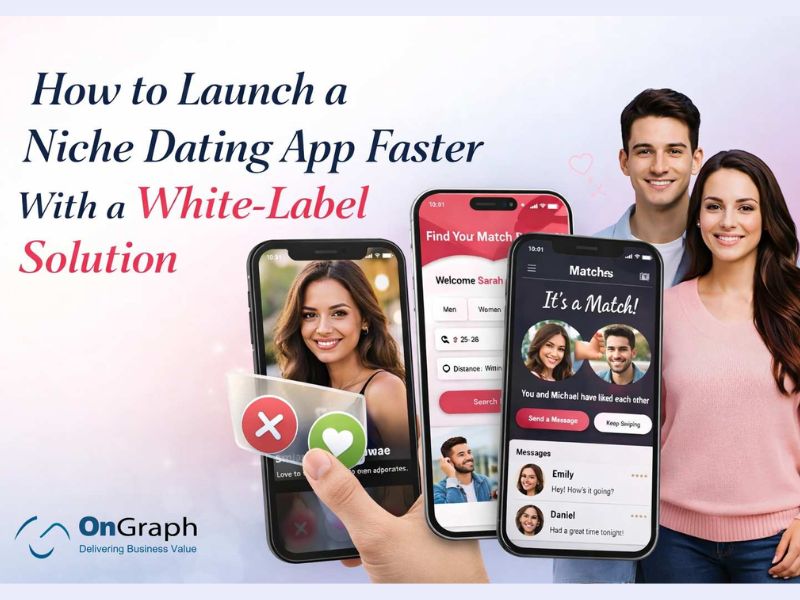
To launch a niche dating app faster, a white-label dating app can be the most efficient and low-risk approach. It allows you to validate demand, reduce development complexity, and enter the market without long delays. Instead of copying a mass-market app blindly, the smarter strategy is to combine a battle-tested backend, focused branding, unique features, and a clear go-to-market plan tailored to your target community.
In this guide, you will learn:
- When a white-label model makes sense for a dating startup
- How to avoid building too much too early
- What features matter most in a niche dating platform
- How to reduce launch risk in a small or targeted market
- How to choose the right development partner and rollout plan
Why Founders Are Choosing a White-Label Dating App Instead of Building From Scratch
Launching a dating product sounds simple until the real work begins. You need user onboarding, profile flows, matching logic, chat, moderation, admin controls, subscription setup, analytics, scalability, and app store readiness. That is why many founders now start with a white label dating app instead of spending months building a product from zero.
A ready foundation helps you move faster, test the market earlier, and avoid wasting budget on core features that users already expect.
For many early-stage founders, the real question is not whether they need a dating app. The real question is whether they should invest in full custom development before they know the market will respond. In many cases, the answer is no.
A white-label model gives you a practical middle path. You get a tested product base, then customize the experience around your audience, brand, and monetization model.
Launch Your Dating App Faster
What a White-Label Dating App Actually Means
A white label dating platform is not just a logo swap. A serious solution usually includes a pre-built backend, standard user flows, admin controls, and a mobile app structure that can be customized for different brands and business models.
That usually means you can launch with:
- Android and iOS apps
- Admin panel
- Profile and onboarding flows
- Discovery and matching logic
- Chat and engagement features
- Payment and subscription readiness
- Moderation and reporting tools
The best results come when founders treat white label as a launch accelerator, not as a shortcut to a generic app.
Who Should Consider This Model
This model is a strong fit for founders who want to launch faster but still need room for differentiation.
A white-label dating app development company is often the right choice for:
- Startups entering a niche community or regional market
- Founders validating demand before a large investment
- Businesses that want branding and customization without six months of engineering
- Teams that need Dating App Development Solutions with lower technical risk
- Entrepreneurs launching diaspora, community, faith-based, event-based, or interest-based dating products
It is especially useful when the target audience is narrow and early traction matters more than building a complex feature set from day one.
Why This Approach Works Better in Niche Markets
A niche dating app usually succeeds or fails based on one thing: whether users find enough relevant matches quickly.
This is where white label dating software becomes valuable. It helps you focus on the things that actually drive early traction:
- Audience positioning
- Onboarding quality
- Search radius and filters
- Trust and moderation
- Branding that fits the niche
- One or two truly differentiating features
For example, a niche app for Indian professionals in Europe needs a different product feel than a casual mainstream app. The same is true for apps built around serious relationships, language exchange, culture-based matching, or community-first dating.
White Label vs Custom Dating App Development
Many founders compare white-label and custom development only on cost. That is too narrow. The smarter comparison is speed, risk, flexibility, and market timing.
| Factor | White Label Dating App | Custom Build From Scratch |
| Launch time | Faster | Much longer |
| Initial budget risk | Lower | Higher |
| Core feature readiness | Already available | Must be built |
| Custom branding | Yes | Yes |
| Deep product flexibility | Moderate to high, depending on provider | Highest |
| Validation speed | Strong | Slower |
| Technical uncertainty | Lower | Higher |
If your goal is to validate, launch, and improve based on real users, white label dating apps are often the more practical starting point.
If your goal is to invent a completely new interaction model with highly original mechanics, custom development may become necessary later.
Your Dating App, Ready in Weeks
What Makes the Best White Label Dating Platform Worth Choosing
Not every ready-made solution is good. The best white label dating platform is not the cheapest one. It is the one that helps you launch quickly without limiting your future growth.
Look for these signs:
1. A stable backend
The platform should already support core matching, chat, user management, and admin workflows reliably.
2. Customizable frontend
Your app should not look like every other clone in the market. Branding, onboarding, screens, and feature placement should be adaptable.
3. Admin control
You should be able to manage users, moderation, subscriptions, geographies, reports, and search settings from one place.
4. Scalability
Even if you start with a niche, your platform should be able to expand to more cities, countries, or communities later.
5. Store-readiness support
Dating apps can face approval challenges. Your development partner should understand what makes a submission stronger and how to shape the product accordingly.
6. Room for custom features
The right white label dating app provider should let you add features that make the product truly yours.
The Biggest Mistake: Launching a Generic Dating App
The market does not need another vague dating app with swipe, chat, and no clear reason to exist.
What works better is a focused product idea with a clear audience promise.
Examples include:
- The Dating for a diaspora community
- Dating for serious long-term relationships
- Dating around shared language or culture
- community-led dating with events
- premium curated matchmaking plus app support
- interest-based or lifestyle-based matching
Even when using private label dating software, your brand still needs a strong point of view. That is what makes marketing easier and retention stronger.
Features That Matter Most in Early Launches
Many founders ask for a large feature list too early. That often slows the launch and adds cost without improving retention.
For an MVP, focus on features that improve trust, relevance, and first-match success.
Core features
- User registration and profile setup
- Photos, bio, interests, and intent selection
- Discovery and recommendation logic
- Swipe, like, or match actions
- In-app chat
- Notifications
- Block and report tools
- Admin moderation dashboard
Smart niche features
- Culture or language filters
- Search radius controls
- Profile prompts designed for your audience
- Event-based connection flows
- Premium boosts or visibility options
- Verification options
- Onboarding questions that improve match quality
Strong Dating App Development Services should help you prioritize features based on market need, not just technical possibility.
How AI Can Add Real Value Without Overcomplicating the App
If you are planning a modern platform, an AI Dating App Development Guide should not begin with hype. It should begin with use cases.
AI makes sense when it improves user experience in clear ways, such as:
- Profile writing assistance
- Image moderation support
- Better match recommendations
- Smart prompts for conversations
- Fraud signal detection
- Support automation in admin workflows
AI should support the dating experience, not distract from it. In early-stage products, simple AI features often create more value than expensive, overly ambitious ones.
How to Launch Without Wasting Budget
A smart launch plan matters more than a long feature list.
Step 1: Choose the market carefully
Start with one clearly defined user segment. Avoid broad targeting.
Step 2: Launch with a strong niche identity
Your audience should understand immediately who the app is for and why it is different.
Step 3: Start with proven core flows
This is where white label dating platforms help. You do not need to reinvent every standard feature.
Step 4: Add one differentiating layer
That could be better onboarding, a trust system, culture filters, events, curated membership, or gamified engagement.
Step 5: Use real feedback before major custom work
Once you see how users behave, you can prioritize the next development phase more intelligently.
This is one of the biggest reasons founders prefer Dating App Development Solutions built on a tested base.
Mini Case Example 1: Diaspora Community Dating App
Imagine a founder targeting a specific diaspora community in one European country. The challenge is not technical complexity first. The real challenge is limited user density.
A full custom build may delay launch and increase investment risk. A better route is to start with a white label dating app, tailor the onboarding and community filters, and then test traction in one city or region before expanding further.
In this case, the product wins by combining:
- Quick launch
- Clear niche positioning
- Trust-focused onboarding
- Controlled geographic rollout
Mini Case Example 2: Serious Relationship Platform
Now imagine a brand positioned for users who are tired of casual apps and want something more intentional.
The best strategy here is not to overload the app with experimental mechanics. It is to use a stable dating foundation, then customize the experience around:
- Thoughtful onboarding
- Stronger profile quality
- Verification options
- Premium serious-user positioning
- Curated or guided discovery
A reliable white label dating platform makes this easier because the team can spend less time on standard features and more time on differentiation.
How to Choose the Right Development Partner
Not every agency or vendor is the same. A strong White Label Dating App Development Company should do more than show you demo screens.
They should help with:
- Product scoping
- Launch planning
- Feature prioritization
- Customization options
- Deployment support
- Post-launch improvements
- Advice around app store readiness and go-to-market logic
Ask practical questions like:
- How much of the frontend can be customized?
- What is included in the admin panel?
- What support is offered after launch?
- Can custom modules be added later?
- How does the platform handle moderation and scaling?
- What parts are fixed and what parts are flexible?
The best partner will be transparent about tradeoffs.
Start Your Dating App Today
Get a scalable white-label solution with full customization, fast deployment, and expert support for your dating app journey.
Signs You Are Ready to Move Forward
You are likely ready for a white-label launch if:
- You already understand your niche or target community
- Faster market entry is a priority
- Lower development risk matters for your investment
- Branding and customization should stay in your control
- You are planning to scale after validating the idea
If those points sound familiar, then white label dating software may be the right commercial and product decision.
Key Takeaways
- A white label dating app is often the fastest way to launch a niche dating product with lower risk.
- The best results come from combining a tested product base with a clear niche strategy.
- The best white label dating platform is one that supports customization, scalability, moderation, and future feature growth.
- A smart founder does not just compare build cost. They compare speed, validation, and market timing.
- Good Dating App Development Services should help you launch lean, differentiate early, and improve the product with real user feedback.
FAQs
To launch a niche dating app faster, start with a white label dating app instead of building from scratch. This reduces development time from months to weeks. Focus on a clearly defined audience, customize branding and onboarding flows, and launch with core features like matching, chat, and discovery. Then iterate based on real user feedback rather than delaying launch for perfection.
Yes, for most early-stage founders, a white label dating platform is a practical choice. It reduces upfront cost, speeds up time-to-market, and minimizes technical risk. Instead of investing heavily in building basic features, startups can focus on growth, positioning, and user acquisition—areas that actually determine success in dating apps.
The cost depends on the approach. A fully custom build can take months and cost significantly more due to backend, frontend, and infrastructure development. A white label dating app provider typically offers a more cost-efficient option by reusing a tested backend and customizing the frontend, helping startups launch at a lower initial investment.
A niche dating app should prioritize:
- Profile creation and onboarding
- Smart matching or discovery system
- In-app chat
- Location or radius-based search
- Moderation and reporting tools
Beyond that, add niche-specific features such as cultural filters, event-based matching, or gamification. Strong Dating App Development Solutions focus on relevance and engagement rather than feature overload.
User acquisition starts before launch. Focus on:
- building a community (WhatsApp, social groups, events)
- onboarding early users manually
- targeting a very specific niche
- ensuring users get matches quickly
Dating apps succeed when they solve the “empty app problem.” A white label dating app helps you launch quickly so you can start solving this early.
Yes, but only if you solve the user density problem. Start with a focused audience in one region, ensure enough active users to generate matches, and expand gradually. Many successful platforms began with small, dense communities before scaling globally.
The best white label dating platform is one that offers:
- a stable backend
- customizable frontend
- strong admin controls
- scalability for future growth
- flexibility to add unique features
Avoid choosing purely on price. A reliable White Label Dating App Development Company should support both launch and long-term product evolution.
About the Author

Let’s Create Something Great Together!
Latest Blog
Let’s have a conversation today!


India
ONGRAPH TECHNOLOGIES PRIVATE LIMITED,
SDF L-1, NSEZ,
Sector 81, Block L, Phase-2,
Noida, Uttar Pradesh-201305

USA
OnGraph Technologies,
120 Bethpage Rd, Suite 304,
Hicksville, NY 11801, USA

Canada
7-1039 CEDARGLEN GATE,
Mississauga, Ontario,
Canada L5C 3A7

UK
89 Banstead Road South,
Sutton, Surrey, SM2 5LH
United Kingdom

Malaysia
G-3A, Amaya Maluri, Jalan
Jejaka 2, Taman Maluri,
KL–55100, Malaysia

Singapore
10 Anson Road,#26-04
International Plaza,
Singapore (079903)