

In this article
- Why the Market Calls for It?
- What Drives the Dating App Development Cost?
- Typical Cost Ranges for 2025
- Feature Checklist: Map Your Scope
- Two Mini Case Studies
- Build Model Options: White Label vs Full Custom
- Monetization Strategies That Affect Cost Recovery
- Security, Privacy & App Store Approval
- Post-Launch & Maintenance Costs
- ROI Example (Quick Math)
- Choosing the Right Development Partner
- Launch Check-List Before Requesting a Quote
- Final Thoughts
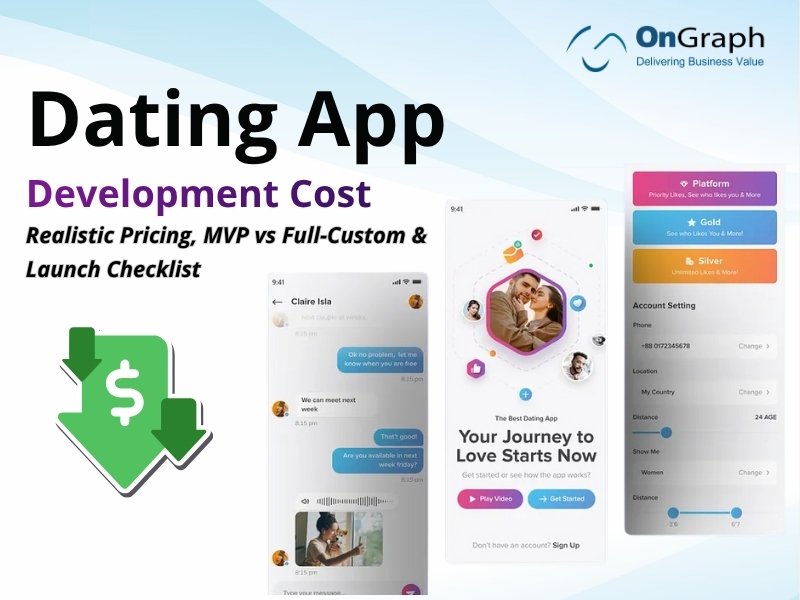
When you’re estimating dating app development cost, the number you hear depends heavily on what you’re building: a simple MVP or a fully-featured custom platform.
Basic versions may begin in the $25,000-$50,000 range, while feature-rich platforms can easily exceed $100,000 or more.
Understanding this cost is critical before you approach a dating app development company or sign a contract for dating app development services.
Why the Market Calls for It?
The global online dating market continues to grow, offering strong potential for entrepreneurs. For example:
- The global online dating applications market was valued at around $7.5 billion in 2021 and is expected to grow steadily.
- More users are comfortable using mobile apps for relationships, not just casual chats.
Given this growth, knowing your cost structure helps you position your product, whether you aim to build a dating app like Tinder or target a niche community with a passion-based dating app with AI.
What Drives the Dating App Development Cost?
Several major factors interact to determine your cost:
Platform & Technology
- Building native iOS + Android is more expensive than a single platform. Cross-platform frameworks (e.g., Flutter, React Native) can reduce cost.
- The technology stack (backend, real-time chat, video streams, AI engines) adds significant cost.
- Third-party integrations (payments, geolocation, push notifications) also add licensing or API usage costs.
Features & Complexity
- Basic features: user registration, profile creation, photo uploads, matching algorithm, chat.
- Advanced features: video calling, live speed dating events, AI matchmaking, event scheduling, advanced filters, and multi-community support.
Each incremental feature increases development time, testing, and maintenance.
Design & User Experience
- A clean, intuitive UI/UX can increase user retention, especially in dating apps. Custom animations, advanced UI flows, and polished brand identity raise design cost.
Team Composition & Location
- Hourly rates vary by region. For example, developers in North America may charge significantly more than developers in Eastern Europe or India.
- Larger or more experienced teams cost more but may reduce risk.
Scalability, Security & Compliance
- Dating apps handle sensitive user data (photos, preferences, location). So security, moderation tools, privacy compliance (GDPR, CCPA), and backend infrastructure scale all contribute to cost.
Maintenance & Ongoing Costs
- The initial build is just part of the cost. After launch, you’ll need hosting, bug fixes, feature updates, user acquisition, and moderation support. Some reports suggest annual maintenance at ~15-20% of the initial build cost.
Typical Cost Ranges for 2025
Here are ballpark ranges, based on current market benchmarks:
- MVP / Basic Build: ~$25,000-$50,000. Provides core features (profiles, basic matching, chat).
- Mid-Level App: ~$50,000-$120,000. Adds payments, richer matching, event scheduling, and moderate UI/UX polish.
- Full-Custom / Scale-Ready: ~$120,000-$400,000+. Includes AI matching, video calls, live events, heavy backend scale, multiple communities, and advanced moderation.
Keep in mind these are estimates; actual cost depends on your unique requirements.
Feature Checklist: Map Your Scope
Below is a more detailed checklist to help scope features and estimate your budget:
Core Features (MVP)
- User registration (email/social login)
- Profile creation & editing (photos, interests)
- Browse/match logic (swipe, list, filters)
- Mutual match notification
- In-app messaging (text chat)
- Launch on one platform (iOS or Android)
- Basic admin dashboard (user management)
Mid-Tier Additions
- Payment/subscription integration (premium features)
- Push notifications & email workflows
- Calendar/scheduling module (for speed-dating events)
- Basic video call functionality
- Advanced filters & search options
- Profile verification (photo ID or selfie)
- Analytics dashboard (basic metrics)
Advanced Features (Full Custom)
- AI-based matching (preference learning, behaviour models)
- Real-time video speed-dating rooms with timers
- Multi-community support (niche segments)
- Gamification / interactive features (gifts, events)
- Social feed or stories features
- Full admin/moderation panel (flagging, audio/video moderation)
- Scalability to tens of thousands of concurrent users
- Multi-platform web + mobile + PWA support
Use this list to prioritize what you launch first and what you defer.
Two Mini Case Studies
Case Study 1 – Niche Community MVP
A startup launched a passion-based dating app with AI targeted at a specific cultural community.
They opted for an MVP focusing on curated user lists, mutual matches, and scheduling mini speed-dating sessions.
Time: three months.
Cost: ~$40,000. They used feedback from early users to plan the next phase of features.
Case Study 2 – Scale & Feature-Rich Platform
Another team aimed to build a dating app like Tinder, but niche-focused. They invested in full custom features: AI matching, video rooms, and multiple community modules.
Time: ~9-12 months.
Cost: ~$180,000+. They had to invest in backend scalability and moderation.
The investment paid off with higher ARPU and paid user conversions in the niche.
These examples illustrate the trade-off between speed to market and depth of features.
Build Model Options: White Label vs Full Custom
When considering your project, you’ll typically pick between two models:
White Label
- Uses an existing base platform modified for your brand and niche.
- Faster to market, lower cost, less customization.
- Good for testing your idea quickly.
- May limit certain features or flexibility.
Full Custom
- Built from scratch or heavily customised.
- Costs more and takes longer—but you get unique workflows, full control.
- Better if you plan to scale, have unique features (e.g., speed-dating schedule, niche community workflows, AI matchmaking).
Decide based on your budget, timeline, and product differentiation goals. A reputable dating app development company can help you analyse which route fits you best.
Ready to Build a Dating App That Stands Out? Get Your Free Project Estimate!
Monetization Strategies That Affect Cost Recovery
Strong monetization reduces your payback period and justifies a higher build cost. Here are strategies to consider:
- Subscription or tiered premium membership (e.g., “premium speed-dating access”)
- Pay-per-event (charge users for joining a speed-dating event)
- In-app purchases (virtual gifts, boosts, featured profile)
- Advertisements (carefully integrated to not impact UX)
- Affiliate/partner offers (community-specific partnerships)
When you plan monetization early, you can build features to support it (e.g., payment gateway, event scheduling module) and thus influence dating app development cost in a positive ROI way.
Security, Privacy & App Store Approval
Because you’re handling personal data, sensitive content, and real human connections, proper security and policy compliance are critical.
- Use SSL/TLS encryption for data in transit.
- Secure photo uploads and store securely.
- Optimize for moderation (flagging, review).
- Draft clear Terms of Service and Privacy Policy.
- For iOS/Android: meet store guidelines for dating apps (which are stricter than many categories).
Failure to prepare these may lead to store rejection or user trust issues, both of which increase cost indirectly.
Post-Launch & Maintenance Costs
A common mistake: budgeting only for build, not ongoing operations.
Post-launch, you should budget for:
- Hosting and infrastructure scaling
- Bug fixes, OS updates, and new device support
- New feature development based on user feedback
- User acquisition/marketing spend
- Customer support and moderation
As noted, ongoing costs can be ~15-20% of the initial build cost annually.
ROI Example (Quick Math)
Imagine you build a mid-tier app at $80,000.
If your premium subscription is $8 per month, and you aim for 1,000 paying users in month 12, → monthly revenue = $8,000 → annualized ~$96,000.
That pays off the build in ~12-14 months (excluding marketing).
Of course, this is simplified — acquisition cost, churn, and operational expense need to be factored. But this shows how monetization can justify the initial dating app development cost.
Choosing the Right Development Partner
When you engage a dating app development company, look for:
- Portfolio of dating/social apps or similar networking platforms
- Experience with both MVP and scale builds
- Good understanding of security, moderation, and data privacy
- Clear cost breakdowns (features, team hours, geo location of team)
- Post-launch support and maintenance terms included
- Transparent monetization and analytics capability
Ask for quotes, ask for references, and examine their working style.
Launch Check-List Before Requesting a Quote
- Define your target audience and niche (e.g., cultural community, interest-based network)
- List must-have features vs nice-to-have features
- Choose platforms (iOS, Android, both)
- Determine monetization model (subscription, events, purchases)
- Determine team/partner location and budget range
- Define the MVP launch timeline and roadmap for future versions
Prepare compliance/privacy/policy documentation
This checklist will help vendors provide more accurate estimates and reduce hidden costs.
Final Thoughts
Estimating the dating app development cost correctly is fundamental to success. A lean MVP allows you to test, learn, and iterate.
If you aim for a niche or highly differentiated product (for example, a passion-based dating app with AI or a scheduling-centric “speed-dating” model), a higher-budget custom build may make sense.
Choose your dating app development company wisely, align your roadmap with a monetization strategy, and include both build and ongoing operational costs in your financial planning.
When done right, your app could tap into a growing market and deliver meaningful returns.
FAQs
For an MVP version of a dating app, you’re typically looking at ~$25,000-$50,000 (USD) depending on region, features, and technology stack. This cost usually covers one platform (iOS or Android), basic user flows: registration, profiles, matching algorithm, chat, basic admin panel. Regions with lower hourly rates may allow lower budgets; higher cost regions or native dual-platform builds push the price up. However, it’s important to remember that MVP doesn’t include advanced features (video calls, AI matching, live events) — these must be budgeted separately. Starting with an MVP allows you to test audience demand, gather feedback and validate monetization before investing heavily.
The biggest cost drivers include:
- The number and complexity of features (swipe, mutual match, video, AI) — advanced features significantly increase hours.
- Platform choice: building for both iOS & Android (or web) vs one platform. Using native tech increases cost vs cross-platform alternatives.
- Team location & size: hourly rates vary by geography. A US/Canada team may cost 2-3× that of an Eastern Europe/South Asia team.
- Backend architecture & scalability: if you expect many concurrent users, complex backend and infrastructure adds cost.
- Security, moderation, compliance: dating apps require strong moderation, safety flows, data privacy — these add both development and maintenance costs.
- UI/UX design: custom designs, animations, complex flows cost more than template-based design.
- Maintenance and ongoing operations: hosting, updates, new devices, bug fixes — if not planned early, lead to cost overruns.
Choosing between white label and full custom depends on your budget, timeline, and differentiation strategy.
- White label: uses a pre-built platform you rebrand and slightly customise. It keeps dating app development cost lower and reduces time to market. Good for validating ideas or when features are standard.
Pros: faster launch, lower cost, proven base platform.
Cons: less flexibility, may share backend logic with other clients, limited uniqueness. - Full custom: built from scratch (or heavily customised). Higher cost and longer build time but gives full control over features, UI, workflow, and can better support niche or unique ideas (e.g., speed-dating event model, custom algorithms, community segmentation).
Pros: high differentiation, full control, better scalability.
Cons: higher cost, risk if scope not tightly managed.
If your business model requires unique workflows (such as curated mutual match + speed events + niche community), a custom build may justify the cost. If you want to get to market quickly and test, white-label might be suitable for your first version.
Integrating AI features such as preference learning, behaviour modelling, suggestion algorithms, or smart matching does add to the cost.
Typical cost increases: anywhere from 20–60% or more above a basic matching algorithm depending on complexity.
Why? Because you need:
- Data engineering (user data, preferences, matches)
- Model design, training, validation
- Additional backend infrastructure for AI compute
- Ongoing tuning and maintenance of the algorithms
However, AI can boost user engagement, retention, and ultimately monetization — making it a strategic investment if you have strong product-market fit and user base growth plan.
Time to build depends on scope. Typical estimates:
- MVP/basic version: 2-4 months
- Mid-range app: 4-8 months
Full custom, scale-ready app: 9-12 months or more. Time increases with number of platforms (iOS + Android + web), complexity of features (video, events, AI), and team size/efficiency. When choosing a vendor, ask for a realistic timeline plus buffer for QA, iterations, and store review processes (especially for App Store). Launching sooner with a lean MVP lets you validate and iterate faster.
Here are strategies to reduce cost while retaining quality:
- Clearly prioritise features: launch must-haves first and defer “nice-to-haves”.
- Use cross-platform development (Flutter/React Native) if brand and UX allow.
- Choose an experienced dating app developers team that knows this market niche — fewer risks = fewer reworks.
- Use third-party components/APIs for chat, payments, geolocation rather than building from scratch.
- Outsource to cost-effective regions or mix local + offshore teams.
- Build in phases: MVP → user feedback → iteration → scale. This avoids over-investing before product-market fit.
- Plan maintenance and operations early so you don’t hit cost surprises later.
- Monitor metrics and iterate based on user behaviour rather than adding features by assumption.
About the Author

Let’s Create Something Great Together!
Latest Blog
Let’s have a conversation today!


India
ONGRAPH TECHNOLOGIES PRIVATE LIMITED,
SDF L-1, NSEZ,
Sector 81, Block L, Phase-2,
Noida, Uttar Pradesh-201305

USA
OnGraph Technologies,
120 Bethpage Rd, Suite 304,
Hicksville, NY 11801, USA

Canada
7-1039 CEDARGLEN GATE,
Mississauga, Ontario,
Canada L5C 3A7

UK
89 Banstead Road South,
Sutton, Surrey, SM2 5LH
United Kingdom

Malaysia
G-3A, Amaya Maluri, Jalan
Jejaka 2, Taman Maluri,
KL–55100, Malaysia

Singapore
10 Anson Road,#26-04
International Plaza,
Singapore (079903)