


In this article
- Why is This Category Becoming More Attractive?
- Which Businesses Should You Target First?
- What Makes a Strong White-Label AI Receptionist Platform?
- Build Vs Customize Vs White-Label
- The MVP that Actually Makes Sense
- Two Real Examples that Show What Good Looks Like
- The Biggest Mistakes to Avoid
- How to Differentiate Before Launch?
- Key Takeaways
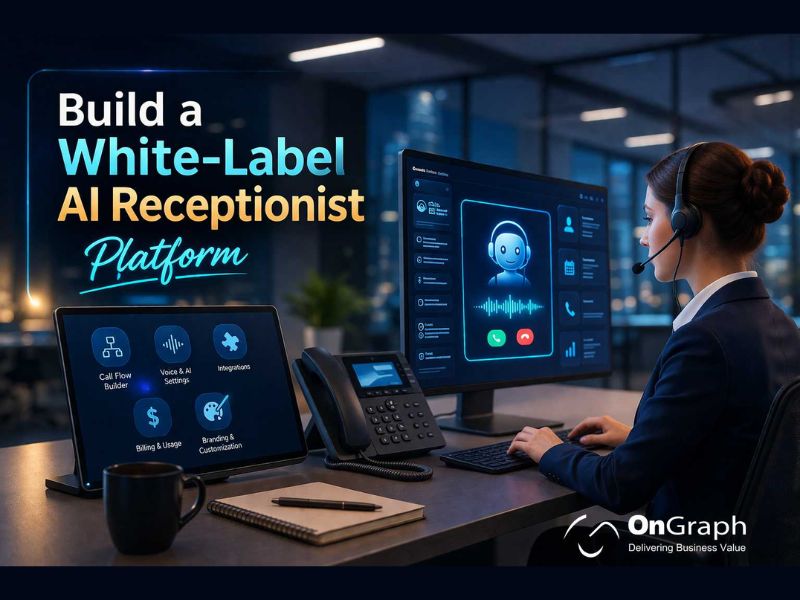
Build a White-Label AI Receptionist Platform is no longer just a technical idea. It is a practical business opportunity for companies that want to solve missed calls, automate appointment handling, and support inbound customer communication at scale. A white-label AI receptionist platform is more than an AI voice demo.
It is a working system for answering calls, qualifying intent, collecting caller details, and booking the next step. That matters because missed calls still create real revenue leakage in legal, dental, and home service businesses.
Clio says 35% of calls from prospective legal clients go unanswered, while Housecall Pro cites data showing home service businesses miss about 27% of inbound calls.
That creates a clear market need. Buyers do not want a general-purpose bot. They want a front desk that sounds natural, follows business rules, and updates the tools they already use. This is also why demand for AI voice agent development services continues to grow among founders, agencies, and service businesses looking for more than a simple chatbot.
Why is This Category Becoming More Attractive?
The market tailwind is strong. Salesforce says 50% of service cases are expected to be resolved by AI by 2027, up from 30% in 2025. Gartner predicts agentic AI will resolve 80% of common customer service issues by 2029, with a 30% cut in operating costs.
At the same time, customer patience is weaker. Twilio says 64% of customers see personalized engagement as critical to buying decisions. Twilio also says only 44% of consumers now describe themselves as highly loyal to brands, down from 48% the year before.
For appointment-based businesses, that means one thing. If the first call feels slow, generic, or broken, the buyer moves on. That is one of the biggest reasons businesses are exploring AI voice agents for customer service that can answer faster, respond consistently, and support round-the-clock availability.
Build the AI Receptionist Platform Your Market Needs
Which Businesses Should You Target First?
Not every industry should be your first launch market. The best early fit is where three conditions exist:
- Calls drive revenue
- Scheduling is common
- Teams are often too busy to answer live
Law Firms
Legal intake is a strong fit because responsiveness is weak across the industry. Clio says 42% of the time, firms take three or more days to respond to a new prospect. It also reports that 86% of firms fail to collect an email address and 45% fail to collect a phone number on an initial call.
Dental Practices
Dental is a fit because the phone call often starts the patient relationship. The ADA advises practices to capture the reason for the call, urgency, recent visit date, availability, and medical issues during intake. That is structured work, which makes it suitable for AI-assisted workflows.
Healthcare Practices
Healthcare is another strong segment, especially for clinics that handle a high volume of repetitive front-desk calls. An AI Voice Agent for Healthcare can support appointment booking, intake routing, follow-up reminders, and common non-emergency queries. However, this segment requires tighter workflow controls, better escalation logic, and careful handling of patient communication.
Plumbers and Local Services
This segment is ideal because the owner is often in the field. Housecall Pro says many home service companies miss calls while doing hands-on work. ServiceTitan data also showed a typical call booking rate of 42%, which means many calls still fail to become revenue.
Also read: What Is an AI Voice Agent? Use Cases, Benefits & How It Works
What Makes a Strong White-Label AI Receptionist Platform?
Many products stop at voice generation and prompt editing. That is not enough. A usable platform needs six working layers. Any experienced AI voice agent development company building in this space should think well beyond conversation quality alone.
1. Telephony and Number Management
The system must connect to phone providers, assign numbers, handle inbound routing, and support region-specific providers when needed. Without this, you cannot scale across clients or countries.
2. Speech Stack Flexibility
A serious platform should not lock you into one voice stack forever. It should let you swap STT, LLM, and TTS providers as quality, pricing, or latency changes. Voice-agent latency comes from multiple layers in the stack, so architecture choices matter early.
3. Appointment and Intake Workflows
This is the core use case. Your AI receptionist must:
- Identify the reason for the call
- Detect urgency
- Collect contact details
- Check availability
- Book or route the next step
The best tools capture high-intent leads, sync with CRM, and book appointments 24/7. This is also where businesses often realize that off-the-shelf tools are not enough and start looking for AI voice agent development services that can match their workflows more closely.
4. Knowledge Base and Answer Controls
The agent needs structured answers for hours, locations, services, insurance questions, consultation rules, emergency handling, and escalation triggers. Generic prompting alone is too brittle.
5. CRM, Calendar, and Webhook Integrations
This is where many weak products fail. A platform should push call summaries, tags, and lead status into the client’s stack. That may mean Clio, Calendly, HubSpot, Salesforce, Google Calendar, ServiceTitan, Housecall Pro, or custom webhooks.
6. Billing, Usage, and Multi-Tenant Controls
White-label products need more than one dashboard. You need:
- Tenant separation
- Usage metering
- Cost tracking
- Client billing logic
- Role-based access
- Branding controls
That is what turns a demo into a resellable product. A skilled AI voice agent development agency will usually treat these controls as core product requirements, not optional add-ons.
Launch Your White-Label AI Receptionist Faster
Build Vs Customize Vs White-Label
| Approach | Best for | Pros | Risks |
| Buy a hosted tool | Agencies testing demand | Fastest launch | Limited control and weaker differentiation |
| Customize a white-label base | Most SMB-focused resellers | Faster than full build, stronger branding, lower risk | Some platform limits remain |
| Build from scratch | Teams with product ambition and technical budget | Full control over workflow, margins, and roadmap | Highest cost, longest timeline, most operational complexity |
If your goal is to validate one market fast, a customizable white-label route is often the best first move. If your goal is long-term platform ownership, custom development becomes more attractive after you validate one repeatable workflow.
This is also where partner selection matters. A general software vendor may build features, but an experienced AI voice agent development company will think in terms of call flows, escalation rules, usage costs, analytics, and multi-client scale.
Also read- AI Voice Agent Platform & Solutions | Business FAQs Guide 2026
The MVP that Actually Makes Sense
Founders often scope too much. Start with one vertical, one inbound use case, and one handoff path.
Step 1: Pick One High-Friction Workflow
Examples:
- Law firm consultation intake
- Dental appointment booking
- Plumber overflow and after-hours calls
- Healthcare front-desk overflow
Step 2: Define the Call Outcomes
Your first MVP should do only a few things well:
- Answer the call
- Gather structured details
- Book, route, or escalate
- Save the call summary
Step 3: Set Hard Escalation Rules
Do not force full automation. Some calls need human review. Legal conflicts, medical emergencies, or complex pricing questions should escalate fast. This is especially important if you are planning an AI Voice Agent for Healthcare, where risk tolerance is lower and handoff logic matters more.
Step 4: Connect One System of Record
Choose one CRM or calendar first. Too many integrations too early slow everything down.
Step 5: Measure the Right Metrics
Track:
- Answer rate
- Booking rate
- Qualified lead rate
- Escalation rate
- No-show rate
- Cost per handled call
- Influenced revenue
Two Real Examples that Show What Good Looks Like
Mini case study 1: Plumbing and Overflow Call Capture
Twilio says Scorpion deployed voice AI that qualified leads, checked calendar availability, and booked services 24/7. One plumbing client saw $185,000 in influenced revenue within three months, with about 8% monthly revenue contribution tied to the assistant.
The lesson is simple. In home services, after-hours and overflow calls are not edge cases. They are revenue moments.
Mini case study 2: Legal Intake and Time Savings
Smith.ai says The Legacy Law Firm used 24/7 call answering, appointment scheduling, and spam blocking to support productivity and growth. The case also highlights something important. Reliability and call handling quality matter as much as automation itself.
That is why law firms need strong guardrails, clear practice-area logic, and easy escalation. It is also why many firms now evaluate AI voice agents for customer service not only for cost savings, but also for lead capture and intake consistency.
The Biggest Mistakes to Avoid
Mistake 1: Selling a Generic Bot as A Receptionist
A receptionist is workflow software. It needs business rules, not only natural language.
Mistake 2: Ignoring Vertical-Specific Intake
A dental caller, a legal prospect, a patient, and a plumbing emergency do not follow the same script.
Mistake 3: Forgetting the Economics
Receptionists and information clerks had a median wage of $17.90 per hour in May 2024, according to BLS. That does not mean AI replaces every role. It does mean buyers will compare automation against labor cost, missed-call loss, and after-hours coverage.
Mistake 4: Optimizing for Demos, Not Uptime
Buyers care about one thing first. Does it answer, log, route, and book reliably?
Mistake 5: No Human Fallback
Some interactions should always pass to a person. The best systems mix automation with smart escalation. This is where experienced AI voice agent development services create more value than a generic plug-and-play setup.
How to Differentiate Before Launch
A new white-label AI receptionist platform should not compete on “we use AI.” Everyone says that. Differentiate on one of these:
- Vertical depth: legal, dental, healthcare, or trades-specific workflows
- Better integrations: the tools your buyers already use
- Faster onboarding: live in days, not weeks
- Stronger controls: billing, tenant management, and analytics
- Better call quality: low latency and cleaner handoffs
Competitor content is crowded with feature lists. Fewer articles explain how to scope the product so it is sellable, supportable, and repeatable across clients. That is your opening.
A focused AI voice agent development agency can help founders reduce launch risk by narrowing the product to one strong use case first, instead of trying to serve every industry at once.
Build a Branded AI Receptionist Platform That Scales
Create a custom AI receptionist solution with call routing, booking flows, integrations, and multi-client management.
Key Takeaways
- A white-label AI receptionist platform is strongest when it solves missed calls, intake, and scheduling for appointment-based businesses.
- Law firms, dental clinics, healthcare providers, and local service businesses are strong first targets.
- The real product is not the voice alone. It is the workflow, routing, integrations, and billing layer.
- Start with one vertical and one narrow inbound use case.
- Add automation carefully, with human escalation for high-risk calls.
If you are evaluating this space, the safest route is to map the workflow before choosing the stack. That prevents expensive rewrites later.
If you want help planning a white-label AI receptionist MVP, choosing the right architecture, or scoping a vertical-ready product, our team can help you turn the idea into a practical launch plan.
And if you are looking for an AI voice agent development company to support custom platform planning, workflow design, and deployment, we can help define the feature set, integration roadmap, and development path needed to bring a branded solution to market faster.
FAQs
A white-label AI receptionist platform is a voice-based software solution that businesses or agencies can rebrand and resell as their own. It is designed to answer incoming calls, collect caller details, qualify leads, schedule appointments, and route conversations based on business rules. Unlike a basic AI chatbot, it is built for real front-desk workflows and usually includes telephony integration, knowledge base support, CRM sync, and usage tracking. For agencies, it creates a recurring revenue opportunity. For end clients, it helps reduce missed calls and improve response speed.
A generic AI voice tool may help with basic conversations, but it often lacks the controls needed for a real business workflow. When you build a white-label AI receptionist platform, you can tailor it for specific industries, add your own branding, control integrations, track client usage, and create a repeatable service model. This is especially useful for agencies, SaaS founders, and service providers who want to resell the product. A white-label solution also gives better flexibility for pricing, customization, and long-term product differentiation.
The best fit is usually appointment-based or call-heavy businesses. This includes law firms, dental clinics, med spas, plumbers, HVAC companies, consultants, and other local service businesses. These companies often lose leads when staff miss calls or cannot respond quickly. An AI receptionist helps by answering calls 24/7, capturing caller intent, collecting contact details, and booking the next action. Businesses with high inbound call volume and repetitive intake questions benefit the most.
A strong platform should include inbound call answering, appointment scheduling, lead capture, call routing, voicemail handling, CRM integration, calendar sync, and a knowledge base. It should also support multi-tenant management, usage analytics, branding controls, webhook support, and billing visibility. If you plan to sell it across industries, flexible configuration is critical. You should be able to change scripts, workflows, escalation rules, and voice settings without rebuilding the whole system.
An AI receptionist handles appointment scheduling by understanding the caller’s request, asking follow-up questions, checking available time slots, and confirming the booking. It can connect with tools like Google Calendar, Calendly, or a custom scheduling system. It may also capture additional details such as service type, urgency, location, or preferred time. A good system does more than just book meetings. It also updates the CRM, sends confirmation messages, and escalates special cases to a human when needed.
That depends on your goals, budget, and speed-to-market needs. If you want to validate demand fast, customizing a white-label base is usually the smarter option. It reduces development time and lets you launch sooner. If you want full product ownership, deep customization, and long-term platform control, building from scratch may be the better path. Many founders start with a focused MVP, prove demand in one niche, and then expand with custom development later.
To stand out, do not sell it as just another AI voice product. Focus on solving a specific workflow problem for a specific industry. For example, legal intake, dental bookings, or after-hours plumber call handling. Add strong integrations, easy onboarding, smart escalation rules, analytics, and reliable call quality. A clear vertical positioning makes the product easier to sell. Buyers respond better when the platform feels purpose-built for their business instead of generic.
About the Author

Let’s Create Something Great Together!
Latest Blog
Let’s have a conversation today!


India
ONGRAPH TECHNOLOGIES PRIVATE LIMITED,
SDF L-1, NSEZ,
Sector 81, Block L, Phase-2,
Noida, Uttar Pradesh-201305

USA
OnGraph Technologies,
120 Bethpage Rd, Suite 304,
Hicksville, NY 11801, USA

Canada
7-1039 CEDARGLEN GATE,
Mississauga, Ontario,
Canada L5C 3A7

UK
89 Banstead Road South,
Sutton, Surrey, SM2 5LH
United Kingdom

Malaysia
G-3A, Amaya Maluri, Jalan
Jejaka 2, Taman Maluri,
KL–55100, Malaysia

Singapore
10 Anson Road,#26-04
International Plaza,
Singapore (079903)