

In this article
- Why Salons and Spas Miss Valuable Bookings
- Why Phone Calls Still Matter in Salon and Spa Booking
- What Is an AI Voice Agent for Salons and Spas?
- How an AI Receptionist for Salons Works
- Key Use Cases of an AI Voice Agent for Salons and Spas
- Human Front Desk vs AI Voice Agent
- Mini Case Study 1: Pure MedSpa Recovered Missed Calls
- Mini Case Study 2: Automated Reminders Reduced No-Shows
- Step-by-Step Guide to Implement an AI Voice Agent
- Ready-Made Tool vs Custom AI Voice Agent
- How Much Does an AI Voice Agent for Salons and Spas Cost?
- Real-World Workflow Examples
- Features to Look for in an AI Voice Agent
- How OnGraph Can Help
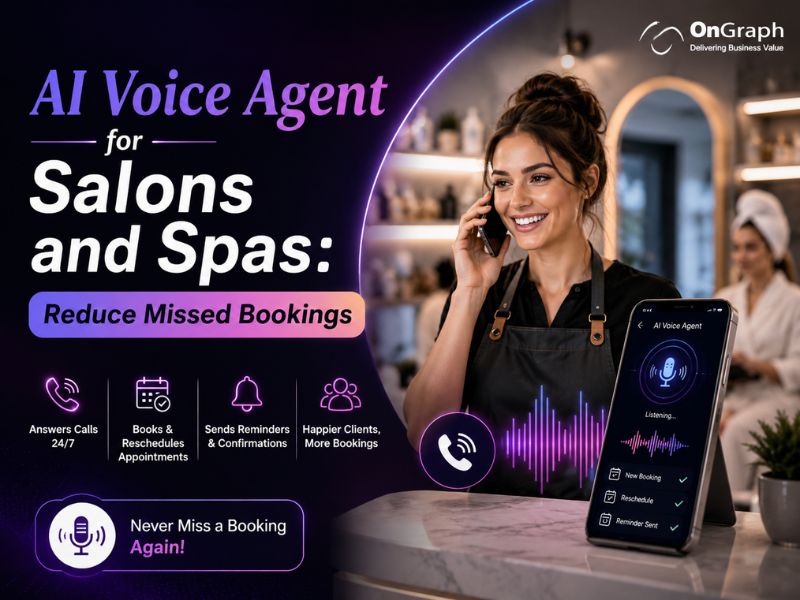
An AI Voice Agent for Salons and Spas helps beauty and wellness businesses answer calls, book appointments, manage rescheduling, and reduce missed bookings.
- It answers client calls 24/7.
- It books and reschedules appointments.
- It sends confirmations and reminders.
- It reduces front desk workload.
- It connects with booking and CRM tools.
Why Salons and Spas Miss Valuable Bookings
An AI Voice Agent for Salons and Spas solves one of the biggest hidden revenue leaks in beauty and wellness businesses: missed calls.
Salon and spa teams are usually busy serving clients, managing walk-ins, handling payments, cleaning rooms, or preparing for the next appointment. During those moments, calls often go unanswered. A missed call may look small, but it can easily become a lost haircut, facial, massage, nail service, or consultation.
Booking friction is already a serious problem. Zenoti’s 2025 survey reports that 69% of salon and spa customers skipped booking because it was difficult to reach someone or book online. For medspas, that number increased to 79%.
This shows a clear customer behavior pattern. People want fast booking access, and they do not wait for long. When a salon or spa cannot respond quickly, the client may choose another provider.
Turn Missed Salon Calls Into Booked Appointments
Why Phone Calls Still Matter in Salon and Spa Booking
Many businesses assume that online booking has replaced phone calls. That is not fully true.
Clients still call when they need appointment changes, staff recommendations, urgent rescheduling, or service clarification. Zenoti’s survey found that 77% of salon and spa regulars still believe calling is the easiest way to change an existing appointment. The same report says 52% of spa customers hang up after three minutes on hold.
This creates a difficult situation for salon owners. Clients still want phone support, but they do not want to wait. Staff want to help, but they cannot always pause in-person service.
A well-designed AI phone answering service for salons fills this gap. It answers quickly, handles routine booking requests, and transfers complex calls to staff when needed.
After-hours demand is also important. Boulevard’s salon industry data notes that around 46% of bookings happen when salons are closed. That means your booking system must work even when your front desk is offline.
What Is an AI Voice Agent for Salons and Spas?
An AI Voice Agent for Salons and Spas is a voice-based assistant that talks with clients over the phone. It understands appointment requests, checks availability, answers common questions, and completes routine booking actions.
Unlike voicemail, it does not only record messages. Compared with a basic phone menu, it can understand natural client requests. A strong voice agent can also connect with your booking calendar, CRM, POS, or custom salon software.
For example, a client may ask:
“Do you have a hair color appointment this Saturday?”
The voice agent can check available slots, ask about stylist preference, confirm the booking, and send a text confirmation.
In a spa setting, the same system can manage massage bookings, facial appointments, therapist preferences, treatment durations, and room availability.
This is why an AI receptionist for salons is more useful than basic call forwarding. It does not just answer calls. It helps turn calls into confirmed appointments.
How an AI Receptionist for Salons Works
An AI receptionist for salons follows a structured workflow. It listens to the caller, understands intent, checks business rules, and takes the next best action.
A typical salon call flow looks like this:
- The client calls your salon.
- The voice agent greets the client.
- It identifies the service request.
- The system checks available slots.
- It confirms staff or location preference.
- The booking is created.
- The client receives confirmation.
- Your team gets a call summary.
For spas, the workflow can include therapist availability, room availability, treatment type, service duration, and package rules.
A good AI receptionist for spas should also know when to stop automation. Complaints, refund requests, sensitive medical spa questions, or VIP client concerns should be routed to a human.
Key Use Cases of an AI Voice Agent for Salons and Spas
1. New Appointment Booking
New appointment calls are direct revenue opportunities. A caller may want a haircut, facial, massage, manicure, consultation, waxing service, or skin treatment.
An AI Voice Agent for Salons and Spas can check live availability and book the client immediately. It can ask for preferred date, time, service type, staff preference, and contact details.
This helps businesses capture appointments even during peak hours.
2. Rescheduling and Cancellations
Clients often call to move appointments. These calls interrupt front desk teams and can create empty slots if handled late.
With AI appointment scheduling for salons, the agent can offer new time options. It can also ask whether the client wants the same stylist, therapist, or location.
When a client wants to cancel, the system can first suggest rescheduling. This helps protect revenue and reduce calendar gaps.
3. After-Hours Appointment Capture
Many clients remember personal care tasks at night, during lunch breaks, or on weekends. If your team is unavailable, the booking may be lost.
A virtual receptionist for salons and spas can answer those calls 24/7. It can book appointments, capture callback requests, and send confirmations after hours.
This is especially useful for salons, spas, medspas, nail studios, and multi-location wellness brands.
4. Service and Pricing Questions
Clients often ask about pricing, service duration, packages, deposits, cancellation rules, and add-ons.
The voice agent can answer approved FAQs using your business information. It can also suggest the right service category based on the client’s need.
For example, someone may ask about hair smoothing. The system can explain available options and offer a consultation slot.
5. Appointment Reminders
Missed appointments affect daily revenue. Reminders help reduce no-shows and give clients a chance to reschedule early.
A case study by Emerging Global reports that El Rio Health reduced no-show rates by 32% using automated voice and SMS reminders. The healthcare setting is different, but the reminder logic applies to appointment-based businesses.
For salons and spas, voice reminders can confirm appointments, collect cancellation intent, and reopen cancelled slots for other clients.
6. Add-On and Upsell Suggestions
A booking call can also create an upsell opportunity. A client booking hair color may need a treatment. Someone booking a massage may want aromatherapy or an extended session.
The voice agent can suggest relevant add-ons during the booking flow. These suggestions should feel helpful, not pushy.
A strong salon booking automation software flow should support both convenience and revenue growth.
Automate Your Salon and Spa Booking Flow
Human Front Desk vs AI Voice Agent
| Area | Human Front Desk | AI Voice Agent for Salons and Spas |
| Availability | Limited by working hours | Available 24/7 |
| Call handling | One call at a time | Handles many calls |
| After-hours support | Usually limited | Always available |
| Booking speed | Depends on workload | Instant response |
| Rescheduling | Manual | Automated workflow |
| Reminders | Manual or tool-based | Voice and SMS supported |
| Best use | Complex client care | Routine calls and bookings |
The best model is not human versus automation. A better approach is human plus automation.
Your team should continue managing client relationships, complaints, VIP requests, and in-person service. The voice agent should handle routine calls, booking requests, reminders, and FAQs.
Mini Case Study 1: Pure MedSpa Recovered Missed Calls
Zenoti reported that Pure MedSpa used its AI receptionist to handle bookings, reschedules, and after-hours calls. According to Zenoti, the system converted 40–50% of previously missed calls into booked appointments.
This example shows why missed-call recovery matters. Many salons and spas already have demand. The real problem is that some demand disappears before staff can respond.
An AI Voice Agent for Salons and Spas helps recover that demand by answering calls immediately and guiding clients toward booking.
Mini Case Study 2: Automated Reminders Reduced No-Shows
El Rio Health used automated voice and SMS reminders to improve appointment attendance. The reported results included a 32% no-show reduction, a 45% increase in confirmations, and less staff time spent on manual outreach.
Although this case comes from healthcare, the workflow is relevant for salons and spas. Both industries depend on scheduled appointments, confirmations, and timely rescheduling.
Beauty and wellness businesses can use similar reminder flows to protect daily revenue.
Step-by-Step Guide to Implement an AI Voice Agent
Step 1: List Your Main Call Types
Start with the calls your team receives most often. Common examples include new bookings, appointment changes, cancellations, pricing questions, location details, and service recommendations.
This step keeps your first version focused. You do not need to automate every conversation from day one.
Step 2: Create a Service Knowledge Base
Your voice agent needs accurate service information. Add service names, pricing, duration, staff skills, deposit rules, cancellation policies, and package details.
For spas and medspas, include treatment categories and consultation requirements. Avoid giving medical or sensitive treatment advice through automation.
Step 3: Connect Your Booking System
The agent should check real-time availability. Without live scheduling integration, it can only collect requests.
OnGraph’s AI Voice Agent platform supports appointment booking, CRM updates, text messages, and integrations with schedulers, ERPs, and CRMs.
This makes integration the most important step after the call script.
Step 4: Define Human Handoff Rules
Some calls need staff involvement. These may include complaints, refund requests, VIP clients, medical spa questions, or complex service packages.
The voice agent should transfer these calls or create a callback task. This keeps automation helpful and safe.
Step 5: Add Confirmation and Reminder Flows
Booking is only the first step. Your system should send confirmation messages, reminder calls, and rescheduling options.
When clients cancel early, your team has more time to fill the slot.
Step 6: Track Performance Weekly
Track metrics that show real business value. Useful KPIs include calls answered, bookings created, missed calls recovered, cancellations saved, no-shows reduced, and staff time saved.
A dashboard can also show handoff rate, call intent, popular services, and after-hours booking volume.
Ready-Made Tool vs Custom AI Voice Agent
| Factor | Ready-Made Tool | Custom AI Voice Agent |
| Launch speed | Faster setup | Needs planning |
| Booking workflow | Standard | Built around your process |
| Branding | Limited | Fully customized |
| Integrations | Vendor-dependent | API-led and flexible |
| Multi-location support | Depends on tool | Custom routing possible |
| Best for | Small salons | Chains, spas, and platforms |
Ready-made tools can work for simple booking needs. They may be enough for single-location salons with standard services.
Custom AI Voice Agent Development Solutions are better when workflows are unique. They are also useful for multi-location brands, medspas, franchise networks, and businesses with custom apps.
How Much Does an AI Voice Agent for Salons and Spas Cost?
The cost depends on features, call volume, integrations, and customization level.
A simple setup may include call answering, FAQs, appointment requests, and SMS confirmation. A mid-level solution may include live booking calendar integration, CRM updates, reminders, and analytics.
Advanced systems may include multi-location routing, custom voice prompts, POS integration, staff preference logic, package rules, and multilingual support.
| Solution Type | Best For | Typical Scope |
| Basic AI receptionist | Small salons | FAQs, call capture, appointment requests |
| Booking-integrated voice agent | Growing salons and spas | Live booking, SMS, reminders, CRM sync |
| Custom voice automation platform | Chains and medspas | Multi-location routing, dashboards, APIs |
The best approach is to start with booking, rescheduling, and missed-call recovery. Once the first workflow performs well, add reminders, upsells, and customer history.
Real-World Workflow Examples
Example 1: Hair Salon Booking
A client calls for a haircut tomorrow. The voice agent checks stylist availability and confirms a slot.
Example 2: Spa Massage Reschedule
A guest wants to move a massage appointment. The system offers new time options and updates the calendar.
Example 3: Nail Salon After-Hours Call
A client calls after closing time. The agent books a manicure for the next morning.
Example 4: Medspa Consultation Inquiry
Someone asks about a skin treatment. The system collects intent and routes the call to staff.
Example 5: Cancellation Recovery
A client cancels a facial appointment. The agent suggests another available time before closing the request.
Example 6: Multi-Location Booking
A customer asks for the nearest branch. The agent checks location preference and books with the right outlet.
Features to Look for in an AI Voice Agent
A strong AI Voice Agent for Salons and Spas should include:
- 24/7 call answering
- Real-time appointment booking
- Rescheduling support
- Cancellation handling
- SMS confirmations
- Appointment reminders
- Service FAQ handling
- Add-on suggestions
- Human handoff
- Call summaries
- CRM or POS sync
- Multi-location routing
- Dashboard reporting
- Multilingual support
Zenoti’s 2025 survey also shows that clients are open to automation when it feels warm and reliable. The same report says 55% of salon clients and 71% of medspa clients are comfortable with AI receptionists.
That means the quality of the conversation matters. The voice agent should sound helpful, accurate, and on-brand.
How OnGraph Can Help
OnGraph builds AI Voice Agent Development Solutions for businesses that need custom voice workflows. Its AI Voice Agent solution supports 24/7 availability, human-like conversations, multilingual communication, API integrations, CRM updates, appointment booking, and SMS actions.
For salons and spas, OnGraph can help build a voice agent that handles appointment booking, rescheduling, missed calls, reminders, and follow-ups.
Launch Your Custom AI Voice Agent With OnGraph
Need salon booking automation? Build a custom AI voice agent for calls, appointments, reminders, and client support.
FAQs
An AI Voice Agent for Salons and Spas is a voice assistant that answers client calls and handles routine booking tasks. It can book appointments, reschedule visits, answer service questions, send confirmations, and capture missed-call leads. When connected with your booking software, it can update calendars in real time.
An AI receptionist for salons answers calls when staff are busy or unavailable. It can check available slots, book appointments, and send confirmation messages. This helps salons capture calls that would otherwise go to voicemail or be lost after hours.
Yes, an AI receptionist for spas can manage rescheduling when connected to your booking calendar. It can ask for the preferred time, suggest available slots, and update the appointment. For complex requests, it can transfer the call to staff.
Yes, an AI phone answering service for salons is useful for small teams. Small salons often miss calls while serving clients. A voice agent helps answer calls, capture booking requests, and keep the calendar active without hiring extra front desk staff.
Good salon booking automation software should include live appointment booking, rescheduling, reminders, client records, SMS confirmations, staff availability, service duration rules, and reporting. Voice automation becomes more powerful when it connects with these features.
The cost depends on features, integrations, and call volume. A basic setup costs less because it handles FAQs and appointment requests. A custom solution with live booking, CRM sync, reminders, analytics, and multi-location routing requires more planning.
Ready-made tools are good for simple booking needs. Custom voice agents are better for multi-location salons, medspas, franchises, and businesses with unique booking workflows. Custom development gives more control over branding, integrations, and client experience.
About the Author

Let’s Create Something Great Together!
Latest Blog


Let’s have a conversation today!


India
ONGRAPH TECHNOLOGIES PRIVATE LIMITED,
SDF L-1, NSEZ,
Sector 81, Block L, Phase-2,
Noida, Uttar Pradesh-201305

USA
OnGraph Technologies,
120 Bethpage Rd, Suite 304,
Hicksville, NY 11801, USA

Canada
7-1039 CEDARGLEN GATE,
Mississauga, Ontario,
Canada L5C 3A7

UK
89 Banstead Road South,
Sutton, Surrey, SM2 5LH
United Kingdom

Malaysia
G-3A, Amaya Maluri, Jalan
Jejaka 2, Taman Maluri,
KL–55100, Malaysia

Singapore
10 Anson Road,#26-04
International Plaza,
Singapore (079903)