


In this article
- What Are Application Management Services in 2026?
- Why Choose Application Management Services in 2026?
- Market Trends Driving Managed Application Services in 2026
- Core Benefits of Application Management Services
- AMS vs Traditional IT Support in 2026
- Industries Accelerating AMS Adoption in 2026
- Case Study: OnGraph Application Managed Service Success
- Custom & Cloud-Based Application Management Services
- How to Choose the Right Application Management Service Provider?
- Why OnGraph for Application Management Services?
- Final Thoughts: AMS as a Strategic Advantage in 2026
- Ready to Future-Proof Your Applications?
Application Management Services (AMS) help businesses monitor, maintain, secure, optimize, and continuously improve applications after launch. Modern AMS goes beyond fixing technical issues. It supports application performance, cloud environments, security, releases, integrations, and ongoing modernization so internal teams can focus on product and business priorities.
For organizations running business-critical web, mobile, SaaS, or enterprise applications, a structured application management model can reduce operational pressure, improve reliability, and make it easier to scale applications as requirements change.
In this guide, you will learn:
- What Application Management Services include
- Why businesses use managed application services
- Key AMS trends and business benefits
- How the AMS lifecycle works
- AMS vs traditional IT support and in-house management
- How to choose the right application management service provider
What Are Application Management Services?
Application Management Services are ongoing services used to support, monitor, maintain, optimize, and modernize business applications throughout their lifecycle. The goal is to keep applications reliable, secure, scalable, and aligned with changing business needs.
A modern application managed service can include:
- 24×7 performance monitoring
- Incident detection and resolution
- Automated patch management
- DevSecOps and deployment support
- Cloud-native optimization
- Security hardening and compliance support
- Continuous performance improvement
Instead of waiting for users to report problems, modern AMS focuses on proactive monitoring, prevention, faster resolution, and continuous application improvement.
Future-Proof Your Applications with Expert AMS
What Do Application Management Services Include?
Application Management Services can cover both day-to-day support and the long-term improvement of business applications. The exact scope depends on application complexity, infrastructure, users, security requirements, and agreed service levels.
- Application monitoring and incident management
- Bug fixes and ongoing maintenance
- Performance optimization
- Security updates and patch management
- Release and deployment support
- Database and API monitoring
- Cloud infrastructure support
- Third-party integration support
- Application upgrades and modernization
- SLA monitoring and service reporting
Businesses that need ongoing fixes, upgrades, L1-L3 support, and preventive maintenance can also use software support services alongside a broader AMS engagement.
Why Choose Application Management Services in 2026?
Modern applications often run across cloud environments, APIs, mobile interfaces, databases, microservices, and third-party platforms. Keeping these systems reliable requires continuous monitoring and specialized skills that many internal teams cannot dedicate full-time.
Businesses use Application Management Services to:
- Reduce downtime and service disruption
- Improve application performance and customer experience
- Strengthen security and operational controls
- Support faster and more reliable releases
- Reduce repetitive support work
- Scale application operations without constantly expanding internal teams
AMS is most valuable when it connects technical operations with business priorities such as uptime, customer experience, release speed, security, and scalability.
Also read- Why Choose Application Management Services (AMS) in 2026
Market Trends Driving Managed Application Services
1. Smarter Application Operations
Application teams increasingly use automation, predictive monitoring, root-cause analysis, and alert prioritization to reduce repetitive operational work. Effective monitoring also depends on clean logs, telemetry, incident history, and application context, which help teams identify recurring issues and resolve them faster.
2. Cloud-Native and Kubernetes Management
As applications move from monolithic systems to containers, microservices, and serverless environments, AMS teams need to manage more distributed infrastructure. This includes Kubernetes orchestration, Infrastructure-as-Code, cloud resource optimization, and performance monitoring across environments.
For applications running across public, private, or hybrid environments, cloud computing services can support migration, infrastructure management, security, and continuous optimization.
3. Security-First Application Governance
Security is increasingly part of day-to-day application operations rather than a separate activity performed after deployment. Managed services can support vulnerability management, patching, access controls, monitoring, audit trails, and secure release practices.
DevOps vs DevSecOps explains how security can be integrated into software delivery and operational workflows.
Core Benefits of Application Management Services
1. Lower Operational Burden
Automation can reduce repetitive support work, while proactive monitoring helps teams identify issues before they create costly disruptions. A defined service model can also make application support requirements and costs easier to plan.
2. Access to Specialized Technical Expertise
An AMS partner can provide access to specialists across cloud infrastructure, APIs, databases, DevOps, security, performance engineering, and application development. This is useful when maintaining every required skill internally is difficult or expensive.
Internal link: When an application needs architectural changes or feature development in addition to support, web application development services can connect modernization work with ongoing application management.
3. Better Application Performance
AMS teams can monitor application response times, database health, API latency, resource usage, errors, and infrastructure bottlenecks. Regular performance tuning helps maintain a consistent experience as traffic, data, and feature complexity grow.
4. 24×7 SLA-Based Support
For business-critical applications, SLAs define how incidents are classified and handled. A good SLA should cover severity levels, response and resolution targets, communication expectations, escalation paths, service availability, and reporting responsibilities.
5. Compliance and Risk Support
AMS can support compliance efforts through access controls, security updates, monitoring, audit trails, documented operational processes, and timely remediation. The exact requirements depend on the industry, application, data, and regulations that apply to the business.
6. Scalability for Growth
As usage grows, applications may require more infrastructure, monitoring, support capacity, integrations, and performance tuning. A scalable AMS model helps businesses increase operational support without rebuilding the support function each time demand changes.
How Application Management Services Work

A structured AMS engagement begins by understanding the applications, infrastructure, dependencies, existing problems, and business priorities. The provider then defines support responsibilities, service levels, monitoring, escalation paths, and an improvement plan.
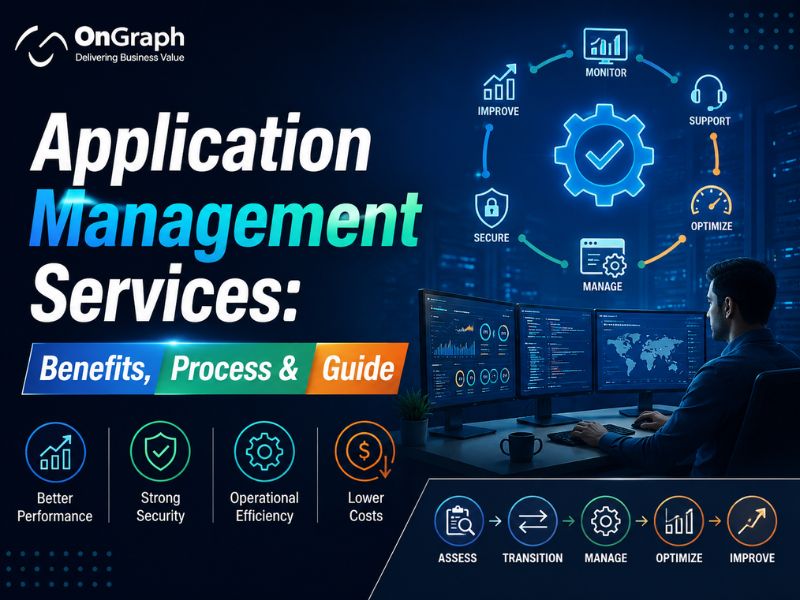
- Assess — Review applications, architecture, infrastructure, dependencies, incidents, and business priorities.
- Transition — Document systems, access, integrations, known issues, support history, and responsibilities.
- Monitor — Track application health, availability, errors, performance, and infrastructure.
- Resolve — Diagnose incidents, fix defects, and follow agreed escalation procedures.
- Optimize — Address recurring issues, performance bottlenecks, and unnecessary operational work.
- Improve — Plan upgrades, modernization, automation, and changes as business needs evolve.
This creates a continuous management cycle instead of relying on repeated break-fix support.
Secure Your Applications with Proactive AMS
AMS vs Traditional IT Support in 2026
| Aspect | Application Management Services | Traditional IT Support |
| Approach | Predictive & automated | Reactive |
| Scope | Full lifecycle management | Incident-based |
| Innovation | Enables modernization | Limited |
| Business Impact | Strategic growth driver | Technical maintenance |
| Automation | AI & DevOps enabled | Manual |
AMS supports transformation. Traditional IT support maintains the status quo.
Application Management Services vs In-House Application Management
Managing applications in-house gives businesses direct control and strong internal product knowledge, but it also requires dedicated skills across support, cloud infrastructure, security, DevOps, databases, and performance. An AMS provider can add specialist expertise and operational capacity when internal teams are stretched.
| Area | Application Management Services | In-House Management |
| Technical expertise | Access to multiple specialists | Depends on internal team |
| 24×7 coverage | Can be included in the SLA | Requires staffing and shifts |
| Scaling support | Capacity can expand as needed | Usually requires hiring |
| Cost model | Defined service agreement | People, tools and infrastructure |
| Application knowledge | Built during transition and documentation | Strong internal knowledge |
| Best suited for | Complex or growing environments | Stable workloads with sufficient expertise |
A hybrid model is also common: the internal team retains product ownership and business decisions, while an external partner handles monitoring, maintenance, infrastructure, releases, or specialist support.
Industries Accelerating AMS Adoption in 2026
Healthcare
- AI-driven diagnostics platforms
- Secure telehealth ecosystems
- HIPAA-compliant cloud systems
Financial Services
- Real-time fraud detection
- RegTech compliance systems
- AI-powered investment analytics
Retail & E-Commerce
- High-volume transaction systems
- Omnichannel platforms
- Real-time personalization engines
Retail enterprises leveraging AMS report 99.9% uptime during peak demand periods.
Case Study: OnGraph Application Managed Service Success
Client: US-based HealthTech SaaS provider
Challenge: Downtime, slow feature rollouts, compliance gaps
Solution Delivered:
- 24×7 monitoring
- Cloud-native optimization
- Automated incident workflows
- HIPAA compliance integration
Results Achieved:
- 70% reduction in downtime
- Full regulatory compliance
- 40% faster deployment cycles
This demonstrates how structured managed application services drive measurable impact.
Custom and Cloud-Based Application Management Services
Application management is increasingly connected with cloud operations, DevOps, Site Reliability Engineering, container management, and application modernization. The right service mix depends on how the application is built and where it runs.
- DevSecOps and deployment automation
- Site Reliability Engineering (SRE)
- Application and infrastructure monitoring
- Kubernetes and container lifecycle management
- Multi-cloud and hybrid-cloud operations
- Application upgrades and modernization
Related reading: What Are Cloud Managed Services? is useful for teams that also need ongoing management of cloud infrastructure, security, backups, monitoring, and optimization.
Related reading: Cloud Migration: Prepare Your Business to Scale and Evolve covers migration planning, cloud strategies, and common challenges when moving existing workloads.
How to Choose the Right Application Management Service Provider
The right AMS partner should understand both the technology behind your applications and the business impact when those applications fail or slow down. Compare providers on operating capability, not only team size or technology lists.
- Relevant application and industry experience
- Clear SLA commitments and severity definitions
- Cloud, DevOps, database, API, and security expertise
- Monitoring and incident-management processes
- Transparent reporting and escalation paths
- Ability to support integrations and modernization
- Security and compliance experience where required
- Knowledge transfer and documentation
- Flexible capacity as application needs change
Ask how the provider handles critical incidents, SLA breaches, security issues, reporting, knowledge transfer, and application ownership. A clear transition plan is equally important because the provider needs to understand your architecture, dependencies, known issues, and business-critical workflows before taking responsibility.
For a large or complex application estate, a pilot engagement can help validate communication, technical capability, reporting, and incident handling before expanding the scope.
Looking for a Reliable Application Management Partner?
Why OnGraph for Application Management Services?
OnGraph combines application development, cloud, software support, and enterprise engineering capabilities, allowing teams to address both ongoing application operations and the development work needed to improve existing systems.
- Application monitoring, maintenance, and support
- Web, mobile, and enterprise application development
- Cloud migration and cloud-native development
- Legacy application modernization
- DevOps and release support
- Performance, security, and integration improvements
For larger application environments, enterprise IT solutions can support broader requirements such as audits, risk assessment, implementation, maintenance, and round-the-clock service operations.
Final Thoughts
Application Management Services help businesses keep critical applications reliable while improving performance, security, scalability, and maintainability over time. The right AMS model should reduce operational burden without taking product ownership away from your internal team.
If recurring incidents, limited internal capacity, aging applications, or growing cloud complexity are slowing your team down, reviewing your current support model is a practical first step.
Need help managing a business-critical application? Share your current application, support challenges, and operating setup with OnGraph to discuss a practical management and modernization approach.
FAQs
Application Management Services (AMS) are ongoing services for monitoring, maintaining, supporting, optimizing, securing, and improving business applications throughout their lifecycle.
AMS can include 24×7 monitoring, incident management, bug fixes, performance optimization, security updates, patching, release support, cloud operations, database and API monitoring, integrations, reporting, and application modernization.
Application maintenance mainly focuses on fixes, updates, and changes to an application. AMS is broader and can include monitoring, incident management, SLAs, performance, cloud operations, security, releases, reporting, and continuous improvement.
Businesses use managed application services to improve reliability, reduce operational workload, access specialist skills, strengthen security, support faster releases, and scale application operations without building every capability internally.
Cost depends on application complexity, number of applications, support hours, SLA requirements, infrastructure, integrations, security needs, and the level of ongoing development or modernization required. Common models include monthly retainers, dedicated teams, SLA-based support, and hybrid arrangements.
Yes. SaaS and digital-first startups can use AMS to add monitoring, maintenance, cloud support, security updates, and operational expertise without hiring a large support team early.
Look for relevant application experience, clear SLAs, strong monitoring and incident processes, cloud and DevOps capability, security expertise, transparent reporting, knowledge transfer, and the ability to scale support as your application grows.
AMS can support compliance efforts through access controls, monitoring, security updates, audit trails, documented processes, and timely remediation. The business remains responsible for determining which regulatory requirements apply to its systems and data.
About the Author

Let’s Create Something Great Together!
Latest Blog
Let’s have a conversation today!


India
ONGRAPH TECHNOLOGIES PRIVATE LIMITED,
SDF L-1, NSEZ,
Sector 81, Block L, Phase-2,
Noida, Uttar Pradesh-201305

USA
OnGraph Technologies,
120 Bethpage Rd, Suite 304,
Hicksville, NY 11801, USA

Canada
7-1039 CEDARGLEN GATE,
Mississauga, Ontario,
Canada L5C 3A7

UK
89 Banstead Road South,
Sutton, Surrey, SM2 5LH
United Kingdom

Malaysia
G-3A, Amaya Maluri, Jalan
Jejaka 2, Taman Maluri,
KL–55100, Malaysia

Singapore
10 Anson Road,#26-04
International Plaza,
Singapore (079903)