

In this article
- What Is a DAO (Decentralized Autonomous Organization)?
- DAO vs Traditional Organizations
- Types of DAO (Decentralized Autonomous Organization)
- How to Create a DAO on Blockchain in 5 Steps?
- Technology Stack to Create a DAO on Blockchain
- Benefits of Creating a DAO
- Risks Associated With DAO Development
- Start Your DAO Journey With OnGraph
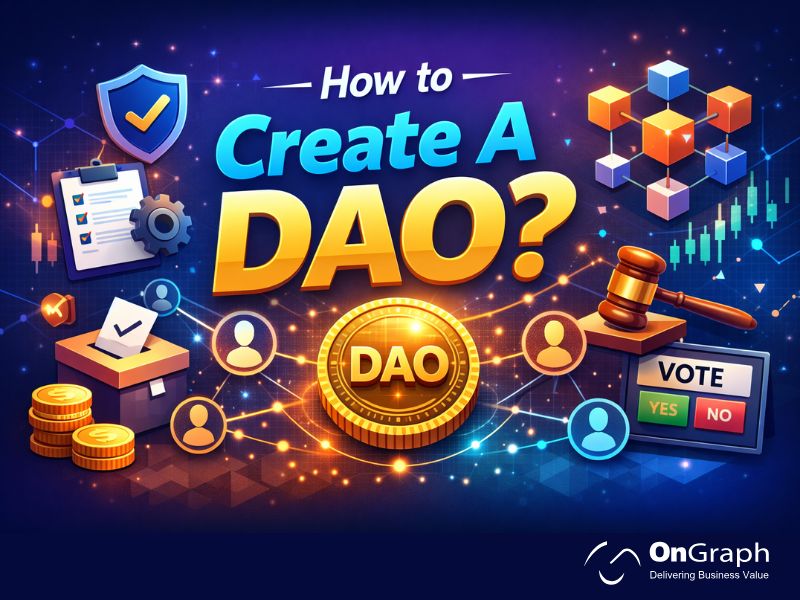
Finding the right investors and partners is a common challenge for startups and growing businesses. When businesses create a DAO (Decentralized Autonomous Organization), they move away from traditional structures where decision-making remains limited to a few individuals. Such centralized systems often lead to power imbalance, lack of transparency, and slower innovation, making it harder for organizations to scale with trust and efficiency.
As businesses scale, centralized structures may restrict participation and reduce trust among stakeholders. This is where a Decentralized Autonomous Organization (DAO) offers a practical alternative.
A DAO removes centralized control and allows members to participate directly in governance through transparent, blockchain-based systems.
What Is a DAO (Decentralized Autonomous Organization)?
A DAO (Decentralized Autonomous Organization) is a blockchain-based structure where decisions are made collectively by members instead of a central authority. Governance rules are written into smart contracts, and voting is typically powered by governance tokens.
How a DAO Works in Simple Terms:
- A DAO is created using blockchain and smart contracts
- Members join by holding governance tokens
- Token holders vote on proposals and decisions
- Voting results are transparent and recorded on the blockchain
- Smart contracts automatically execute approved actions
Once deployed, DAO rules cannot be changed without community approval, ensuring fairness and accountability.
As of early 2025, more than 2,500 DAOs exist globally, collectively managing treasuries valued at over $30 billion, according to data from DeepDAO.
Also read – Top Enterprise Blockchain Benefits & Use Cases for 2025
DAO vs Traditional Organizations
| Aspect | DAO | Traditional Organization |
| Decision-Making | Decentralized, member-driven | Centralized leadership |
| Transparency | Fully transparent on blockchain | Often limited |
| Governance | Token-based voting | Top-down management |
| Efficiency | Automated via smart contracts | Manual processes |
| Cost | Lower operational overhead | Higher admin costs |
| Security | Cryptographically secured | Centralized risk |
| Participation | Open and permissionless | Restricted |
Types of DAO (Decentralized Autonomous Organization)
Before you create a DAO, it is important to choose the right type based on your business goals.
1. Protocol DAOs
Used to govern blockchain protocols and platforms.
Example: Uniswap DAO
2. Collector DAOs
Formed by artists and collectors to manage NFTs and digital assets.
Examples: Flamingo DAO, PleasrDAO
3. Grant DAOs
Fund and support innovation through community-driven grants.
4. Investment & Venture DAOs
Pool capital to invest in startups, crypto assets, or Web3 projects.
Examples: BitDAO, ConstitutionDAO
5. Media DAOs
Enable creators and audiences to collaborate without intermediaries.
6. Social DAOs
Communities are built around shared interests, access, or networking.
7. Service DAOs
Operate like digital agencies, offering services governed collectively.
Example: MetaverseDAO
8. Entertainment DAOs
Allow members to influence creative and entertainment projects.
9. Philanthropy DAOs
Focus on social causes and community-driven impact initiatives.
How to Create a DAO on Blockchain in 5 Steps?
A successful DAO is built on four core elements: Goal, Governance, Voting, and Rewards.
Step 1: Define the Goal of Your DAO
Start by clearly identifying:
- What problem will your DAO solve
- Who your community is
- What decisions will members make
- How decentralization adds value
This step shapes your DAO’s smart contracts, governance rules, and token design.
Step 2: Establish Ownership and Voting Mechanism
Ownership in a DAO is typically represented through governance tokens, which can be distributed via:
- Token purchases
- Airdrops
- Rewards for contributions
Voting power is usually proportional to token holdings, ensuring transparent and measurable governance.
Step 3: Decide the Governance Structure
Your DAO governance model defines:
- Proposal creation rules
- Voting duration and quorum
- Execution methods
- Treasury access
A clear governance document helps avoid disputes and ensures long-term stability.
Step 4: Set Up Rewards and Incentives
Incentives encourage long-term participation and contribution.
Common reward types include:
- Governance tokens
- Stablecoins
- NFTs
- Reputation-based rewards
Fair and transparent reward systems help maintain trust and engagement.
Step 5: Launch and Grow Your DAO
After deployment, focus on:
- Community onboarding
- Transparency in treasury usage
- Regular governance updates
Platforms like Discord and Telegram are commonly used for DAO communication.
Also read- The Ultimate Guide to Blockchain Development
Technology Stack to Create a DAO on Blockchain
| Layer | Tools / Technologies |
| Blockchain | Ethereum, Polygon, BNB Chain, Solana |
| Smart Contracts | Solidity, Vyper, Rust |
| DAO Frameworks | Aragon, DAOstack, MolochDAO |
| Governance Tools | Snapshot, Tal |
| Wallets | MetaMask, WalletConnect |
| Treasury | Gnosis Safe, Multisig Wallets |
| Storage | IPFS, Arweave |
| Analytics | Dune Analytics, The Graph |
| Security Audits | OpenZeppelin, CertiK, Trail of Bits |
Benefits of Creating a DAO
- Smart Contract Automation – Reduces manual intervention
- Community-Driven Governance – Improves trust and innovation
- Cost-Effective Operations – No intermediaries
- Global Participation – Borderless collaboration
- Transparency & Security – Blockchain-backed records
Risks Associated With DAO Development
1. Governance Power Imbalance
Large token holders may influence decisions disproportionately.
2. Security Risks
Poorly written smart contracts can expose DAOs to exploits.
3. Operational Costs
Gas fees and continuous development require budgeting.
4. Legal and Regulatory Uncertainty
DAOs often operate in unclear regulatory environments, requiring expert guidance.
Start Your DAO Journey With OnGraph
DAOs are transforming how organizations operate by enabling transparent, decentralized governance through blockchain technology.
OnGraph offers end-to-end DAO development services, including:
- DAO smart contract development
- Governance and voting system setup
- Secure DAO deployment
- Blockchain consulting and audits
Whether you are a startup or an enterprise, our blockchain development team helps you build scalable, secure, and compliant DAO solutions.
FAQs
There are several services that specialize in helping individuals and businesses build Blockchain-Based DAOs:
- Blockchain Development Services
- DAO Governance Design
- Smart Contract Auditing
- DAO Launch & Marketing
- Ongoing DAO Management
To find the right service provider for building a DAO, consider the following:
- Expertise and Experience
- Blockchain Specialization
- Reputation and Reviews
- Security Focus
- End-to-End Support
The cost of building a Blockchain-Based DAO varies depending on several factors:
- Blockchain Choice: Some blockchains have lower transaction fees (e.g., Binance Smart Chain) compared to others (e.g., Ethereum).
- Complexity: The complexity of your DAO, such as custom smart contracts, unique governance models, and integration with other platforms, can increase costs.
- Smart Contract Audits: Independent security audits can be a significant expense, but they are crucial for ensuring the safety of your DAO.
- DAO Launch & Marketing: Some service providers offer marketing packages to help launch your DAO and grow the community, which can add to the cost.
- Ongoing Maintenance: DAO management services, such as community management, governance optimization, and system updates, may require ongoing fees.
Yes, many service providers specialize in DAO governance and community building. They can:
- Governance Design: Help you design the rules and structure for your DAO, including how voting works, how members are incentivized, and how decisions are made.
- Community Management: Assist with building an engaged community around your DAO through social media management, forums, and incentivization programs.
- Token Distribution Strategy: Develop a fair and effective strategy for distributing governance tokens to ensure decentralization and broad participation.
- Facilitate Proposals and Voting: Provide tools and frameworks to facilitate the proposal submission and voting process, ensuring smooth operations and transparent decision-making.
About the Author

Let’s Create Something Great Together!
Latest Blog


Let’s have a conversation today!


India
ONGRAPH TECHNOLOGIES PRIVATE LIMITED,
SDF L-1, NSEZ,
Sector 81, Block L, Phase-2,
Noida, Uttar Pradesh-201305

USA
OnGraph Technologies,
120 Bethpage Rd, Suite 304,
Hicksville, NY 11801, USA

Canada
7-1039 CEDARGLEN GATE,
Mississauga, Ontario,
Canada L5C 3A7

UK
89 Banstead Road South,
Sutton, Surrey, SM2 5LH
United Kingdom

Malaysia
G-3A, Amaya Maluri, Jalan
Jejaka 2, Taman Maluri,
KL–55100, Malaysia

Singapore
10 Anson Road,#26-04
International Plaza,
Singapore (079903)