


In this article
- The Hidden Cost of Choosing the Wrong Build Strategy
- White-Label App Solutions: Speed with Structural Trade-Offs
- Custom Development: Maximum Control, Maximum Responsibility
- Engineering Reality: What Scalable Architecture Actually Requires
- Fixed-Bid vs Milestone Engineering: What Founders Get Wrong
- The ROI Perspective: Think 24 Months, Not 3 Months
- When White-Label App Solutions Make Strategic Sense?
- When Custom Architecture is the Only Viable Option?
- The Hybrid Strategy: Engineering the Smart Middle Path
- What Decision-Makers Should Ask Before Signing Any Contract?
- The Expensive Mistake Most Founders Make
- The Consultant-Level Next Step
- Final Thought
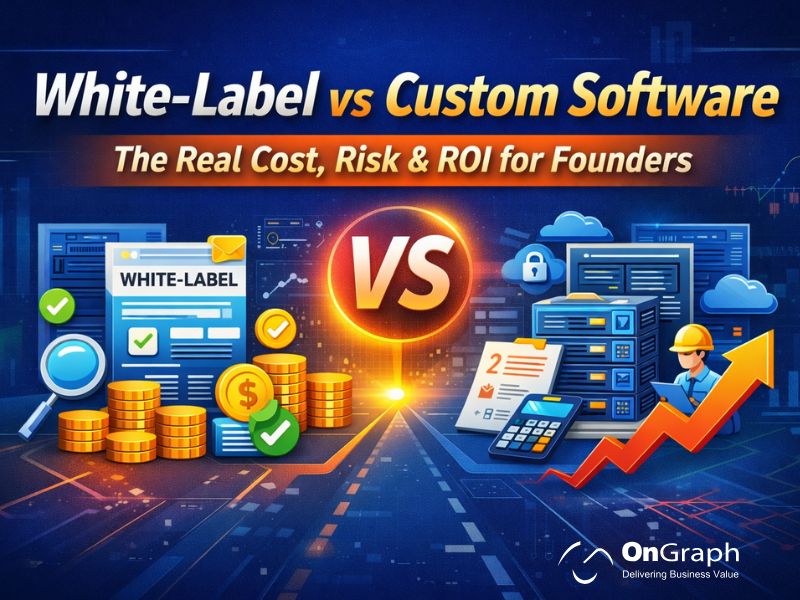
When evaluating White-Label vs Custom Software, the decision is not about UI preference or feature lists — it is a capital allocation strategy. The wrong approach can delay your launch by 6–9 months and increase total development costs by 30–50%. As an experienced App Development Company, we help founders and CTOs assess scalability, IP ownership, architectural control, and long-term ROI before committing to a build path that impacts both valuation and growth trajectory.
The Hidden Cost of Choosing the Wrong Build Strategy
Here’s what most founders don’t realize:
The biggest risk in product development isn’t engineering complexity.
It’s architectural misalignment.
We regularly speak with funded founders who:
- Spent $120K+ on a custom MVP that never scaled.
- Launched a white-label product that couldn’t support their business model.
- Locked themselves into tech stacks they couldn’t maintain.
- Hit performance bottlenecks at 5,000 users because scalability wasn’t designed from day one.
The build vs. buy decision is not tactical. It’s structural.
If your roadmap includes:
- Multi-region expansion
- Real-time features
- Complex workflows
- AI integration
- High concurrency traffic
You are making an infrastructure decision — not just launching an app.
Don’t Just Build AI Products. Build Profitable AI Platforms.
White-Label App Solutions: Speed with Structural Trade-Offs
White-Label App Solutions can reduce time-to-market by 40–60%. That matters in competitive markets.
But here’s what most agencies won’t tell you:
White-label systems are opinionated architectures.
You are inheriting:
- Predefined database schemas
- Fixed service boundaries
- Limited extensibility
- Platform-specific logic constraints
For early validation, this may be acceptable.
But for scale-stage companies, hidden constraints surface quickly:
- Performance limitations under traffic spikes
- Rigid data models blocking new features
- Vendor dependency
- Limited DevOps flexibility
White-label is a growth accelerator — not always a growth engine.
Custom Development: Maximum Control, Maximum Responsibility
Custom builds give you:
- Full IP ownership
- Architecture designed for your roadmap
- Scalable backend strategy
- Flexible API-first development
But they also require disciplined execution.
The biggest failures we see in custom projects:
- Undefined scope
- Feature creep
- No infrastructure planning
- Weak DevOps pipeline
- No load testing
Custom is powerful — but only when architecture is intentional.
Engineering Reality: What Scalable Architecture Actually Requires
Let’s move beyond theory.
When we architect enterprise-grade systems, we consider:
1. Backend Design for Concurrency
Supporting 10,000+ concurrent users requires:
- Node.js or Go-based microservices
- Event-driven architecture
- Redis caching layers
- Asynchronous queue processing (Kafka, RabbitMQ)
- Horizontal scaling via Kubernetes
If you’re building real-time marketplaces, chat systems, or booking engines, WebSocket scaling becomes critical. We implement:
- Load-balanced WebSocket clusters
- Auto-scaling containers using Docker + Kubernetes
- Sticky sessions or distributed pub/sub architecture
Without this, your “MVP” collapses at scale.
2. Cloud Infrastructure Strategy
Enterprise-grade platforms run on:
- AWS (EC2, ECS, Lambda, RDS, S3)
- GCP Cloud Run
- Azure Kubernetes Service
We design:
- Auto-scaling groups
- CI/CD pipelines
- Infrastructure as Code (Terraform)
- Blue-green deployment strategy
Many white-label systems don’t allow this flexibility.
3. API Architecture & Extensibility
If your product will integrate with:
- Payment gateways
- CRM systems
- ERP platforms
- AI services
- Analytics dashboards
You need:
- GraphQL or RESTful API design
- Secure OAuth2 authentication
- Modular service boundaries
- API rate limiting
This is where architecture thinking separates agencies from engineers.
Build for Scale, Not Just Launch
Schedule a founder-focused strategy session to compare White-Label vs Custom Software based on cost, risk, and growth goals.
Fixed-Bid vs Milestone Engineering: What Founders Get Wrong
Founders love fixed-price models.
But here’s the hard truth:
Fixed-bid only works when:
- Scope is frozen
- Market assumptions are validated
- No pivot is expected
In high-growth environments, that rarely happens.
We prefer:
- Milestone-based engineering
- Sprint-level deliverables
- Agile roadmap flexibility
- Continuous integration
Because products evolve. Architecture must allow that evolution.
The ROI Perspective: Think 24 Months, Not 3 Months
Most early decisions are optimized for launch.
Serious CTOs optimize for:
- Cost per user at scale
- Infrastructure elasticity
- Deployment velocity
- Talent hiring flexibility
- Future feature extensibility
A white-label launch might save $40K upfront.
But if it blocks:
- API monetization
- AI integration
- Enterprise customer onboarding
That early saving becomes a long-term liability.
When White-Label App Solutions Make Strategic Sense?
We recommend white-label when:
- Speed to market is critical
- You are testing a narrow MVP
- Feature complexity is low
- You want proof-of-concept validation
- Budget is constrained
We do NOT recommend it when:
- You plan international expansion
- You need multi-tenant architecture
- You require custom workflows
- You expect high concurrency
- You want investor-grade scalability
This is where experienced App Development Services matter.
When Custom Architecture is the Only Viable Option?
Custom becomes necessary when:
- Business model depends on unique logic
- Real-time infrastructure is core
- AI/ML will be integrated
- Enterprise clients require compliance
- You need data ownership and portability
This is no longer “building an app.”
It is engineering a platform.
The Hybrid Strategy: Engineering the Smart Middle Path
The most strategic path we recommend:
Start with accelerated base modules.
Architect backend from scratch.
Design extensible APIs.
Keep infrastructure scalable from day one.
This reduces:
- Development time
- Capital burn
- Technical debt
Without sacrificing:
- Scalability
- Ownership
- Control
As a senior-level White label App Development Company, this is the model we use most frequently with growth-stage founders.
What Decision-Makers Should Ask Before Signing Any Contract?
Before choosing any vendor, ask:
- What happens when we hit 50,000 users?
- Can we deploy on our own cloud account?
- Who owns the source code?
- Is the system containerized (Docker)?
- Is Kubernetes supported?
- What is the DevOps pipeline?
- How is performance testing handled?
- What is the disaster recovery strategy?
If the vendor hesitates — walk away.
The Expensive Mistake Most Founders Make
They choose based on:
- Lowest quote
- Fastest promise
- Flashiest demo
Instead of:
- Architecture depth
- DevOps maturity
- Scalability design
- Engineering culture
That decision usually surfaces 12 months later.
And by then, refactoring costs more than building correctly.
The Consultant-Level Next Step
If you are deciding between White-Label App Solutions and custom development, you do not need a sales call.
You need clarity.
Book a 45-Minute Architecture Review
We will:
- Evaluate your product roadmap
- Identify scalability risks
- Estimate realistic build cost ranges
- Advise whether white-label or custom makes sense
- Outline infrastructure strategy
No junior sales rep.
No generic pitch deck.
A senior solutions architect only.
Final Thought
Building software is easy.
Engineering scalable systems that survive growth is not.
If you are serious about long-term ROI, infrastructure control, and architectural integrity, treat your build decision as a capital investment — not a design project.
When you are ready to make that decision intelligently, we are ready to guide it.
FAQs
White-label software is a pre-built system you rebrand and slightly customize. Custom software is engineered specifically for your business model, workflows, and scalability needs.
White-label prioritizes speed and lower upfront cost.
Custom prioritizes architecture control, IP ownership, and long-term scalability.
If your roadmap includes complex integrations, multi-region scaling, or AI features, custom architecture usually becomes necessary.
Initially, yes. White-label solutions typically reduce launch costs by 30–60%.
However, long-term cost depends on:
- Scalability limits
- Vendor dependency
- Customization constraints
- Infrastructure flexibility
If a white-label system blocks future growth, refactoring costs can exceed original savings.
The decision should be based on the total 24–36 month ROI, not just the launch budget.
Choose custom software when:
- Your business model depends on unique workflows
- Require deep API integrations
- You expect high concurrency traffic
- You need multi-tenant or enterprise features
- Data ownership is critical
If scalability is central to your strategy, custom architecture provides structural control.
Some white-label systems can scale, but most are designed for speed-to-market rather than deep extensibility.
Key limitations often include:
- Rigid database structures
- Limited DevOps flexibility
- Fixed feature boundaries
- Infrastructure restrictions
Before choosing white-label, ask whether it supports containerization (Docker), orchestration (Kubernetes), and custom cloud deployment.
Custom software offers flexibility, but risks include:
- Scope creep
- Budget overruns
- Poor architecture decisions
- Weak DevOps planning
- Underestimating performance testing
The key risk is not “custom” itself — it is poor architectural planning.
Working with a senior-level App Development Company reduces these risks significantly.
A realistic timeline depends on scope and complexity.
Typical ranges:
- MVP: 3–6 months
- Scalable production platform: 6–12 months
- Enterprise-grade systems: 9–18 months
Milestone-based development and CI/CD pipelines reduce delivery risk and improve timeline predictability.
For short-term validation, white-label can offer faster ROI.
For long-term scalability, IP control, and valuation growth, custom software usually delivers stronger ROI.
Investors often favor businesses that own their technology stack rather than depend entirely on third-party platforms.
The right choice depends on growth ambition, capital strategy, and technical roadmap.
About the Author

Let’s Create Something Great Together!
Latest Blog


Let’s have a conversation today!


India
ONGRAPH TECHNOLOGIES PRIVATE LIMITED,
SDF L-1, NSEZ,
Sector 81, Block L, Phase-2,
Noida, Uttar Pradesh-201305

USA
OnGraph Technologies,
120 Bethpage Rd, Suite 304,
Hicksville, NY 11801, USA

Canada
7-1039 CEDARGLEN GATE,
Mississauga, Ontario,
Canada L5C 3A7

UK
89 Banstead Road South,
Sutton, Surrey, SM2 5LH
United Kingdom

Malaysia
G-3A, Amaya Maluri, Jalan
Jejaka 2, Taman Maluri,
KL–55100, Malaysia

Singapore
10 Anson Road,#26-04
International Plaza,
Singapore (079903)