


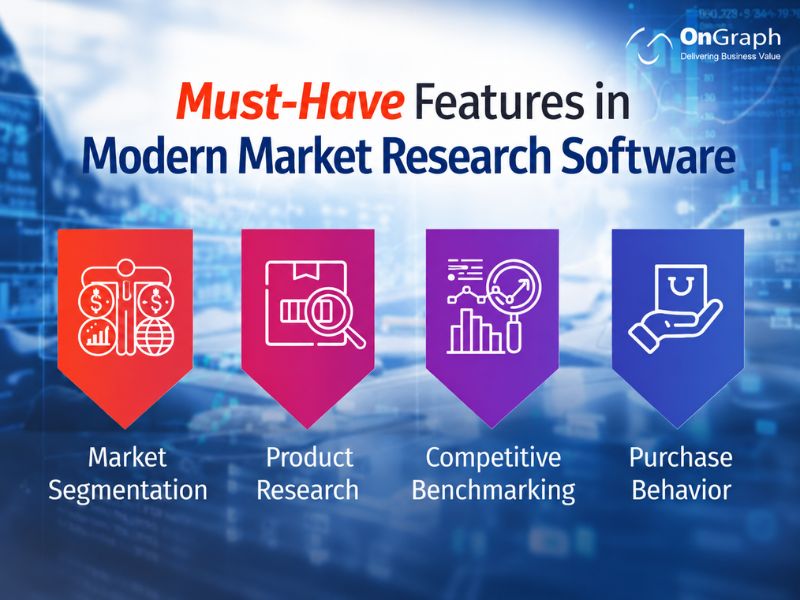
Features in Modern Market Research Software now include much more than survey creation. The best platforms support mobile-first surveys, panel management, fraud detection, reporting, and integrations. Buyers also expect better security, faster workflows, and easier collaboration.
- Strong survey logic and templates save time
- Mobile-first design improves completion rates
- Panel tools help with targeting and recruitment
- Fraud checks protect data quality
- Dashboards and integrations speed up decisions
Modern buyers expect more from research tools than basic survey creation. Features in Modern Market Research Software now shape how fast teams can launch studies, recruit the right audience, protect data quality, and turn responses into decisions.
That shift is happening for a reason. The online survey software market is estimated at USD 4.66 billion in 2025 and is projected to grow to USD 15.87 billion by 2034, according to Fortune Business Insights. That growth reflects rising demand for smarter, faster, and more scalable research workflows.
For founders, agencies, enterprises, and product teams, the challenge is not finding software. The challenge is choosing the right feature set. Many articles discuss basic survey software features. Fewer explain what a modern market research platform truly needs across survey creation, panel operations, reporting, integrations, and governance.
This guide breaks down the features that matter most and explains how to evaluate them before buying or building.
Build Market Research Software Around Your Workflow
Why These Features Matter Now?
Research teams are expected to move faster than before. They also need cleaner data, better targeting, and easier reporting. That becomes difficult when survey tools, panel systems, dashboards, and operations live in separate products.
Mobile behavior has also changed the way people respond. SurveyMonkey reports that 58.2% of survey responses were completed on mobile in 2024. It also says 2024 was the first year that US mobile responses exceeded non-mobile responses.
That means survey experiences must work well on phones. It also means response quality, drop-off rates, and completion times depend on mobile usability.
Industry growth also supports bigger software investment. The UK research and insights industry is now valued at nearly £9 billion, according to the Market Research Society. In India, the research and insights industry reached INR 29,008 crore in FY2025, up 10.9% over FY2024, according to MRSI.
When the industry grows, expectations rise. Buyers want software that handles more work with fewer manual steps.
1) Flexible Survey Builder with Advanced Logic
A modern platform still starts with the survey builder. But basic form creation is no longer enough. Teams need tools for quotas, skip logic, branching, randomization, piping, multilingual surveys, and reusable templates.
These features reduce setup time and improve study accuracy. They also help less technical teams launch faster. Capterra highlights customizable questions, branching, templates, and analytics as key features in modern survey tools.
SurveyMonkey also promotes 500+ expert survey templates, which shows how much value buyers place on speed and repeatability.
If your team runs multiple studies each month, advanced logic is not a bonus feature. It is a basic requirement.
2) Mobile-First Respondent Experience
A survey can be well-designed and still fail on mobile. That is a major problem today because most responses happen on phones.
Mobile-first design means:
- Simple screen layouts
- Tap-friendly answer options
- Fast load speed
- Short progress steps
- Clear error handling
- Minimal clutter
This matters because poor mobile design increases drop-offs and lowers response quality. It can also bias the results if some users abandon more often than others.
If you are evaluating market research tools, always test the respondent flow on a real phone. Do not rely only on desktop previews.
3) Built-in Panel Management Software
One of the most important Features in Modern Market Research Software is the built-in panel capability. This includes recruitment, profiling, segmentation, targeting, quotas, panel health, and reward tracking.
Many businesses now want more control over how they source respondents. That is why panel management software has become central to modern research operations.
SurveyMonkey says its panel audience reaches 335M+ people in more than 130 countries. It also promotes the delivery of insights in as little as an hour for some audience studies.
These examples show what buyers care about:
- Speed of recruitment
- Targeting flexibility
- Audience scale
- Geographic coverage
- Predictable turnaround
For companies that need more ownership, custom panel tools can be even more valuable. A branded system can help manage respondent data, incentive history, verification, and supplier relationships in one place.
4) Survey Fraud Detection and Data Quality Controls
This is one of the most overlooked platform requirements. It is also one of the most important.
Without strong survey fraud detection, even a well-run study can produce weak or misleading insights. Research teams today need ways to detect low-quality responses, duplicates, bots, rushed answers, and suspicious traffic.
Good fraud protection usually includes:
- Speed checks
- Duplicate detection
- IP checks
- Device fingerprinting
- Attention checks
- Open-end quality review
- Geo screening
- Respondent history checks
Data quality is now a core buying factor. GWI lists data quality, freshness, and transparency as major criteria when choosing research tools.
This matters even more when you run incentive-based panels, high-volume concept tests, or fast-turn studies.
If you are choosing a tool or planning custom development, fraud protection should sit near the top of the feature list.
5) Real-Time Dashboards and Faster Reporting
Research loses value when reporting is slow. Teams need dashboards that update in real time, support filtering, and make it easy to share results across departments.
This is one area where modern software creates a clear operational advantage. Forsta says its platform helps research teams improve time-to-insight by 50% and reporting speed by 50%.
Fast dashboards are especially useful for:
- Campaign tracking
- Product testing
- Stakeholder reviews
- Multi-market studies
- Ongoing trackers
If reporting still depends on spreadsheets and slide decks, the process will slow down as your research volume grows.
6) Integrations with Sample Providers, CRM, BI, and Workflow Tools
Modern research operations rarely happen in one product. Teams use survey engines, sample sources, CRM systems, reporting tools, communication tools, and finance systems.
That is why integration support matters so much.
SurveyMonkey says it supports 200+ integrations.
Strong integration support can reduce manual work in several ways:
- Import contacts or panelists automatically
- Sync response data to CRM or BI systems
- Connect with sample suppliers
- Push alerts to teams
- Automate reward and payout workflows
For agencies and enterprises, integrations also support scale. They help connect research with customer experience, product feedback, and internal reporting systems.
This is where custom Market Research Software Development Solutions often make sense. Off-the-shelf tools may offer broad integrations, but custom platforms can match your exact workflow.
Need Smarter Market Research Software?
7) Collaboration, Roles, and Approval Workflows
Research is a team activity. Stakeholders may include researchers, project managers, analysts, clients, finance teams, and operations staff.
A strong platform should support:
- Role-based access
- Workspace permissions
- Review and approval flows
- Audit visibility
- Shared dashboards
- Reusable templates
These features reduce internal confusion and support better governance. They also matter for agencies that manage multiple clients at once.
If you need a white-label market research product, roles and permissions become even more important. Client-facing workspaces need stronger separation and better access control.
8) Security, Privacy, and Compliance Support
Trust is essential in research. Companies often collect customer data, health data, financial information, or proprietary business feedback. That creates higher expectations around security and compliance.
GWI includes security and compliance among the most important platform criteria.
At a minimum, buyers should look for:
- Controlled user access
- Secure storage
- Data export control
- Audit visibility
- Privacy support by region
- Vendor and respondent protection workflows
This becomes even more important for global teams serving the US, UK, and India.
9) Support for Both Quantitative and Qualitative Workflows
Many teams now mix methods. They may run surveys, interviews, focus groups, digital diaries, concept tests, and trackers in the same program.
That is why the best market research platform solutions support both quant and qual needs or connect easily with tools that do.
Pollfish groups market research tools across survey platforms, interview tools, data aggregators, sentiment analysis, and reporting products.
A flexible platform should support at least some of the following:
- Surveys
- Interviews
- Focus groups
- Concept tests
- Diary studies
- Segmentation studies
- Export-ready reporting
This reduces tool sprawl and helps teams keep projects more organized.
10) Scalability and White-Label Readiness
The last key feature is scalability. Many buyers start with one team, one market, or one workflow. Over time, they need more users, more projects, more integrations, and more control.
That is where Features in Modern Market Research Software move from convenience to strategy.
A scalable platform should support:
- Higher response volume
- Multi-region studies
- More researchers and clients
- Supplier expansion
- Branded workspaces
- Modular upgrades over time
This is especially useful for agencies and research businesses exploring market research software development services or white label market research systems.
If your workflow is highly specific, a custom build may provide more long-term value than forcing a standard tool to fit.
Ready to Launch Your Own Research Software?
We help businesses build branded market research platforms with custom features, integrations, and scalable architecture for long-term growth.
Basic Survey Tool vs Modern Market Research Platform
| Capability | Basic survey tool | Modern market research platform |
| Survey builder | Basic forms and logic | Advanced logic, quotas, and templates |
| Mobile experience | Often limited | Built for mobile-first response |
| Panel management | Rare | Core feature |
| Fraud detection | Light or manual | Layered quality controls |
| Dashboards | Basic charts | Real-time dashboards and sharing |
| Integrations | Limited | Broad API and workflow support |
| Collaboration | Minimal | Roles, approvals, and access control |
| White-label readiness | Rare | Valuable for agencies and enterprises |
This is the main difference between simple survey software and a modern research system. One collects responses. The other supports the full research workflow.
Mini Case Study 1: Dubai Parks and Resorts
Dubai Parks and Resorts brought research operations in-house using QuestionPro. The company reported a 75% reduction in research costs and an increase in survey responses of up to 7%. It also improved real-time reporting and data protection.
This case shows the value of:
- Internal control
- Faster reporting
- Stronger workflow efficiency
- Better use of a centralized platform
Mini Case Study 2: LRW / Lieberman
Forsta reports that LRW reduced delivery times by 30% and cut QA effort by more than 50%.
That result highlights why dashboards, validation workflows, and smoother operations matter so much. As studies become more complex, manual QA and reporting processes become expensive.
Forsta also reports that GlobeScan cut reporting time by 40% using its reporting tools.
How to Evaluate the Right Feature Set
Here is a simple way to choose the right software or development roadmap.
Step 1: Define your main research use cases
Start with the work you do most often. That could be tracking, panel research, ad testing, customer feedback, or product studies.
Step 2: Find manual bottlenecks
List every part of the workflow that still depends on spreadsheets, email, or manual exports.
Step 3: Prioritize data quality
If you use incentives, open panels, or high-volume studies, make survey fraud detection a top priority.
Step 4: Test mobile experience
Review your entire respondent journey on a phone. This matters because mobile responses now dominate many studies.
Step 5: Review integrations
Check whether the software connects to your sample sources, reporting stack, CRM, and internal tools.
Step 6: Decide build vs buy
If your process is simple, packaged tools may be enough. If your workflow is unique, custom development may fit better.
When Custom Development Makes Sense
A custom platform is worth considering when:
- A branded platform under your own business identity
- Supplier-specific integrations for smoother operations
- Support for complex panel management workflows
- Custom fraud detection and quality control rules
- One system for surveys, projects, and reporting
In these cases, working with a market research software development company can help you build around your exact workflow.
If your team is exploring custom or branded research products, OnGraph offers market research software development services for panel management, DIY tools, fraud controls, and reporting workflows.
Key Takeaways
The most important Features in Modern Market Research Software are no longer limited to survey creation. The best tools now combine survey logic, mobile-first design, panel management software, survey fraud detection, real-time dashboards, integrations, collaboration, and scalability.
For simple needs, packaged market research tools may be enough. For complex workflows, custom development may be the smarter long-term path.
If your team wants to build a branded or more tailored market research platform, it helps to start with a clear feature roadmap first. That makes software selection easier and reduces expensive mistakes later.
FAQs
The most important Features in Modern Market Research Software include a flexible survey builder, mobile-friendly design, panel management, fraud detection, real-time dashboards, integrations, and role-based access. These features help research teams collect better data, reduce manual work, and make faster decisions. Modern platforms should also support reporting, security, and workflow automation so teams can manage the full research process in one place.
Mobile-first design is important because a large share of survey responses now comes from smartphones. If a survey does not work well on mobile, response rates can drop, and data quality can suffer. Good mobile design improves completion rates, reduces friction, and creates a better respondent experience. It also helps brands reach users in more regions and usage contexts.
Survey fraud detection helps remove low-quality, duplicate, rushed, or fake responses. This improves the reliability of research findings and protects teams from making wrong decisions based on poor data. Good fraud controls often include attention checks, speed checks, device fingerprinting, IP screening, and duplicate detection. These features are especially useful in incentive-based and high-volume studies.
Panel management software helps companies recruit, organize, segment, and engage survey participants. It usually includes respondent profiles, targeting filters, quotas, rewards, and participation history. This makes it easier to run studies with the right audience and improve response quality over time. It is a key part of any strong market research platform.
Survey software mainly helps create and distribute surveys. A market research platform does much more. It often includes survey logic, panel management, fraud detection, dashboards, workflow automation, integrations, and reporting. In simple terms, survey software collects responses, while a market research platform supports the complete research workflow.
A business should consider custom development when its workflow is too specific for standard tools. This usually happens when a company needs custom panel logic, supplier integrations, branded portals, advanced reporting, or stronger internal control. A custom platform can also help agencies and enterprises unify multiple research tasks in one system. In such cases, market research software development services can provide more long-term flexibility.
Buyers should check survey logic, mobile usability, panel features, fraud controls, integrations, dashboards, user roles, and security. They should also review how the tool handles scale, reporting speed, and support for their research model. The best choice depends on whether the team needs a ready-made tool or a custom solution. A clear feature checklist makes this decision much easier.
About the Author

Let’s Create Something Great Together!
Latest Blog

Let’s have a conversation today!


India
ONGRAPH TECHNOLOGIES PRIVATE LIMITED,
SDF L-1, NSEZ,
Sector 81, Block L, Phase-2,
Noida, Uttar Pradesh-201305

USA
OnGraph Technologies,
120 Bethpage Rd, Suite 304,
Hicksville, NY 11801, USA

Canada
7-1039 CEDARGLEN GATE,
Mississauga, Ontario,
Canada L5C 3A7

UK
89 Banstead Road South,
Sutton, Surrey, SM2 5LH
United Kingdom

Malaysia
G-3A, Amaya Maluri, Jalan
Jejaka 2, Taman Maluri,
KL–55100, Malaysia

Singapore
10 Anson Road,#26-04
International Plaza,
Singapore (079903)