

In this article
- Q1. What are AI voice agent solutions from a business perspective?
- Q2. Why are businesses investing in AI voice agents?
- Q3. What business use cases fit AI voice agent solutions best?
- Q4. How are AI voice agents different from IVR systems?
- Q5. What core features should businesses expect?
- Q6. How customizable are AI voice agent solutions?
- Q7. What is the typical cost of AI voice agent solutions?
- Q8. How do AI voice agents deliver ROI?
- Q9. What ongoing maintenance costs should businesses plan for?
- Q10. How long does deployment usually take?
- Q11. What preparation is required before deployment?
- Q12. Can AI voice agents integrate with existing systems?
- Q13. How scalable are AI voice agent solutions?
- Q14. Are AI voice agents suitable for customer service operations?
- Q15. How do AI voice agents improve customer experience?
- Q16. What industries benefit most from AI voice agents?
- Q17. What is an AI voice agent for healthcare businesses?
- Q18. Are AI voice agents secure for enterprise use?
- Q19. How do AI voice agents support regulatory compliance?
- Q20. What is the business role of AI voice cloning?
- Q21. Are AI voice cloning services safe for enterprises?
- Q22. How do businesses measure AI voice agent success?
- Q23. Can AI voice agents support sales teams?
- Q24. What risks should businesses consider before adoption?
- Q25. Why choose an AI voice agent agency?
- Q26. How does OnGraph deliver AI voice agent solutions?
- Final Business Perspective
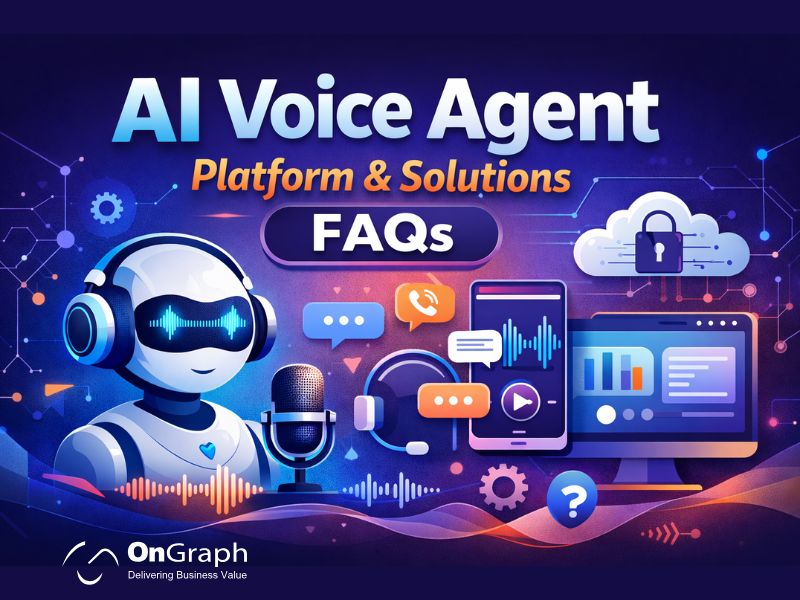
This guide helps organizations evaluate AI Voice Agent Platform & Solutions from cost, risk, deployment, and ROI perspectives.
Q1. What are AI voice agent solutions from a business perspective?
AI voice agent solutions are end-to-end systems that automate business voice interactions.
They include technology, integrations, security, and ongoing support.
From a business view, they are operational efficiency tools.
They reduce costs while improving service quality.
Build a Scalable AI Voice Agent for Your Business
Q2. Why are businesses investing in AI voice agents?
Businesses face rising support costs and customer expectations.
AI voice agents help organizations:
- Reduce call center expenses
- Improve response times
- Offer 24/7 availability
- Scale without hiring
They support growth without proportional cost increases.
Q3. What business use cases fit AI voice agent solutions best?
AI voice agent perform best in repeatable workflows.
Common business use cases include:
- Customer service inquiries
- Appointment scheduling
- Billing and payments
- Order tracking
- Lead qualification
- Follow-up reminders
They free human teams for complex work.
Q4. How are AI voice agents different from IVR systems?
IVR systems follow fixed menus.
AI voice agents understand natural speech.
Business advantages include:
- Shorter call times
- Higher resolution rates
- Better customer satisfaction
- Fewer call transfers
They reduce customer frustration.
Q5. What core features should businesses expect?
Enterprise AI voice agent features support reliability and scale.
Core features include:
- Natural speech recognition
- Intent detection and routing
- CRM and ERP integration
- Human escalation logic
- Analytics and reporting
- Security and access control
Features align with operational needs.
Q6. How customizable are AI voice agent solutions?
AI voice agents are highly customizable.
Businesses can customize:
- Call flows
- Conversation tone
- Business rules
- Integrations
- Branding and voice
Customization ensures alignment with company processes.
Q7. What is the typical cost of AI voice agent solutions?
AI voice agent cost depends on complexity and scale.
Cost components include:
- Initial setup and configuration
- Platform or usage fees
- Integration efforts
- Ongoing support
Costs are predictable and controllable.
Also read- How Much Does It Cost to Develop a Chatbot?
Q8. How do AI voice agents deliver ROI?
ROI improves through automation and scale.
Key ROI drivers include:
- Reduced staffing costs
- Lower cost per call
- Faster resolution times
- Improved customer retention
Most businesses see returns within months.
Q9. What ongoing maintenance costs should businesses plan for?
AI voice agent maintenance cost is lower than human staffing costs.
Maintenance includes:
- Performance monitoring
- System updates
- Minor retraining
- Security patches
Monthly support plans are common.
Q10. How long does deployment usually take?
Deployment depends on business readiness.
Typical timelines are:
- Basic workflows: 4–6 weeks
- Enterprise systems: 8–12 weeks
Using an established AI voice agent platform reduces time.
Q11. What preparation is required before deployment?
Preparation improves success.
Businesses should define:
- Clear objectives
- Priority use cases
- Escalation rules
- Integration access
- Compliance requirements
Good planning reduces risk.
Q12. Can AI voice agents integrate with existing systems?
Yes, integration is essential.
Common integrations include:
- CRM platforms
- ERP systems
- Helpdesk software
- Payment gateways
- Internal databases
Integration prevents data silos.
Q13. How scalable are AI voice agent solutions?
AI voice agents scale automatically using cloud infrastructure.
Scalability benefits include:
- Handling traffic spikes
- Supporting new regions
- Adding languages easily
No re-platforming is required.
Q14. Are AI voice agents suitable for customer service operations?
Yes, AI voice agents for customer service are widely adopted.
They handle:
- High call volumes
- Repetitive inquiries
- Peak-hour demand
Human agents focus on complex cases.
Also read- Why AI Voice Agents Are Transforming Customer Support?
Q15. How do AI voice agents improve customer experience?
They reduce waiting time and transfers.
Customers receive faster answers.
Interactions feel more natural than menus.
Consistency improves trust.
Q16. What industries benefit most from AI voice agents?
Industries with frequent voice interactions benefit most.
High-impact industries include:
- Healthcare
- Insurance
- Logistics
- Retail
- Financial services
- Real estate
ROI increases with call volume.
Q17. What is an AI voice agent for healthcare businesses?
An AI voice agent for healthcare supports patient communication.
Typical uses include:
- Appointment reminders
- Follow-ups
- Basic inquiries
Compliance and privacy are mandatory.
Q18. Are AI voice agents secure for enterprise use?
Security is critical for enterprise adoption.
Security measures include:
- Data encryption
- Role-based access
- Secure integrations
- Audit logs
Enterprise-grade design ensures protection.
Q19. How do AI voice agents support regulatory compliance?
Compliance is built into system architecture.
Support includes:
- Controlled data access
- Logging and audit trails
- Industry-specific safeguards
This simplifies audits.
Q20. What is the business role of AI voice cloning?
AI voice cloning supports branding and consistency.
Business uses include:
- Branded voice assistants
- Training simulations
- Accessibility support
Consent-based usage is essential.
Q21. Are AI voice cloning services safe for enterprises?
AI voice cloning services are safe when governed properly.
Enterprises must ensure:
- Legal approvals
- Ethical guidelines
- Technical safeguards
Responsible use protects brand reputation.
Q22. How do businesses measure AI voice agent success?
Success is tracked using defined KPIs.
Common metrics include:
- First-call resolution
- Call duration
- Customer satisfaction
- Cost savings
Dashboards provide insights.
Q23. Can AI voice agents support sales teams?
Yes, AI voice agents assist sales workflows.
Sales benefits include:
- Lead qualification
- Appointment booking
- Automated follow-ups
Sales teams work more efficiently.
Q24. What risks should businesses consider before adoption?
Risks exist without proper execution.
Common risks include:
- Poor conversation design
- Weak integrations
- Security gaps
Experienced partners reduce these risks.
Q25. Why choose an AI voice agent agency?
An AI voice agent agency provides expertise and structure.
Agencies help businesses:
- Deploy faster
- Reduce technical risk
- Ensure compliance
- Scale reliably
They prevent costly mistakes.
Q26. How does OnGraph deliver AI voice agent solutions?
OnGraph builds secure, scalable AI voice agent solutions.
Our focus includes:
- Business ROI
- Compliance and security
- Long-term scalability
Clients retain full IP ownership.
Final Business Perspective
AI voice agent solutions are strategic investments.
They reduce costs, improve service quality, and scale operations.
Success depends on planning, security, and execution.
The right partner turns automation into an advantage.
About the Author

Let’s Create Something Great Together!
Latest Blog

Let’s have a conversation today!


India
ONGRAPH TECHNOLOGIES PRIVATE LIMITED,
SDF L-1, NSEZ,
Sector 81, Block L, Phase-2,
Noida, Uttar Pradesh-201305

USA
OnGraph Technologies,
120 Bethpage Rd, Suite 304,
Hicksville, NY 11801, USA

Canada
7-1039 CEDARGLEN GATE,
Mississauga, Ontario,
Canada L5C 3A7

UK
89 Banstead Road South,
Sutton, Surrey, SM2 5LH
United Kingdom

Malaysia
G-3A, Amaya Maluri, Jalan
Jejaka 2, Taman Maluri,
KL–55100, Malaysia

Singapore
10 Anson Road,#26-04
International Plaza,
Singapore (079903)