

In this article
- How Much Does It Cost to Build an AI SaaS Product in 2026?
- Why AI SaaS Products Cost More Than Traditional SaaS
- AI SaaS Development Cost Factors in 2026
- AI SaaS Product Development Cost Breakdown in 2026
- One-Time Development Cost vs Ongoing AI SaaS Costs
- Understanding AI SaaS Pricing Models
- Calculate Unit Economics Before You Scale
- AI SaaS Development Budget Planning in 2026
- AI SaaS Cost Optimization Strategies
- AI SaaS Development Cost Trends in 2026
- API-Based vs Self-Hosted Models: Which Is More Cost-Effective?
- Final Thoughts
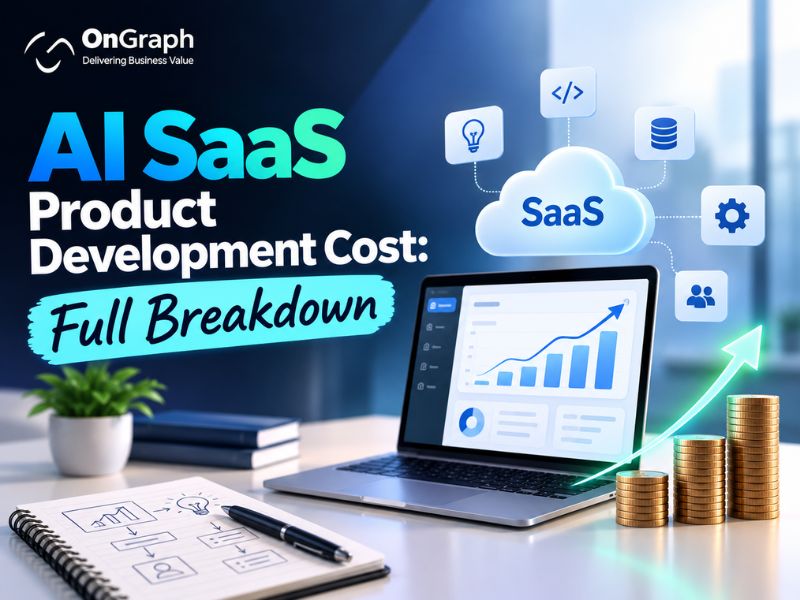
Understanding AI SaaS product development cost is crucial for founders planning a competitive Software-as-a-Service (SaaS) product in 2026. Costs can vary significantly depending on product scope, model integration, data requirements, infrastructure, security, and expected usage.
Whether you’re building your first Minimum Viable Product (MVP) or scaling up to a full-featured solution, understanding the cost drivers, pricing models, and optimization strategies is essential.
This founder’s guide explores the cost to build an AI SaaS product in 2026 and equips you with actionable insights to manage your budget without compromising on quality or speed.
How Much Does It Cost to Build an AI SaaS Product in 2026?
The cost to build an AI SaaS product depends on how much you need to build beyond the core SaaS application. A focused MVP using third-party models will generally cost less than a platform that requires custom workflows, retrieval pipelines, multiple integrations, advanced security, or high-volume infrastructure.
Instead of relying on one broad price range, estimate the product based on its SaaS features, model requirements, data layer, integrations, infrastructure, security, and expected usage. These factors provide a more realistic budget than product size alone.
Know What Your SaaS Product Will Cost Before You Build
Why AI SaaS Products Cost More Than Traditional SaaS
AI SaaS products combine the power of artificial intelligence with the scalability of cloud-based platforms. These applications offer intelligent automation, predictive capabilities, natural language processing, and personalized user experiences—all essential in a data-driven era.
But unlike traditional SaaS, AI SaaS development cost includes additional layers like model training, data pipelines, vector databases, and GPU infrastructure. This naturally increases complexity and budget requirements.
AI SaaS Development Cost Factors in 2026
To better understand the financial landscape, let’s break down the AI SaaS product development cost factors:
1. MVP vs. Full Product
- AI SaaS MVP development cost: Typically ranges from $25,000 to $60,000 for a basic version with 2–3 core features (e.g., AI chatbot, dashboard, and user authentication).
- A full-featured AI SaaS product can cost upwards of $100,000 to $300,000 or more depending on scale, integrations, and proprietary AI.
2. AI Model Integration
- Using open-source LLMs (e.g., Mistral, Llama3) is cost-effective, but requires skilled developers for fine-tuning.
- Proprietary APIs like OpenAI or Anthropic cost more due to usage-based pricing and model limitations.
3. Data Infrastructure
- You’ll need vector databases (like Pinecone or Weaviate) for semantic search, along with pipelines for structured/unstructured data.
- Data ingestion, cleaning, labeling, and versioning are hidden but crucial expenses.
4. Frontend & Backend Development
- Custom UI/UX: $8,000–$20,000+
- Backend logic (APIs, database): $15,000–$50,000+
- AI-specific microservices (agents, LLM orchestration): $10,000–$30,000+
SaaS Architecture and Multi-Tenancy
SaaS architecture also affects development cost. Multi-tenant data isolation, user roles, subscription billing, usage limits, admin controls, SSO, and tenant-level reporting require additional backend and security work.
These requirements should be defined early because changing the tenancy or billing architecture after launch can require significant rework.
5. Security & Compliance
Especially for healthcare or fintech AI SaaS, compliance (HIPAA, GDPR) can add 10–20% extra to your budget.
6. Ongoing AI Ops and Maintenance
Expect monthly costs of $3,000–$10,000 for model retraining, prompt updates, API usage, server hosting, and bug fixes.
AI SaaS Product Development Cost Breakdown in 2026
Here’s a simplified cost breakdown for a mid-level AI SaaS platform in 2026:
| Development Area | Estimated Cost (USD) |
| Market Research & Product Design | $3,000 – $7,000 |
| Frontend Development | $10,000 – $25,000 |
| Backend & Database | $15,000 – $40,000 |
| AI Model Integration | $10,000 – $30,000 |
| DevOps & Cloud Setup | $5,000 – $15,000 |
| Security & Compliance | $5,000 – $20,000 |
| QA & Testing | $3,000 – $7,000 |
| Project Management | $5,000 – $10,000 |
| Total | $56,000 – $154,000 |
This represents a baseline estimate—enterprise-grade tools or advanced AI capabilities will push this higher.
Get a Cost Estimate Based on Your Actual Requirements
One-Time Development Cost vs Ongoing AI SaaS Costs
The development budget gets your product to launch, but it does not represent the full cost of running a SaaS product. Model usage, cloud infrastructure, databases, monitoring, support, and product improvements continue after release.
| Cost | Examples |
| Initial Development | Product design, frontend, backend, integrations, testing |
| Model Usage | API calls, tokens, inference or hosted models |
| Cloud Infrastructure | Compute, databases, storage and networking |
| Data Infrastructure | Vector databases, ingestion and retrieval pipelines |
| Third-Party Services | Authentication, email, payments and monitoring |
| Maintenance | Bug fixes, dependency updates and security patches |
| Scaling | Higher traffic, storage, compute and reliability requirements |
Founders should calculate both development cost and operating cost before finalizing SaaS pricing. A product can be affordable to build but expensive to run if every customer action triggers costly model or infrastructure usage.
Understanding AI SaaS Pricing Models
When developing a product, your AI SaaS pricing model should also be defined early. Common models include:
1- Freemium + Usage Tiering: Free limited features with charges based on usage (tokens, documents, queries).
2- Monthly Subscriptions: Fixed fee, suitable for B2B AI dashboards.
3- Per-User Pricing: Ideal for AI tools used by teams (e.g., AI CRMs, analytics).
4- Outcome-Based Pricing: Charge based on value delivered (e.g., leads qualified, hours saved).
Your pricing model also influences your cost optimization strategy since infrastructure needs scale with users or usage frequency.
Your pricing model should also reflect how your operating costs grow. For example, a usage-heavy product needs enough margin to cover model calls, data retrieval, storage, and infrastructure as customer activity increases.
Calculate Unit Economics Before You Scale
A SaaS product can grow in users while losing margin if the cost of serving each customer grows too quickly. Before setting subscription or usage-based pricing, estimate what an average customer costs you each month.
Include model usage, retrieval requests, cloud compute, storage, third-party APIs, support, and payment costs. Then compare that amount with your expected revenue per customer.
Simple framework:
Revenue per customer – Cost to serve that customer = Contribution margin
AI SaaS Development Budget Planning in 2026
Proper AI SaaS development budget planning is more crucial than ever. Follow these practices:
1. Phase Your Rollout
Start with an MVP focused on your key differentiator. Avoid building everything upfront.
2. Choose Open-Source LLMs and Frameworks
Compare managed and open-source options based on expected usage, infrastructure requirements, engineering effort, privacy, and long-term control. Open-source models can reduce vendor dependency, but self-hosting also creates infrastructure and maintenance costs.
3. Hire a Distributed Team
Outsource to development teams in India, Eastern Europe, or LATAM to optimize labor costs without sacrificing expertise.
4. Build a Feature-Based Cost Estimate
Break the product into core SaaS features, model capabilities, data requirements, integrations, infrastructure, security, and post-launch support. Estimate each area separately instead of applying one fixed price to the entire product.
AI SaaS Cost Optimization Strategies
Let’s cover a few powerful AI SaaS cost optimization strategies founders can implement in 2026:
- Use GPU credits from AWS, GCP, or AI accelerator programs.
- Monitor model usage to reduce unnecessary token consumption.
- Implement caching & batching in AI query flows.
- Replace APIs with in-house inference servers for high-volume tasks.
- Automate testing & deployment pipelines to reduce human error and QA costs.
AI SaaS Development Cost Trends in 2026
Key AI SaaS development cost trends shaping the market this year:
1. Model Choice Is Becoming a Cost-Control Decision
Teams now have more choice between managed APIs, smaller task-specific models, and self-hosted options. The cheapest model per request is not always the cheapest overall, so latency, accuracy, engineering effort, and infrastructure should be evaluated together.
2. Retrieval and Business Data Add Real Engineering Cost
Products that answer questions from private business data need ingestion pipelines, retrieval, permissions, evaluation, and ongoing data updates. These costs should be planned separately from basic model integration.
3. Workflow Automation Increases Integration Costs
Products that take actions across CRM, payments, support tools, or internal systems require reliable integrations, permissions, error handling, and audit trails. This adds more development work than a simple text-generation feature.
4. Cost Optimization Is Moving Toward Usage Efficiency
Caching, routing, shorter context, efficient retrieval, and monitoring can reduce unnecessary model and infrastructure usage as the product scales.
Also read: The Future of White Label Software in the Growing SaaS Industry
API-Based vs Self-Hosted Models: Which Is More Cost-Effective?
API-based models are often easier for an MVP because they reduce infrastructure and model-management work. You pay based on usage and can launch without operating dedicated model infrastructure.
Self-hosting can offer more control over data, deployment, and high-volume workloads, but it introduces infrastructure, monitoring, optimization, and engineering responsibilities.
| Choose | When It Makes Sense |
| Managed API | MVP, variable usage, faster launch |
| Self-Hosted Model | High or predictable volume, greater infrastructure control |
| Hybrid Approach | Different models for different workloads |
The right choice should be based on total operating cost, performance, privacy, and engineering capacity, not API price alone.
Build Your SaaS Product With a Team That Understands Scale
Final Thoughts
Building an AI SaaS product in 2026 is no longer optional—it’s a competitive necessity. As a founder, knowing your AI SaaS development cost upfront, combined with a clear understanding of AI SaaS pricing models, development cost factors, and optimization strategies, can dramatically improve your odds of launching successfully within budget.
Remember, the smartest founders aren’t just spending wisely—they’re planning precisely. Use this guide as your compass to navigate the AI SaaS budgeting landscape confidently.
FAQ
The cost depends on product scope, SaaS architecture, model choice, data requirements, integrations, security, and expected usage. A focused MVP using managed APIs generally requires less investment than an enterprise platform with custom data pipelines, multiple integrations, and strict compliance requirements.
The biggest cost drivers are product complexity, multi-tenant architecture, model integration, data preparation, third-party integrations, cloud infrastructure, security, and ongoing model usage.
Ongoing costs can include model usage, cloud infrastructure, databases, monitoring, third-party APIs, security updates, maintenance, customer support, and continued product development.
APIs usually reduce upfront infrastructure work and can suit early-stage products. Self-hosting may become attractive for specific high-volume or privacy-sensitive workloads, but it adds infrastructure and engineering costs.
Start with a focused MVP, validate the core workflow first, avoid unnecessary integrations, monitor usage costs, and choose architecture based on current requirements rather than building for hypothetical future scale.
About the Author

Let’s Create Something Great Together!
Latest Blog


Let’s have a conversation today!


India
ONGRAPH TECHNOLOGIES PRIVATE LIMITED,
SDF L-1, NSEZ,
Sector 81, Block L, Phase-2,
Noida, Uttar Pradesh-201305

USA
OnGraph Technologies,
120 Bethpage Rd, Suite 304,
Hicksville, NY 11801, USA

Canada
7-1039 CEDARGLEN GATE,
Mississauga, Ontario,
Canada L5C 3A7

UK
89 Banstead Road South,
Sutton, Surrey, SM2 5LH
United Kingdom

Malaysia
G-3A, Amaya Maluri, Jalan
Jejaka 2, Taman Maluri,
KL–55100, Malaysia

Singapore
10 Anson Road,#26-04
International Plaza,
Singapore (079903)