


In this article
- How AI-Powered Home Service Apps Are Changing On-Demand Services
- What Is an AI-Powered Home Service App?
- Key Benefits of AI-Powered Home Service Apps for Businesses
- AI-Powered Home Service App vs Traditional Home Service App
- Must-Have Features of an AI-Powered Home Service App
- AI in Cleaning Service Apps: Practical Business Use Case
- How AI Automation Improves Home Service App Operations
- Top Trends Shaping AI-Driven Home Service Apps
- How to Choose the Right Home Service App Development Partner
- Conclusion
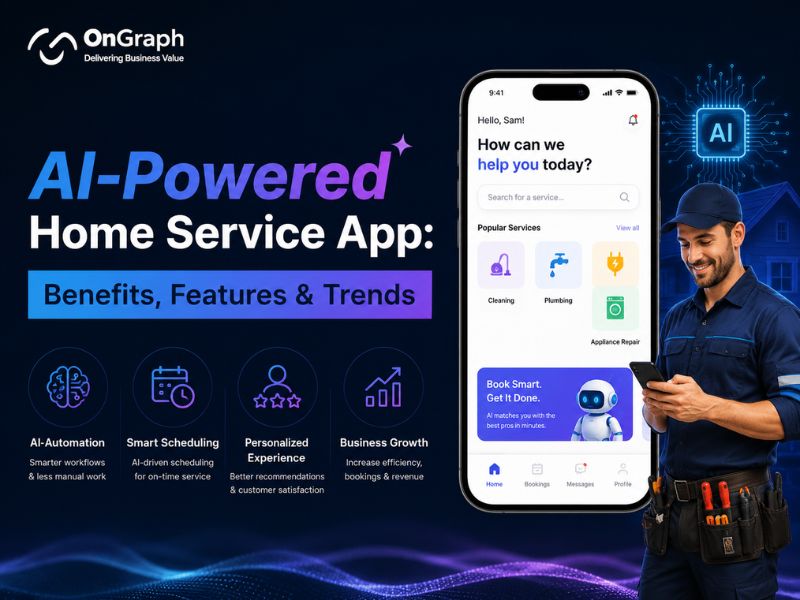
AI-powered home service apps use artificial intelligence to automate bookings, provider assignments, scheduling, customer support, and service management. By reducing manual work and improving operational efficiency, these apps help businesses deliver faster, more personalized customer experiences. As demand for on-demand services continues to grow, an AI-powered home service app has become a valuable tool for increasing bookings, improving customer satisfaction, and scaling operations efficiently.
How AI-Powered Home Service Apps Are Changing On-Demand Services
The home service industry, which includes cleaning, plumbing, maintenance, and other on-demand services, is evolving rapidly. According to a report by Statista, the global on-demand home services market is projected to reach $663 billion by 2026, growing at a CAGR of 49% since 2020. This massive growth is driven by customer expectations for instant booking, reliability, and personalized service.
Traditional apps often require manual intervention to assign tasks, check availability, or track service providers. This leads to inefficiencies and delays. AI automation in service apps eliminates these challenges by intelligently managing every step of the workflow—from booking to completion.
Let’s Discuss Your AI Home Service App Project
What Is an AI-Powered Home Service App?
An AI-powered home service app uses artificial intelligence to automate and optimize key business operations such as service booking, provider matching, scheduling, customer support, pricing, and dispatch management. Unlike traditional home service apps, AI-powered platforms can analyze customer behavior, predict service demand, automate repetitive tasks, and improve overall operational efficiency.
Businesses use AI-powered home service apps to reduce manual work, improve customer satisfaction, increase booking conversions, and streamline service delivery. These applications are commonly used for cleaning services, plumbing, electrical repairs, HVAC maintenance, landscaping, pest control, and other on-demand home services.
Key Benefits of AI-Powered Home Service Apps for Businesses
Implementing AI automation in service apps brings numerous advantages:
1. Intelligent Task Assignment
AI algorithms can assign tasks based on service provider availability, location, skill level, and customer ratings. For example, if a user books a plumber, the AI system instantly identifies the best-suited provider nearby. This reduces idle time for service providers and ensures faster service for customers.
2. Predictive Scheduling
AI can predict peak demand times and allocate resources accordingly. This feature helps businesses plan their workforce efficiently, reducing service delays during high-demand periods. For instance, AI-driven apps can forecast more cleaning requests on weekends or holidays.
3. Enhanced Customer Experience
With AI-powered notifications, users receive real-time updates about their service status. AI-driven mobile apps can also offer personalized recommendations, such as suggesting additional services based on customer history.
4. Cost Efficiency
Automation reduces the need for manual intervention, decreasing operational costs. Companies can allocate resources more effectively, ensuring that service providers spend more time on tasks rather than managing schedules.
AI-Powered Home Service App vs Traditional Home Service App

| Feature | AI-Powered Home Service App | Traditional Home Service App |
| Booking Management | Automated and intelligent | Manual or rule-based |
| Provider Matching | AI-based smart matching | Manual assignment |
| Customer Support | AI chatbot and voice assistant | Human support only |
| Scheduling | Predictive scheduling | Fixed scheduling |
| Pricing | Dynamic and demand-based | Static pricing |
| Dispatch Management | Automated dispatch | Manual coordination |
| Customer Experience | Personalized recommendations | Standard experience |
| Scalability | Highly scalable | Limited automation |
AI-powered home service apps enable businesses to manage more service requests with less manual effort. Features such as intelligent scheduling, automated dispatch, AI-powered customer support, and demand forecasting help improve efficiency while reducing operational costs.
For businesses looking to scale, an AI-powered home service app offers a significant advantage over traditional home service platforms by delivering faster response times, improved customer experiences, and higher operational productivity.
Must-Have Features of an AI-Powered Home Service App

When considering on-demand home services app development, integrating the following AI features can elevate your app:
- Automated Booking and Scheduling: Users can book services in a few clicks, while AI manages assignments.
- Smart Provider Matching: AI selects the right provider based on proximity, expertise, and availability.
- Real-Time Tracking: Customers can track service providers in real-time, enhancing transparency.
- Predictive Analytics: AI forecasts demand and suggests optimal staffing.
- AI Chatbots: Chatbots handle queries instantly, reducing support overhead.
Launch a White-Label AI Home Service App Faster
AI in Cleaning Service Apps: Practical Business Use Case
Consider a real-world example of a home cleaning app that integrated AI automation. Before implementing AI, the app relied on manual assignment, leading to 30% longer service times and frequent cancellations. After integrating AI for task assignment and predictive scheduling, the app reported:
- 25% faster booking-to-service time
- 40% reduction in missed appointments
- Higher customer satisfaction scores
This case demonstrates the tangible benefits of AI in home service applications.
How AI Automation Improves Home Service App Operations
Businesses looking for a competitive edge can leverage AI in several ways:
- AI-Powered Recommendations: Suggesting additional services like carpet cleaning or appliance maintenance based on past bookings.
- Dynamic Pricing: AI can adjust prices based on demand, location, and service complexity.
- Fraud Detection: AI can flag suspicious bookings or payment issues.
- Customer Behavior Analysis: Understanding patterns helps in marketing and retention strategies.
By implementing these features, a home service app development company can offer a modern, efficient solution that improves both revenue and customer loyalty.
Top Trends Shaping AI-Driven Home Service Apps
The following trends are shaping the future of AI-powered home service apps:
- Voice-Activated Bookings: Users can schedule services through smart assistants like Alexa or Google Assistant.
- Integration with IoT Devices: Smart homes can automatically request services based on device alerts (e.g., leak detection).
- On-Demand Service Expansion: Businesses are expanding beyond cleaning to include plumbing, electrical, pest control, and more.
- Data-Driven Personalization: AI analyzes customer data to provide a tailored experience.
How to Choose the Right Home Service App Development Partner
For businesses aiming to create AI-powered home service apps, it’s essential to choose a home service app development company experienced in AI integration. Key considerations include:
- Expertise in AI and machine learning models for task automation
- Ability to develop scalable and secure apps
- Experience in on-demand service app development
- Proven track record with AI-driven mobile apps
Partnering with the right development company ensures a smooth implementation of AI, reducing errors and maximizing efficiency.
Ready to Launch an AI-Powered Home Service App?
Automate bookings, dispatch, scheduling, and support with a custom AI-powered home service app built for growth.
Conclusion
The future of home services is intelligent, automated, and customer-centric. AI-powered home service apps are revolutionizing the industry by enhancing efficiency, improving customer satisfaction, and reducing operational costs. From AI automation in service apps to predictive scheduling, AI is transforming the way businesses manage tasks and interact with customers.
Businesses that embrace home service app development with AI integration will stay ahead of the competition, providing seamless experiences in an increasingly on-demand world. By leveraging AI-driven mobile apps, companies can ensure smarter operations, happier customers, and higher profitability.
FAQs
AI improves home service apps by automating task assignments, predicting peak demand, suggesting relevant services, and optimizing routes for service providers. It reduces manual work, minimizes errors, and ensures customers receive faster and more personalized services.
Key benefits include:
- Faster service assignment and delivery
- Real-time tracking of service providers
- Reduced operational costs
- Personalized recommendations for users
- Improved customer satisfaction
- Data-driven insights for better decision-making
AI automation in service apps uses algorithms to analyze data such as service provider availability, location, ratings, and skill sets. Based on this analysis, it automatically assigns tasks, schedules appointments, and sends notifications to both customers and service providers. Some advanced AI apps also include predictive analytics and dynamic pricing features.
Yes. An on-demand home services app development can integrate AI to manage multiple services such as cleaning, plumbing, electrical repairs, and more. AI ensures that the right provider is assigned to each task efficiently, even across different service categories.
Essential features include:
- Automated booking and smart scheduling
- AI-based service provider matching
- Real-time provider tracking
- Predictive demand analytics
- Chatbots for instant customer support
- Payment integration and automated payouts
- Dynamic pricing based on service demand
Investing in AI-driven mobile apps helps businesses stay competitive in the rapidly growing on-demand home service market. AI reduces manual errors, improves operational efficiency, enhances customer satisfaction, and provides actionable insights for better decision-making. It also allows businesses to scale easily and offer a personalized experience to their users.
About the Author

Let’s Create Something Great Together!
Latest Blog


Let’s have a conversation today!


India
ONGRAPH TECHNOLOGIES PRIVATE LIMITED,
SDF L-1, NSEZ,
Sector 81, Block L, Phase-2,
Noida, Uttar Pradesh-201305

USA
OnGraph Technologies,
120 Bethpage Rd, Suite 304,
Hicksville, NY 11801, USA

Canada
7-1039 CEDARGLEN GATE,
Mississauga, Ontario,
Canada L5C 3A7

UK
89 Banstead Road South,
Sutton, Surrey, SM2 5LH
United Kingdom

Malaysia
G-3A, Amaya Maluri, Jalan
Jejaka 2, Taman Maluri,
KL–55100, Malaysia

Singapore
10 Anson Road,#26-04
International Plaza,
Singapore (079903)