


In this article
- What Is an AI Voice Agent?
- How an AI Voice Agent Works
- Why Businesses Care About AI Voice Agents Now
- Common AI Voice Agent Use Cases
- AI Voice Agent vs IVR vs Live Agents
- Benefits of an AI Voice Agent
- Risks and Limits to Address
- Two Mini Case Studies
- How to Implement an AI Voice Agent
- What to Look for in an AI Voice Agent Platform
- Key Takeaways
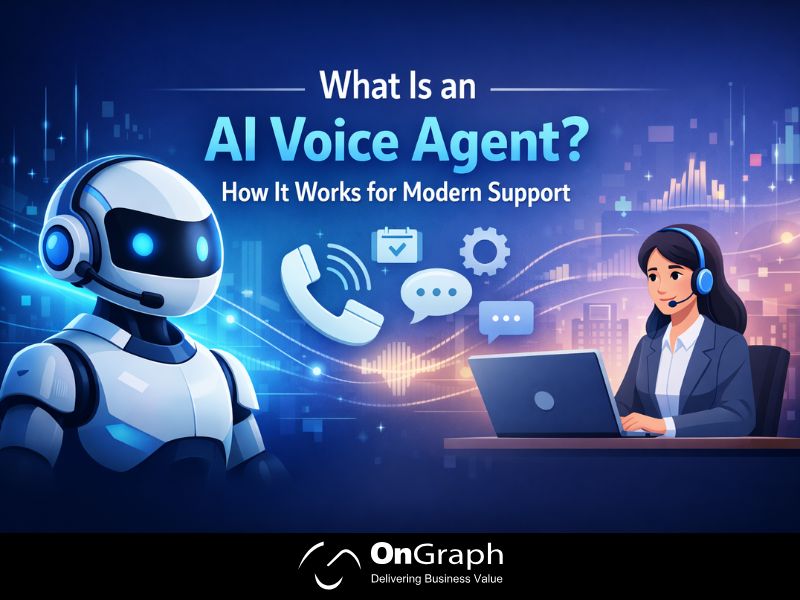
An AI Voice Agent is a voice-based system that understands callers, replies naturally, and completes tasks during a call.
- It replaces rigid phone menus with natural conversation.
- It uses speech recognition, reasoning, and voice synthesis.
- It supports booking, routing, reminders, and service workflows.
- It works best with integrations, analytics, and human handoff.
- It helps businesses improve speed, availability, and consistency.
What Is an AI Voice Agent?
An AI Voice Agent is software that speaks with users over the phone or voice channels. It understands spoken requests, responds naturally, and completes tasks in real time. Unlike a basic IVR, it can handle open questions and changing conversation paths. It can also connect with CRMs, calendars, help desks, and internal systems. That makes an AI Voice Agent useful for customer service, appointment booking, reminders, lead qualification, and post-call support.
This matters because voice remains a high-trust service channel. Many consumers still prefer speaking with a real human for important issues. At the same time, customer expectations around response speed and availability are rising fast. That is why many businesses are now exploring ai powered voice agents instead of relying only on traditional phone menus.
How an AI Voice Agent Works
Most conversational ai voice agents follow a similar process.
- A caller speaks.
- Speech recognition converts audio into text.
- The system detects intent and missing details.
- It decides the next question or task.
- It checks connected systems for information.
- It generates a spoken response.
- It resolves the task or transfers the call.
This stack usually combines speech recognition, language understanding, workflow logic, and text-to-speech. The real value comes when the system can also act. A strong AI voice agent platform does not only answer questions. It can update records, trigger actions, schedule appointments, send follow-up messages, and route calls with context.
Build Your AI Voice Agent with the Right Tech Partner
Why Businesses Care About AI Voice Agents Now
Customer expectations have changed quickly. People now expect customer service to be available around the clock. They also expect faster response times than before. That puts pressure on businesses to improve support without expanding teams at the same speed.
Trust is just as important as speed. Users want clear explanations when automated systems make decisions. That means a voice agent must not only sound helpful. It must also behave clearly, safely, and consistently.
Adoption is moving from experimentation to real deployment. Many organizations are already scaling agent-based systems, while others are still testing them. This shows that the market is moving beyond curiosity and into workflow design, integration, and measurable outcomes.
Customers also notice the difference between companies that use automation well and those that do not. That gap is now a service quality issue, not only a technical issue.
Common AI Voice Agent Use Cases
AI Voice Agents in Customer Support
This is often the first use case businesses test. AI Voice Agents in Customer Support can answer common questions, explain charges, collect issue details, route calls, and support after-hours demand. They are especially useful when the same types of calls repeat often.
This does not mean human agents disappear. It means repetitive work shifts first, while people focus on more sensitive and complex cases.
Appointment Booking and Reminders
Appointment workflows are structured, measurable, and high-volume. That makes them a strong early fit for voice automation. Voice agents can book appointments, confirm availability, reschedule calls, and send reminders. They can also reduce front-desk workload and improve response times.
This is especially valuable in healthcare. Automated reminders can reduce missed appointments and improve operational flow. That makes voice automation useful for clinics, hospitals, and patient support teams.
AI Voice Agent for Healthcare
An AI Voice Agent for Healthcare can support appointment booking, reminders, prescription alerts, patient intake, and after-hours support. These workflows are practical because they are frequent, structured, and time-sensitive. Healthcare providers also benefit from improved accessibility and reduced staff burden.
Healthcare also requires strict boundaries. A voice agent should never guess on high-risk medical decisions. Human review, escalation logic, consent handling, and privacy controls must be built in from the start.
Lead Qualification and Sales Follow-Up
Voice agents can qualify inbound leads, collect timeline and budget details, and schedule demos. They can also follow up on missed calls and confirm next steps. This helps sales teams respond faster while reducing repetitive manual work.
Fintech and Banking Support
Banking and fintech teams often handle repetitive calls about balances, transactions, fraud alerts, EMI schedules, and card issues. These workflows make voice automation useful when security, audit trails, and escalation paths are clearly defined.
Retail, Travel, and Field Service
Retail and travel workflows often include bookings, store support, order updates, and service coordination. Field teams can also benefit from hands-free support for scheduling, task logging, and location-aware assistance. These examples show that an AI Voice Agent works far beyond traditional contact centers.
Let’s Build Your AI Voice Agent Solution
AI Voice Agent vs IVR vs Live Agents
The best operating model often uses all three together.
| Option | Best for | Main strength | Main weakness |
| Traditional IVR | Basic routing and menu choices | Predictable and simple | Poor with open questions |
| AI Voice Agent | Repetitive but variable voice workflows | Natural conversation plus action-taking | Needs testing, setup, and guardrails |
| Human agent | Complex, emotional, or regulated issues | Judgment and empathy | Expensive and harder to scale |
A smart setup does not try to replace everything. It uses each option where it performs best. Let the AI Agent handle routine tasks. Let human agents handle sensitive, emotional, or high-risk issues.
Benefits of an AI Voice Agent
The first benefit is always-on support. A voice agent can respond day and night without adding new shifts. That fits modern expectations for continuous service.
The second benefit is faster response. A voice agent can collect details quickly, reduce wait times, and resolve simple requests during the first interaction. This helps businesses handle more calls without increasing support pressure at the same rate.
The third benefit is consistency. A well-designed agent follows the same workflow each time. It can log information, trigger next steps, and reduce service gaps across large call volumes.
The fourth benefit is better human handoff. Modern voice systems can pass conversation context to human teams. That reduces repetition for callers and helps support teams work faster.
Risks and Limits to Address
An AI Voice Agent is not a full replacement for every call type. It still needs testing, monitoring, and clear escalation rules. Accuracy problems, poor routing, and weak prompts can damage the customer experience.
Trust is another major factor. Many users still prefer human support for important issues. That means the best model is usually hybrid, not fully automated.
Teams must also test accents, interruptions, poor audio quality, low-confidence responses, and unexpected requests. These details often matter more in production than in demos.
Two Mini Case Studies
Case Study 1: Retail Banking
A retail banking deployment used a voice assistant for common customer service tasks. The result was a major reduction in call volume. This shows the value of starting with high-volume, repeatable service workflows.
The lesson is simple. Start where patterns already exist. That is where an AI Voice Agent often proves value fastest.
Case Study 2: Intuit
A large contact center transformation reduced deployment time from months to weeks. It also supported thousands of agents at scale. This shows that platform readiness, routing, and integrations matter as much as the model itself.
The lesson is broader. Businesses do not only need smarter conversations. They also need speed, reliability, and system-level readiness.
How to Implement an AI Voice Agent
Step 1: Start with one narrow workflow
Choose one use case with clear intent and measurable outcomes. Good first options include appointment booking, order status, common support questions, or call routing. A narrow pilot reduces risk and speeds learning.
Step 2: Map the conversation path
List common intents, required inputs, edge cases, and failure points. Then decide what the agent can handle alone and what must go to a human. This step shapes both quality and safety.
Step 3: Connect business systems
The agent becomes useful when it can act. Connect calendars, CRMs, help desks, internal databases, and messaging systems. Without actions, the system remains informative but limited.
Step 4: Add prompts and guardrails
Define tone, approved actions, restricted topics, and disclosure rules. Prompt control and workflow boundaries matter in every industry. They matter even more in regulated sectors.
Step 5: Test real-world call conditions
Use real accents, interruptions, vague requests, and noisy audio. Test low-confidence responses and failed lookups. Good pilots are judged by real call performance, not perfect demos.
Step 6: Define human handoff rules
Never trap callers inside automation. Set triggers for escalation, frustration, repeated failure, or compliance risk. A good transfer should include full context, not a cold handoff.
Step 7: Measure outcomes
Track containment rate, transfer rate, latency, resolution quality, booking rate, and caller feedback. Strong teams redesign workflows based on real performance data.
What to Look for in an AI Voice Agent Platform
If you are comparing an ai voice agent platform, do not judge it only by how the voice sounds. Focus on how well it supports real business workflows.
Look for:
- Strong speech accuracy across accents
- Fast response times
- CRM and scheduling integrations
- Analytics and transcript review
- Human handoff with context
- Security and access controls
- Multilingual capabilities
- Easy testing and iteration
These capabilities separate demo tools from production-ready systems.
If your business needs custom rollout support, it may be better to work with a partner instead of only buying a tool. A partner can help define use cases, connect systems, shape prompts, and tune the workflow after launch.
Our AI Voice Agent Solutions page covers use cases across healthcare, fintech, e-commerce, SaaS, mobility, utilities, education, and travel.
If you are planning healthcare workflows, our AI Voice Agent for Healthcare solutions can support appointment booking, reminders, patient support, and system integrations.
Need an AI Voice Agent That Actually Works?
We develop reliable AI voice agent apps with real-time responses, CRM integrations, and smooth handoff for modern support teams.
Key Takeaways
- An AI Voice Agent works best for repeatable voice workflows.
- It combines speech recognition, reasoning, workflow logic, and voice output.
- Strong use cases include support, booking, reminders, and follow-up.
- Testing, trust, and escalation matter as much as automation.
- A narrow pilot is usually the smartest place to begin.
For founders, product teams, agencies, and enterprises, the real question is not whether voice automation matters. The better question is which workflow should go live first. That is where a practical pilot usually beats a broad rollout.
FAQs
An AI Voice Agent is a software system that talks with people using voice. It listens to spoken questions, understands the meaning, and replies in a natural way. It can also complete actions like booking appointments, routing calls, sending reminders, or updating records.
Unlike a basic IVR, it does not rely only on fixed menu options. It can handle natural conversation and respond based on what the caller actually says. This makes it more useful for real customer interactions.
An AI Voice Agent works in a few simple steps. First, it listens to the caller’s voice. Then it converts speech into text. After that, it identifies the user’s intent and decides what action or response is needed. Finally, it speaks the answer back using a natural-sounding voice.
In many cases, it also connects with business systems like CRMs, calendars, help desks, or internal databases. This allows it to do more than just answer questions. It can actually complete tasks during the conversation.
The main difference is flexibility. A traditional IVR usually follows a fixed menu, like “Press 1 for support.” It works well for simple routing, but it struggles with open-ended questions.
An AI Voice Agent supports natural conversation. A caller can explain their problem in their own words, and the system can understand and respond. This creates a smoother experience and reduces frustration, especially for common service requests.
AI Voice Agents are used in many industries. Common use cases include customer support, appointment booking, reminders, lead qualification, order tracking, payment follow-up, and call routing.
In healthcare, they can help with appointment scheduling and patient reminders. In fintech, they can assist with balance checks, alerts, and account-related requests. In customer support, they are often used to handle repetitive questions and after-hours calls.
Not fully, and they should not be expected to. AI Voice Agents are best for repetitive, structured, and high-volume tasks. They help reduce workload, speed up response times, and improve consistency.
Human agents are still essential for emotional, complex, sensitive, or high-risk conversations. The best setup is usually a hybrid model. The voice agent handles routine work, while human teams manage exceptions and important cases.
Yes, they can work very well in both areas when designed carefully. In customer support, they can answer common questions, route calls, collect issue details, and provide 24/7 service.
In healthcare, they can support appointment booking, reminders, basic intake, and follow-up communication. However, healthcare requires stronger privacy controls, clear escalation paths, and careful boundaries. High-risk medical decisions should always go to qualified human staff.
Businesses should look beyond voice quality alone. A good platform should support speech accuracy, fast response times, CRM and calendar integrations, analytics, multilingual workflows, and human handoff.
It should also support prompt control, testing, compliance needs, and real workflow automation. The right platform is not just one that sounds good in a demo. It is one that performs well in real business conditions.
About the Author

Let’s Create Something Great Together!
Latest Blog
Let’s have a conversation today!


India
ONGRAPH TECHNOLOGIES PRIVATE LIMITED,
SDF L-1, NSEZ,
Sector 81, Block L, Phase-2,
Noida, Uttar Pradesh-201305

USA
OnGraph Technologies,
120 Bethpage Rd, Suite 304,
Hicksville, NY 11801, USA

Canada
7-1039 CEDARGLEN GATE,
Mississauga, Ontario,
Canada L5C 3A7

UK
89 Banstead Road South,
Sutton, Surrey, SM2 5LH
United Kingdom

Malaysia
G-3A, Amaya Maluri, Jalan
Jejaka 2, Taman Maluri,
KL–55100, Malaysia

Singapore
10 Anson Road,#26-04
International Plaza,
Singapore (079903)