


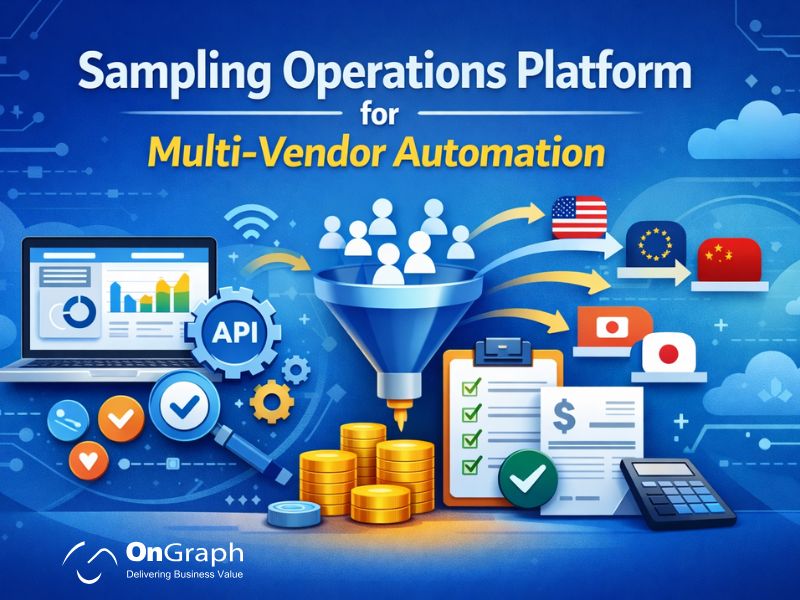
A scalable Sampling Operations platform is often the difference between a sampling business that grows smoothly and one that collapses under spreadsheets, vendor emails, and reconciliation chaos. In this anonymized case-style blog, we explain how an API-first sampling operations platform can automate multi-vendor fieldwork, enforce quality controls, track every click in real time, and streamline reconciliation and invoicing—so market research teams can scale profitably without sacrificing control.
In this article
- The Scenario: When Manual Sampling Stops Scaling
- The Real Problem: Sampling Complexity Lives in the Integration and Transaction Layers
- Why Standard Tools Don’t Solve This Problem?
- The Solution Approach: Start Lean, Then Expand Into White-Label + Custom Integrations
- The Core Stack and Architecture
- What We Built: The Modules That Make Sampling Scalable
- Scalability: Why Infrastructure Is Part of the Product
- The Projected Outcomes: Faster Delivery, Better Quality, Cleaner Margins
- How This Aligns With Emerging Trends in Market Research?
- Why This Work Requires More Than “Developers”?
- Get a Free Architecture Audit
The Scenario: When Manual Sampling Stops Scaling
A sampling-focused market research business approached us with a growth problem disguised as an “operations problem.”
They were servicing market research agencies and fulfilling study requirements by buying sample from multiple third-party suppliers. Early on, they managed projects manually using email threads, spreadsheets, and internal coordination. That approach worked when volumes were small.
But as they started handling more studies—often with multiple countries, multiple targets, and tight deadlines—the cracks widened:
- Each new project required repetitive setup work across clients and suppliers
- Supplier links and redirects were being created and shared manually
- Quality checks varied by project manager and vendor
- Fieldwork status updates were delayed or inconsistent
- End-of-project reconciliation was slow and dispute-prone
- Invoicing clients and verifying supplier costs consumed too much time
They also had a clear roadmap:
- Start with a lean, lower-cost system to manage projects and sampling
- Later, grow into deeper vendor integrations and an API-based supply business
- Eventually, build their own panel and connect it to live studies
This wasn’t just a request for a “tool.” It was a request for an operating system that could handle traffic, suppliers, compliance needs, and financial workflows—at scale.
The Real Problem: Sampling Complexity Lives in the Integration and Transaction Layers
Most teams underestimate sampling complexity because the visible work looks simple: create a survey, send traffic, deliver completes.
In practice, the business lives in a click-level reality:
- Vendors send traffic with different parameters and standards
- Redirect and callback handling must be consistent
- Qualifications and quotas must match supplier capabilities
- Fraud controls must be enforceable and auditable
- Every click has cost implications
- Reconciliation determines the final truth of billing and payouts
When these mechanics are handled manually, the company becomes dependent on heroic project managers, not reliable systems.
That’s where a Market Research Software Development Company provides real value: not by adding more screens, but by engineering the workflows, integrations, and data model that make the business scalable.
Get a Sampling Ops Automation Blueprint
Why Standard Tools Don’t Solve This Problem?
Many buyers begin by comparing popular market research platforms and trying a few tools. Those comparisons are useful—but most products focus on doing one thing well, like survey building, panel engagement, or reporting. The real gap shows up when you need an end-to-end sampling operations layer that connects multiple suppliers, standardizes redirects and callbacks, enforces quality rules, and supports reconciliation and invoicing at click level.
Sampling operations need something different.
Generic tools tend to break because they don’t handle:
- Multi-vendor sampling integrations and redirect standards
- Click-level transaction tracking across suppliers and clients
- Supplier-aware qualification mapping and quota propagation
- Real reconciliation workflows that match how approvals happen
- Finance-ready invoicing that reflects reconciled reality
This is why many sampling teams eventually move toward custom platform work. The differentiator isn’t the UI. The differentiator is how cleanly the system handles vendor traffic, quality, reconciliation, and billing.
The Solution Approach: Start Lean, Then Expand Into White-Label + Custom Integrations
In the consultation, we proposed a phased approach designed to reduce risk while still enabling long-term differentiation.
Phase 1: Launch on a managed setup to validate workflows
This helps the team start quickly, reduce manual work immediately, and confirm that the operational flow matches their process.
Phase 2: Migrate to a white-label deployment for full control
Once the business is confident and needs customization, the platform moves to their infrastructure, with full access to codebase and database.
Phase 3: Add custom integrations and API supply capabilities
This is where competitive differentiation happens—new vendor integrations, API partner workflows, and deeper automation for scale.
This phased model supports real-world business behavior: validate first, then invest in differentiation when outcomes are proven.
The Core Stack and Architecture
Based on the requirements discussed, the platform architecture was built around:
- Backend: Node.js
- Database: MongoDB
- Admin Frontend: AngularJS (existing operational UI)
- Modular design: to add features without breaking fieldwork
The focus wasn’t “new tech for the sake of it.” The focus was on operational reliability under heavy fielding volume and constant vendor variability.
What We Built: The Modules That Make Sampling Scalable
1. Role-Based Access Control for real teams
Sampling operations involve different responsibilities, and permissions matter.
The platform supports controlled access for:
- Sales or client-facing users (bids, clients, pricing notes)
- Project managers (fielding, suppliers, quotas, reconciliation)
- Accounting (invoices, supplier costs, approvals)
- Admin users (configuration, security, system settings)
This prevents mistakes, protects sensitive data, and keeps the workflow consistent.
2. Client and Supplier Management With Guardrails
The platform structures client and supplier data so the team stops relying on tribal knowledge.
Capabilities include:
- Multiple contacts per account (primary and billing contacts)
- Country and address information for operational clarity
- Supplier billing models (flat rate or revenue share)
- Spend caps with automated alerts (e.g., notify at 80% and 100%)
- Supplier eligibility controls (project type, geography restrictions, ad-hoc-only rules)
This reduces the most common operational error: placing the wrong supplier on the wrong project.
3. Security and Quality Controls That Can Be Applied Consistently
A scalable platform must enforce quality, not just report it.
Controls include:
- Hashing methods and server-to-server callbacks
- Unique member ID logic
- Speeder checks and basic fraud signals
- Optional third-party fingerprinting integration (license brought by client)
The goal is flexibility without chaos: security can be enabled at account level or managed at project level, depending on how strict the client’s requirements are.
4. Bid-to-Project Workflow (Plus a Direct Project Option)
Not every sampling business has a dedicated sales cycle.
So the platform supports both:
- Bid → booking → assignment → project creation, for sales-driven workflows
- Direct project creation, for teams that want to field quickly without bids
This is important because forcing a workflow that doesn’t match reality leads to workaround behavior and poor data.
5. Survey Setup With Qualification Library and Supplier Mapping
One of the most useful operational features is a structured qualification library and supplier mapping.
Project teams can:
- Add pre-screener questions and profile questions
- See which questions map to which suppliers
- Use supplier-aware profiling to reduce redundant questions
- Route respondents efficiently and reduce drop-offs
This also supports smarter buying decisions—because feasibility and cost depend heavily on how well qualifications match vendor supply.
6. Quotas Built for Real Fieldwork (Not Demo Scenarios)
Quota management is where many platforms fall short.
This platform supports:
- Quotas based on combinations of up to three questions
- Start-based quotas and complete-based quotas
- Hard stop rules
- Copying quota sets for large quota structures
When teams run 20–30 quotas across regions or ethnicity, the ability to manage quotas cleanly is not a “nice to have.” It’s core infrastructure.
7. Supplier Integrations in Three Modes
To scale, sampling operations need different supplier modes.
A) Exchange integrations (API-based)
For suppliers/exchanges where qualifications, quotas, and postings can be pushed automatically.
B) Manual suppliers
Where the system generates live and test links and PMs share them with supplier contacts.
C) API supplier workflows (custom)
For sampling companies building a future business line that provides its own API to partners.
This is where the roadmap matters. Many businesses start with manual suppliers and later move into API-led scale.
8. Real-Time Transaction Tracking: The “Truth Layer”
A sampling platform must be able to answer, at any time:
- How many clicks came in?
- How many started?
- How many completed?
- Where did dropouts happen?
- Which supplier drove the traffic?
- What does the client callback say?
This platform tracks click-level activity and updates status in real time. It also supports exporting transaction data in CSV format so operations and finance teams can audit outcomes without digging through email threads.
This is one of the biggest advantages of a platform approach: no more “guessing” about what happened.
9. Reconciliation That Matches How Projects Actually Close
Reconciliation is where time gets lost and disputes appear.
The platform supports:
- Marking fieldwork as paused when complete
- Uploading approved IDs or tokens after client review
- Reconciling against the system’s transaction history
- Syncing outcomes back to integrated suppliers where applicable
This reduces disputes and shortens the time between fieldwork end and invoice issuance.
10. Invoicing Workflow That Helps Accounting, Not Hurts It
Most sampling businesses use external accounting tools. The platform should support that reality.
Capabilities include:
- Creating invoice rows from project and reconciliation data
- Marking projects as ready-to-invoice
- Allowing accounting to verify or override invoice details
- Downloading invoice PDFs for sending through the preferred accounting toolchain
The system becomes finance-ready without forcing finance teams into a new tool they don’t want.
Build an API-First Sampling Operations Platform
Scalability: Why Infrastructure Is Part of the Product
Sampling volume can jump quickly—especially when API integrations start pulling large inventories.
To support growth, we plan for:
- Background workers for heavy tasks (posting, syncing, reconciliation jobs)
- Rate-limit-safe API handling and retries
- Database indexing and performance tuning for transaction-heavy collections
- Monitoring and capacity planning for click spikes
This is the difference between a platform that survives real fieldwork and one that works only in controlled demos.
This is also why we emphasize Scalable Backend Architecture early. In sampling ops, performance issues quickly become revenue issues.
The Projected Outcomes: Faster Delivery, Better Quality, Cleaner Margins
With an API-first sampling operations platform, the business can reasonably expect:
- Faster project setup and fewer manual steps
- Improved conversion from cleaner qualification flows
- More consistent quality enforcement across suppliers
- Real-time operational visibility into fieldwork
- Reduced reconciliation time and fewer disputes
- Faster invoicing and improved cash flow predictability
- Better supplier performance reporting over time
And importantly, the platform becomes a foundation for new revenue opportunities, including API supply partnerships and future panel integration.
How This Aligns With Emerging Trends in Market Research?
Emerging Trends in Market Research consistently point toward operational modernization, respondent integrity, and automation.
In practice, that means:
- API-led sampling relationships
- Better identity and fraud prevention signals
- Real-time transparency into fieldwork performance
- Owning data pipelines rather than relying on manual work
An API-first sampling platform isn’t a buzzword trend. It’s a pragmatic response to how the market is evolving.
Why This Work Requires More Than “Developers”?
Many teams think they need to “hire developers” to build features.
But sampling platforms need system design—because the business depends on integration standards, data correctness, and operational workflows.
That’s why we position our work as engineering-led.
As a Market Research Software Development Company, we deliver:
- Market Research Software Development Services built around real operational workflows
- Custom App Development Services for sampling, supplier integrations, and reporting
- Options to Hire Dedicated Developers for ongoing releases and vendor changes
- Enterprise Mobile App Solutions when field teams need mobility and faster approvals
- A future-ready base that supports API partnerships and panel integration
Get a Free Architecture Audit
If your sampling team is still managing multi-vendor fieldwork manually, the biggest risk isn’t workload. It’s scalability.
Facing similar issues with supplier integrations, quality controls, reconciliation, or click-level tracking?
Don’t just hire coders—hire architects. Reach out to our engineering team for a free architecture audit. We’ll map your current workflow, identify the bottlenecks, and propose a scalable backend architecture and rollout plan tailored to your growth stage.
Automate Quotas, Redirects & Status Updates
Stop manual fieldwork updates. Build a system that standardizes redirects, tracks every click, and keeps suppliers and clients in sync in real time.
About the Author

Let’s Create Something Great Together!
Latest Blog


Let’s have a conversation today!


India
ONGRAPH TECHNOLOGIES PRIVATE LIMITED,
SDF L-1, NSEZ,
Sector 81, Block L, Phase-2,
Noida, Uttar Pradesh-201305

USA
OnGraph Technologies,
120 Bethpage Rd, Suite 304,
Hicksville, NY 11801, USA

Canada
7-1039 CEDARGLEN GATE,
Mississauga, Ontario,
Canada L5C 3A7

UK
89 Banstead Road South,
Sutton, Surrey, SM2 5LH
United Kingdom

Malaysia
G-3A, Amaya Maluri, Jalan
Jejaka 2, Taman Maluri,
KL–55100, Malaysia

Singapore
10 Anson Road,#26-04
International Plaza,
Singapore (079903)