


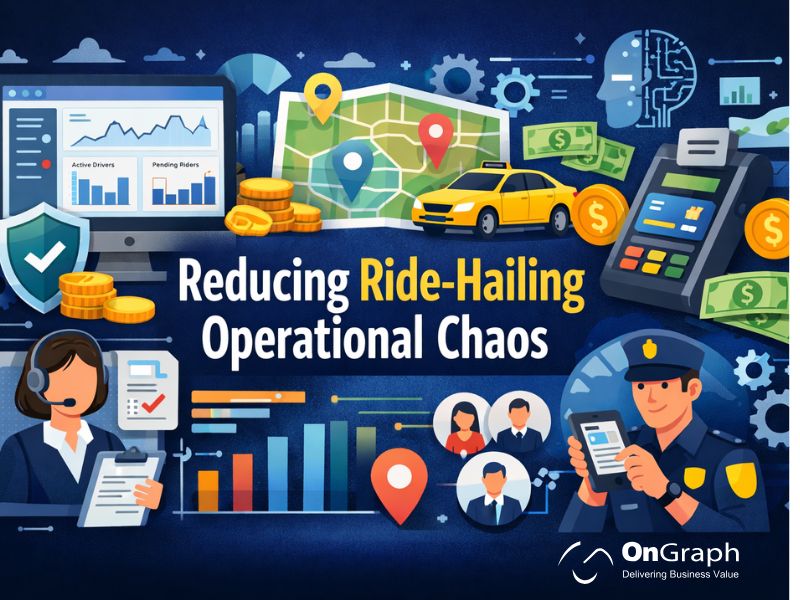
Launching a ride-hailing platform is not a technology challenge. It is an operational governance challenge disguised as an app project. Reducing Ride-Hailing Operational Chaos Fast requires more than building rider and driver apps.
Many founders approach a Taxi App Development Company, believing success is measured by how quickly the apps go live.
In reality, platforms fail or stall because the operational backbone — approvals, payouts, pricing control, dispute handling, compliance, and payment routing — was never designed for real-world scale.
If you are evaluating Taxi App Development Services, this blueprint explains what actually determines long-term success: governance architecture.
Why Most “Uber Clone” Projects Collapse After Launch?
Industry data shows that marketplace startups fail most frequently due to operational misalignment rather than technical instability. According to CB Insights’ startup failure analysis, operational inefficiency and unit economics mismanagement are leading contributors to early-stage collapse.
In ride-hailing specifically, the first 90 days post-launch typically reveal:
- Driver onboarding bottlenecks
- Payment settlement confusion
- Refund and dispute chaos
- Region-based pricing inconsistencies
- Manual coordination outside the system
When these processes live in spreadsheets and WhatsApp instead of inside the platform, scale becomes impossible.
The apps are the surface layer.
Operations are the product.
The Core Principle: Build the Command Center First
A scalable ride-hailing system consists of:
1. Rider App
2. Driver App
3. Admin Governance Panel (the real engine)
4. Modular payment infrastructure
5. Region-based deployment architecture
The admin layer determines whether your Taxi App Development Cost remains stable over time — or balloons due to constant rewrites.
Ready to Reduce Ride-Hailing Operational Chaos Fast?
Let’s break down what an operations-ready architecture must include.
1. A Role-Based Admin Panel Built for Governance, Not Monitoring
Most white-label systems offer a dashboard. Few offer operational control.
A mature system should answer, in real time:
- Active vs. inactive drivers
- Pending verification cases
- Daily gross booking value
- Commission split performance
- Cancellation rates per city
- Complaint resolution time
In production systems we’ve audited, platforms without structured admin workflows required 3–5 additional support hires within six months purely to manage manual coordination.
A role-based architecture (RBAC) allows:
- Compliance team → document approvals
- Finance team → payouts & reconciliation
- Support team → complaint resolution
- Super admin → pricing, region control
This separation reduces internal fraud risk and improves accountability — especially in multi-city expansion.
2. Region-Based Rollout: Scaling City by City Without Rebuilding
Multi-city expansion is not marketing — it is architectural design.
A scalable system must allow:
- City creation with geofenced boundaries
- Time zone configuration
- Distance unit flexibility (km/miles)
- City-level activation or deactivation
- Region-specific pricing models
In practice, we’ve seen operators expand to a second city in under 48 hours when region architecture was built correctly — versus 4–6 weeks when hard-coded changes were required.
This is where experienced Taxi App Development Services differentiate themselves: scalability is configured, not rebuilt.
3. Driver Onboarding and Compliance Automation
Driver risk is the largest operational liability in ride-hailing.
A production-ready document engine should allow configurable requirements:
- Driving license (with expiry tracking)
- Vehicle registration
- Insurance
- Local permits
- Background checks (optional per region)
Why configurable?
Because compliance laws change by jurisdiction.
Hard-coded validation rules increase Taxi App Development Cost every time you expand into a new region.
Automated expiry alerts alone can reduce manual compliance review workload by 30–40% in medium-scale operations.
4. Wallet Governance and Withdrawal Controls
Payments are where early-stage platforms quietly break.
A strong architecture supports:
- Rider wallet loading
- Driver earnings tracking
- Withdrawal request workflows
- Approval hierarchies
- Settlement logs
Fraud risk typically increases during payout windows. In platforms without structured withdrawal governance, finance teams often report reconciliation mismatches within the first three months.
Policy-driven withdrawal settings allow:
- Minimum withdrawal thresholds
- Manual or auto-approval
- City-level payout rules
This transforms wallet management from chaos into controlled liquidity governance.
5. Taxi App Payment Gateway Integration: Designing for Local Rails
One of the most underestimated risks in ride-hailing expansion is payment infrastructure.
Global providers do not always function seamlessly in high-growth or regulated markets. Settlement cycles, KYC requirements, and payout routing differ by country.
A future-proof Taxi App Payment Gateway Integration strategy should be modular:
- Cash (for early-stage liquidity)
- Wallet-based internal accounting
- Pluggable card gateway layer
- Separate driver payout routing logic
Instead of tying the architecture to a single processor, a gateway abstraction layer allows substitution without rewriting the core system.
This approach prevents launch delays and significantly reduces long-term Taxi App Development Cost when entering new markets.
6. Intelligent Pricing Engine and Commission Control
Unit economics determine survival.
Your pricing engine should allow per-region configuration of:
- Base fare
- Distance rate
- Time rate
- Waiting thresholds
- Cancellation fees
- Fixed or percentage commission
- Surge multipliers
Platforms that lack configurable commission logic often struggle when adjusting profitability models.
We’ve observed that even a 2% commission optimization can significantly alter net margins at scale — but only if the system supports controlled testing.
7. Complaint Management as a Retention Strategy
Disputes are inevitable.
Platforms without structured complaint workflows often experience higher churn because response times increase.
An integrated complaint system should support:
- Rider and driver ticket submission
- Categorization (payment, safety, route, behavior)
- Status lifecycle tracking
- Escalation controls
Operational data shows that reducing complaint resolution time by even 24 hours can materially improve repeat booking rates.
Trust retention is operational, not marketing-driven.
8. AI in Taxi App: Where It Creates Real Value
“AI in Taxi App” should not mean gimmicks like chatbots without context.
High-impact AI use cases include:
Fraud and anomaly detection
- Flag abnormal cancellation behavior
- Detect suspicious withdrawal patterns
- Identify unusual route deviations
Demand-supply intelligence
- Highlight underserved zones
- Recommend surge windows
- Detect supply imbalance
Support triage
- Auto-classify complaints
- Prioritize safety-related cases
In mature systems, AI assists human operators — it does not replace them.
This hybrid governance approach reduces operational overhead while improving risk management.
9. White-Label App Development Solutions — When They Make Sense
White-label app development solutions are often misunderstood.
They are not shortcuts — they are accelerators when built on configurable infrastructure.
The advantage:
- Faster launch (weeks instead of months)
- Lower upfront development cost
- Reduced engineering risk
- Proven workflows
The risk:
- Vendor lock-in
- Hard-coded constraints
- Limited payment flexibility
The correct approach is white-label with full source code ownership and architectural transparency.
That is the difference between renting a system and building an asset.
10. Understanding Taxi App Development Cost Beyond Initial Build
Many founders evaluate cost based only on initial delivery.
The real cost drivers are:
- Payment rewrites
- Compliance updates
- Regional expansion modifications
- Pricing logic changes
- Support workflow upgrades
Don’t Just Launch an App — Launch a Business System
A configurable architecture may initially cost slightly more, but it dramatically reduces the total cost of ownership over 3–5 years.
In long-term platform economics, architecture quality is a financial decision.
What to Ask Before Hiring a Taxi App Development Company?
Instead of asking, “Can you build an Uber-like app?” ask:
1. Can I add or disable cities without publishing app updates?
2. Is payment routing modular?
3. Can the driver document rules change per region?
4. Does the admin panel support role-based access control?
5. Can pricing and commission be adjusted without engineering intervention?
6. Is wallet governance configurable?
7. Will I receive full source code ownership?
A mature Taxi App Development Company should treat these as baseline requirements — not premium add-ons.
The Real Differentiator: Operational Architecture
Ride-hailing is not a UI product.
It is:
- A financial system
- A compliance engine
- A dispute management workflow
- A real-time logistics network
The apps are simply interfaces to that engine.
When designed correctly, your platform becomes:
- Expansion-ready
- Fraud-resistant
- Payment-flexible
- Governance-controlled
- AI-optimized
That is what transforms Taxi App Development Services from a coding project into a business infrastructure investment.
Final Perspective
If you are planning to launch or scale a ride-hailing platform, your competitive advantage will not come from matching features.
Build a Ride-Hailing Platform That Actually Scales
Stop managing chaos in spreadsheets. Launch a governance-ready taxi platform built for payments, compliance, and multi-city growth.
It will come from:
- Payment resilience
- Regional scalability
- Compliance automation
- Intelligent governance
- Controlled cost structure
Do not just build an app.
Build an operational system that survives real-world pressure.
Because in ride-hailing, technology enables the business — but operations determine whether it lasts.
FAQs
Operational chaos typically stems from weak governance architecture — not app instability.
The most common causes include:
- Manual driver approvals without structured workflows
- No role-based admin controls
- Payment routing limitations
- Poor wallet and payout governance
- Lack of region-based pricing controls
- Dispute management handled outside the system
When these processes rely on spreadsheets or messaging apps instead of built-in workflows, the platform becomes unscalable. Reducing ride-hailing operational chaos requires building automation, compliance controls, and financial governance directly into the admin layer.
A mature Taxi App Development Company reduces risk by designing infrastructure beyond the rider and driver apps.
Key risk-mitigation mechanisms include:
- Role-Based Access Control (RBAC) for internal teams
- Configurable driver document verification
- Region-based service and pricing controls
- Modular Taxi App Payment Gateway Integration
- Wallet governance with payout approval workflows
- Built-in complaint and escalation tracking
Instead of focusing only on features, the right development partner builds a scalable operations command center.
Professional Taxi App Development Services typically include:
- Rider mobile app (iOS & Android)
- Driver mobile app
- Web-based admin dashboard
- Region and geofencing management
- Pricing and commission configuration engine
- Wallet system and payout management
- Payment gateway integration
- Driver verification workflows
- Complaint and dispute management
- Analytics and reporting
Enterprise-grade services also support scalability, compliance automation, and AI-based optimization tools.
Payment gateway integration must be modular.
In early stages, many platforms launch with:
- Cash payments
- Internal wallet accounting
Later, card payments are integrated using localized gateway routing. A flexible architecture allows:
- Gateway substitution without system rewrites
- Separate routing logic for customer payments and driver payouts
- Settlement tracking per region
- Compliance with local KYC and financial regulations
Without modular integration, expansion often leads to costly redevelopment.
Taxi App Development Cost varies based on:
- Feature depth (basic clone vs. enterprise governance)
- Payment architecture complexity
- AI capabilities
- Region scalability requirements
- Custom UI/UX design
- Ownership model (white-label vs. custom build)
Basic platforms may start lower, but platforms built with governance, scalability, and compliance automation have higher upfront costs — yet significantly lower long-term total cost of ownership.
Architecture quality determines lifetime cost more than initial build price.
AI in Taxi App platforms should improve operations — not just add cosmetic features.
High-impact use cases include:
- Fraud detection (suspicious cancellations or withdrawals)
- Dynamic pricing recommendations
- Demand-supply imbalance detection
- Complaint classification and prioritization
- Route anomaly monitoring
The most effective AI systems operate in “human-in-the-loop” mode, where administrators maintain final decision control.
Yes — if structured correctly.
White-Label App Development Solutions are ideal for faster launch and reduced engineering risk. However, founders must ensure:
- Full source code ownership
- Configurable pricing and region controls
- Modular payment infrastructure
- No vendor lock-in
- Scalable admin panel with role-based access
White-label should accelerate launch — not limit long-term control.
About the Author

Let’s Create Something Great Together!
Latest Blog



Let’s have a conversation today!


India
ONGRAPH TECHNOLOGIES PRIVATE LIMITED,
SDF L-1, NSEZ,
Sector 81, Block L, Phase-2,
Noida, Uttar Pradesh-201305

USA
OnGraph Technologies,
120 Bethpage Rd, Suite 304,
Hicksville, NY 11801, USA

Canada
7-1039 CEDARGLEN GATE,
Mississauga, Ontario,
Canada L5C 3A7

UK
89 Banstead Road South,
Sutton, Surrey, SM2 5LH
United Kingdom

Malaysia
G-3A, Amaya Maluri, Jalan
Jejaka 2, Taman Maluri,
KL–55100, Malaysia

Singapore
10 Anson Road,#26-04
International Plaza,
Singapore (079903)