


In this article
- The Market Reality: Why Dating Is Competitive but Still Viable
- Why App Store Rejection Is a Bigger Risk Than Development?
- Architecture Strategy: Custom Build vs Script vs White-Label
- Dating vs Matchmaking: Strategic Positioning Decision
- Where AI Actually Adds Value (And Where It Doesn’t)
- Admin Infrastructure: The Hidden Monetization Engine
- Compliance for EU Community Platforms (Critical for Netherlands Launch)
- 5-Week Deployment Framework
- Post-Launch Reality: What Happens After Week 5
- Cost Transparency: Realistic Budget Overview
- Strategic Conclusion
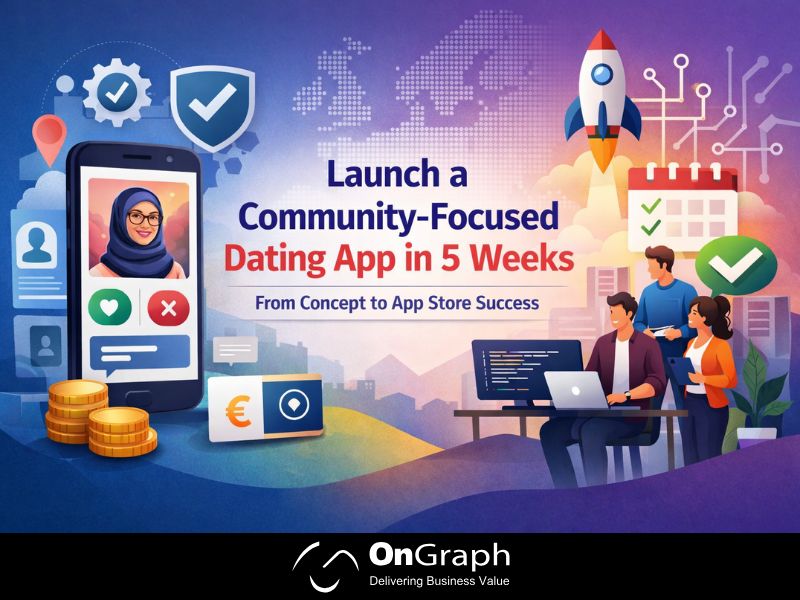
Launching a niche dating platform no longer requires 6–12 months of custom development or seven-figure venture funding. Today, founders can launch a Community-Focused Dating App in just 4–5 weeks by using a structured white-label architecture combined with App Store–compliant positioning. This approach allows entrepreneurs to deploy a fully branded dating or matchmaking platform quickly—without sacrificing scalability, compliance, or long-term monetization potential.
However, speed alone isn’t the advantage.
The real advantage is reducing:
- App Store rejection risk
- Burn rate during validation
- Compliance mistakes (especially in EU markets)
- Infrastructure rework during scale
This guide explains the architecture, cost ranges, approval considerations, and monetization strategy required to launch a community-focused dating app responsibly and sustainably.
The Market Reality: Why Dating Is Competitive but Still Viable
The global online dating market was valued at $9–10+ billion in recent years and continues to grow steadily, driven by mobile adoption and subscription-based revenue models (Statista, Grand View Research).
But here’s what founders often miss:
The market is saturated at the mass level — not at the community level.
Broad competitors like:
- Tinder
- Bumble
- Hinge
dominate general audiences.
Niche platforms — cultural, religious, professional, or interest-based — still show strong retention because they solve a filtering problem, not just a matching problem.
Community alignment reduces noise. Reduced noise improves perceived match quality. That increases subscription conversion.
Launch Your Community Dating App in 5 Weeks — Not 6 Months
Why App Store Rejection Is a Bigger Risk Than Development?
Most founders assume coding is the hard part.
It isn’t.
Approval and compliance are harder.
Both the Apple App Store and Google Play enforce strict policies around:
- User safety
- Content moderation
- Data privacy
- Subscription transparency
- Location tracking permissions
- User reporting systems
Apple’s Review Guidelines (Section 1 & 5 categories) require:
- Clear user-generated content moderation workflows
- Blocking and reporting tools
- Privacy disclosures
- Subscription clarity
In practice, we’ve seen niche dating apps rejected for:
- No visible report button
- Insufficient moderation explanation
- Weak privacy policy structure
- Misleading subscription language
Rejection delays can cost weeks — and burn early marketing momentum.
Architecture Strategy: Custom Build vs Script vs White-Label
1. Fully Custom Build
Typical timeline: 6–9 months
Cost range: €120,000–€250,000+
Pros: Maximum flexibility
Cons:
- High burn rate before validation
- No proven retention benchmarks
- Higher QA instability
This approach makes sense for VC-backed startups — not early-stage validation.
2. Cheap Script-Based Clone
Cost range: €5,000–€15,000
Risks:
- Poor scalability
- Shared code vulnerabilities
- Weak admin controls
- App Store rejection risk
- Limited subscription flexibility
These products often collapse at 5,000–20,000 users due to backend bottlenecks.
3. Structured White-Label Architecture (Balanced Model)
Typical timeline: 4–5 weeks
Cost range: €15,000–€40,000 depending on customization
Monthly infrastructure: €800–€3,000 (scale dependent)
The advantage is not just speed — it’s:
- Proven matching engine
- Modular feature expansion
- Admin-driven monetization
- Store-compliant structure
- Controlled customization
This allows founders to validate community traction before scaling engineering complexity.
Don’t Just Build an App — Build a Sustainable Dating Ecosystem
Dating vs Matchmaking: Strategic Positioning Decision
Many community founders struggle with this:
Should the platform be swipe-based or compatibility-based?
Swipe-Based Dating
- Faster onboarding
- Higher daily engagement
- Subscription upsell opportunities
- Casual discovery model
Compatibility-Driven Matchmaking
- Deeper profiles
- Intent-based filtering
- Slower match cycle
- Premium positioning
Hybrid Model (Early-Stage Recommended)
In practice, hybrid platforms perform best in niche communities.
Recommended launch stack:
- Swipe-based matching
- Intent tagging (serious, marriage, networking)
- Cultural/interest filters
- Event discovery layer (Phase 2)
This reduces user acquisition friction while preserving long-term premium positioning.
Where AI Actually Adds Value (And Where It Doesn’t)
AI is frequently over-marketed in dating.
Phase-based integration works better.
Phase 1 – Launch
- Rule-based filtering
- Preference logic
- Behavior tagging
Phase 2 – Growth
- AI match ranking
- Compatibility scoring
- Behavioral reordering
- Fake profile detection
Retention improves when AI enhances relevance, not when it’s used as a marketing buzzword.
Notably, AI dating platforms differ from AI companion apps like Replika, which simulate emotional interaction rather than connecting real users.
Also read- AI Dating Apps vs AI Companion Apps: Full Comparison Guide
For community platforms, moderation and authenticity matter more than AI conversation simulation.
Admin Infrastructure: The Hidden Monetization Engine
Founders often focus on the mobile UI.
Revenue lives in the backend.
A robust admin panel enables:
- Subscription tier control
- Regional pricing experiments
- Promotion targeting
- Push campaign segmentation
- Moderation management
- Geo-analytics
- Revenue tracking
In production environments, pricing experiments alone can increase ARPU by 15–25% when tested across regions.
Without admin flexibility, monetization becomes static.
Compliance for EU Community Platforms (Critical for Netherlands Launch)
If targeting Europe:
- GDPR compliance is mandatory
- Explicit consent flows are required
- Data deletion workflows are required
- Age verification considerations
- Content reporting logs
Failure to implement compliant data workflows risks regulatory penalties — not just store rejection.
Early architecture decisions must reflect these realities.
5-Week Deployment Framework
1-2 Week
- Brand customization
- UI/UX localization
- Subscription structure setup
- Privacy policy alignment
3 Week
- Feature configuration
- Geo-targeting setup
- QA testing
- Moderation workflow testing
4-5 Week
- Store submission
- Compliance response cycle
- Production deployment
Delays typically occur in documentation — not coding.
Post-Launch Reality: What Happens After Week 5
The first 60 days determine viability.
Key metrics to monitor:
- Day 1 retention (30–40% healthy benchmark)
- Day 7 retention (15–25%)
- Match-to-message ratio
- Subscription conversion rate (2–8% typical niche range)
- CAC vs LTV balance
We’ve seen platforms fail not because of technology — but because:
- Community onboarding stalled
- Moderation capacity was underestimated
- Marketing spend exceeded retention capability
Technology must support growth, not outpace it.
Cost Transparency: Realistic Budget Overview
| Component | Estimated Range |
| White-label license & setup | €15k–€40k |
| Branding & UI customization | €3k–€10k |
| Legal & compliance setup | €2k–€8k |
| Initial marketing budget | €10k–€50k |
| Monthly infrastructure | €800–€3k |
Founders should budget beyond development.
Launch cost ≠ total startup cost.
Turn Your Community Vision Into a Revenue-Ready Dating Platform
From strategy to App Store approval, we build compliant, scalable dating apps designed for subscription growth and retention.
Strategic Conclusion
Launching a community-focused dating platform is no longer about building from scratch.
It’s about:
- Structured architecture
- Compliance awareness
- Monetization readiness
- Phased AI integration
- Backend control
Speed matters — but risk control matters more.
The founders who succeed are not those who build the fastest.
They are those who validate intelligently.
FAQs
The cost to launch a community-focused dating app depends on the architecture approach.
Typical ranges:
- White-label architecture: €15,000–€40,000
- Full custom development: €120,000–€250,000+
- Script-based clone: €5,000–€15,000 (higher scalability risk)
In addition to development, founders should budget for:
- Legal & GDPR compliance: €2,000–€8,000
- Branding & UI customization: €3,000–€10,000
- Initial marketing: €10,000–€50,000
- Monthly infrastructure: €800–€3,000
The biggest mistake is underestimating post-launch marketing and moderation costs. Technology is only one part of the total investment.
Yes — but only under specific conditions.
A 4–5 week launch is realistic if:
- You use a structured white-label architecture
- Core features are predefined (swipe, chat, subscription)
- You avoid major custom feature builds
- Compliance documentation is prepared early
Delays usually happen during:
- App Store review cycles
- Privacy policy revisions
- Subscription configuration errors
A fully custom build rarely ships in under 6 months.
You can’t guarantee approval, but you can significantly reduce risk.
Key compliance requirements include:
- Clear user reporting and blocking tools
- Content moderation workflow
- Transparent subscription terms
- Privacy policy aligned with data collection
- Age verification system
- Explicit consent mechanisms (especially for EU users)
Many apps are rejected due to missing moderation explanation — not because of technical issues.
Compliance-first positioning improves approval odds dramatically.
It depends on your community and revenue model.
Swipe-based apps:
- Faster engagement
- Higher daily active usage
- Strong subscription upsell
Matchmaking platforms:
- Deeper profile filtering
- Slower but higher-intent connections
- Premium positioning
For niche communities, a hybrid model works best:
- Swipe discovery
- Intent tagging
- Cultural filters
- Compatibility scoring (Phase 2)
This reduces onboarding friction while maintaining long-term differentiation.
No — not at launch.
Early-stage success depends more on:
- User density
- Match relevance
- Smooth onboarding
- Community trust
AI becomes valuable during growth for:
- Smart match ranking
- Compatibility scoring
- Behavioral learning
- Fake profile detection
Launching with AI hype but no user base rarely improves retention.
They don’t compete on scale.
They compete on relevance.
Large platforms like:
- Tinder
- Bumble
serve mass audiences.
Community-focused platforms win by offering:
- Cultural alignment
- Language filtering
- Intent clarity
- Lower match noise
- Stronger identity verification
Reduced noise often leads to higher perceived match quality — and stronger subscription conversion.
White-label platforms are ideal for:
- Market validation
- Early monetization
- Community building
You should consider deeper customization or microservices architecture when:
- Active users exceed 100,000+
- Advanced AI becomes core to differentiation
- Complex regional expansion is required
- Unique feature IP becomes strategic
Scaling too early increases burn rate without guaranteed traction.
About the Author

Let’s Create Something Great Together!
Latest Blog
Let’s have a conversation today!


India
ONGRAPH TECHNOLOGIES PRIVATE LIMITED,
SDF L-1, NSEZ,
Sector 81, Block L, Phase-2,
Noida, Uttar Pradesh-201305

USA
OnGraph Technologies,
120 Bethpage Rd, Suite 304,
Hicksville, NY 11801, USA

Canada
7-1039 CEDARGLEN GATE,
Mississauga, Ontario,
Canada L5C 3A7

UK
89 Banstead Road South,
Sutton, Surrey, SM2 5LH
United Kingdom

Malaysia
G-3A, Amaya Maluri, Jalan
Jejaka 2, Taman Maluri,
KL–55100, Malaysia

Singapore
10 Anson Road,#26-04
International Plaza,
Singapore (079903)