


In this article
- What Is Digital Transformation Consulting?
- Why Digital Transformation Matters Now
- 5 Reasons to Hire a Digital Transformation Consulting Firm
- What Does a Digital Transformation Consultant Do?
- Case Study 1: MutualArt’s Scalable Auction Platform
- Case Study 2: Pirkx Benefits Platform
- Challenges in Digital Transformation (And How Consultants Help)
- Why OnGraph Stands Out Among Digital Transformation Consulting Providers?
- Digital Transformation in Healthcare
- How to Choose the Best Digital Transformation Consulting Firm?
- Embracing Agile: The Future of Digital Transformation
- Conclusion
Digital transformation consulting helps businesses improve outdated systems, simplify processes, connect data, and use technology where it can deliver measurable value. A consultant identifies what is slowing the business down and creates a practical roadmap covering technology, processes, people, security, and implementation.
What Is Digital Transformation Consulting?
Digital transformation consulting means working with experts to help your company adopt modern technologies and new ways of working. This includes streamlining operations, improving customer experience, and updating your business model to meet changing demands.
It’s not just about technology—it’s about changing your mindset, culture, and workflows. A good digital transformation consultant brings the knowledge to guide you through this journey, from planning to implementation.
Why Digital Transformation Matters Now?
- 74% of companies prioritize digital transformation to improve operations and create new revenue streams. (Deloitte)
- 89% of organizations have already adopted or are planning a digital-first strategy. (IDC)
- 64% believe building new digital businesses is key to staying competitive post-2025.
With customer expectations evolving and industries becoming more automated, digital transformation in business models is no longer optional—it’s a must.
Turn Your Digital Strategy Into a Working Product
5 Reasons to Hire a Digital Transformation Consulting Firm
Working with digital transformation consulting firms offers clear advantages. Whether you’re a startup or an enterprise, here’s why hiring a business transformation consultant makes sense:
1. Better Use of Resources
Consultants evaluate your tools, platforms, and workflows to reduce waste and prioritize the right projects. This helps improve productivity and cut unnecessary costs.
2. Smarter Talent Planning
Technology is only one part—people are the other. A digital transformation management consulting partner helps assess your team’s skills, plan training, and hire talent with the right digital mindset.
3. Customer-Centric Strategy
Understanding customer needs is key. Consulting teams use research and data to align your services with what customers truly want, improving loyalty and retention.
4. Agility Through Automation
Using automation, you can streamline repetitive tasks and reduce delays. Consultants help integrate automation tools that match your business goals and processes.
5. Change Management Expertise
One of the biggest roadblocks is internal resistance to change. A consultant in digital transformation guides your team through organizational changes, making adoption smoother and faster.
What Does a Digital Transformation Consultant Do?
A good digital transformation consultant will:
1. Assess Your Business
They look at your current systems, workflows, and goals. This helps them build a roadmap that fits your size, industry, and challenges.
2. Recommend the Right Tools
Whether it’s cloud platforms, mobile apps, or automation, they’ll help you choose the right tech stack for your business without unnecessary costs.
3. Redesign Your Processes
Consultants eliminate bottlenecks and digitize key operations. This can include CRM systems, workflow automation, or supply chain tools.
4. Set and Track KPIs
Transformation isn’t a one-time project. Consultants define KPIs and track improvements to ensure long-term growth and adaptability.
Case Study 1: MutualArt’s Scalable Auction Platform

Challenge: MutualArt, an online art auction platform, struggled with server issues, slow deployments, and rising infrastructure costs.
Solution: OnGraph implemented Terraform and AWS Lambda to automate infrastructure. We improved CI/CD with Jenkins and used Datadog for performance tracking.
Result: MutualArt saw better speed, reduced costs, and improved reliability, creating a seamless user experience.
Case Study 2: Pirkx Benefits Platform

Challenge: Pirkx needed a secure and scalable system to manage user data and well-being benefits.
Solution: OnGraph used AWS CodePipeline, Lambda, and Fargate to streamline deployments. Security was improved through AWS Shield and WAF.
Result: With improved database performance and reduced operating costs, Pirkx delivered a more reliable experience to users.
5. Build a Digital Transformation Roadmap
Build a Digital Transformation Roadmap: A consultant turns business priorities into a phased digital transformation roadmap. It identifies what should be improved first, which systems depend on each other, and where early results can be achieved.
Still Running on Outdated Systems? Let’s Modernize
Digital Transformation Consulting Process
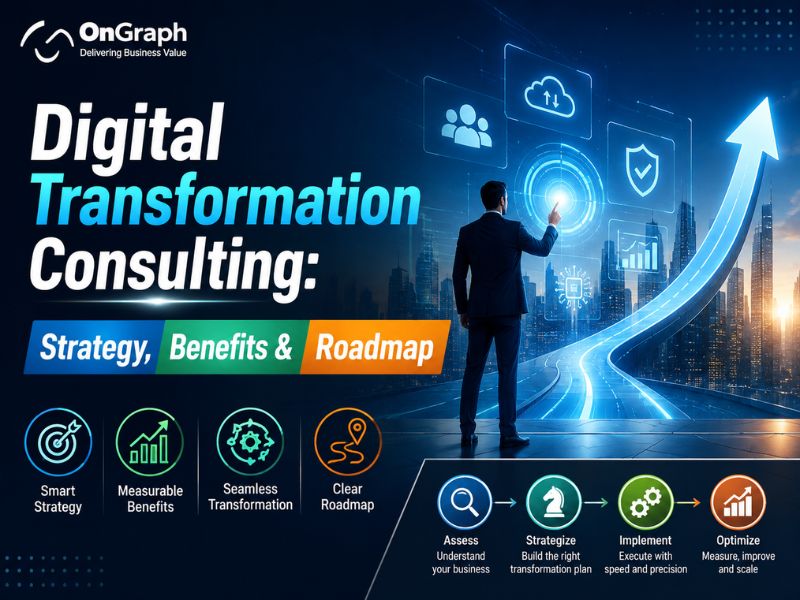
A structured digital transformation consulting process helps businesses move from identifying problems to implementing changes without disrupting daily operations. Start with a current-state assessment, identify gaps, prioritize improvements, create a roadmap, implement changes, and measure results against defined business goals.
- Current-State Assessment – Review systems, workflows, infrastructure, and data.
- Gap Analysis – Find outdated systems, manual work, and integration gaps.
- Prioritization – Rank improvements by impact, cost, and urgency.
- Roadmap – Define timelines, responsibilities, and dependencies.
- Implementation – Modernize, integrate, migrate, or automate.
- Measurement – Track results and improve continuously.
How to Build a Digital Transformation Roadmap
A digital transformation roadmap connects business goals with specific technology and process improvements. Start by identifying the problems costing the most time or money, systems holding teams back, improvements that can deliver quick value, and changes requiring long-term investment. Group initiatives into short-, medium-, and long-term priorities rather than trying to transform everything at once.
Challenges in Digital Transformation (And How Consultants Help)
1. Lack of Strategy
Without a solid plan, digital projects often fail. Consulting partners bring a structured approach with achievable milestones.
2. Talent Shortages
44% of companies lack digital skills in cloud, mobile, or cybersecurity. Consultants either fill the gap or train your team.
3. Customer Expectations
Your users want fast, personalized experiences. Consultants help design intuitive systems that meet these needs.
4. Resistance to Change
Employee pushback is common. Consultants use clear communication and phased rollouts to ease transitions.
5. Security Concerns
As digital tools grow, so do threats. Strong cybersecurity and compliance strategies are built into every consultant’s plan.
6. Budget Constraints
The cost of digital transformation can be high. Consultants help optimize investment by choosing tools with high ROI and scaling gradually.
7. Legacy Systems and Integration Complexity
Older applications often contain important business data and cannot simply be replaced overnight. A digital transformation consultant can map dependencies and decide whether each system should be modernized, integrated, migrated, or gradually replaced. Legacy systems can slow down growth and make integrations difficult. Using cloud migration services can help businesses modernize outdated systems and move applications to a more scalable cloud environment.
How to Measure Digital Transformation ROI
Digital transformation should be measured by business outcomes, not by how many new tools have been implemented. Define a baseline before starting and track KPIs connected to the problem being solved.
| Business Goal | Metrics to Track |
| Reduce Costs | Cost per transaction, infrastructure costs, manual work hours |
| Improve Efficiency | Processing time, automation rate, employee productivity |
| Improve Customer Experience | Conversion rate, customer retention, response time |
| Application Modernization | Downtime, application performance, deployment frequency |
| Increase Digital Revenue | Online conversions, digital sales, revenue per user |
| Reduce Risk | Vulnerabilities, security incidents, compliance issues |
Before setting a transformation budget, understand the key factors that drive digital transformation costs and how those investments relate to expected business value.
Digital Transformation Consulting vs In-House Transformation
An internal team can work well for a focused, well-defined project. A consulting partner becomes more useful when transformation involves legacy systems, multiple applications, integrations, cloud migration, security requirements, or major process changes. A hybrid model can also work well, with internal teams retaining business ownership while specialists provide technical expertise and implementation capacity.
Why OnGraph Stands Out Among Digital Transformation Consulting Providers
Here’s how OnGraph helps businesses unlock value from transformation:
Tailored Strategies
We don’t believe in one-size-fits-all. Every business has a different structure, team, and target market. Our solutions are built around that.
Change Management Leadership
We guide teams through new systems, ensuring everyone—from leadership to operations—is onboard and confident.
Focus on Results
We work backward from your business goals, whether it’s revenue growth, reduced churn, or better customer experience.
Upskilling and Training
We help bridge the gap with custom training plans for your workforce. From cybersecurity to cloud computing, your team gets future-ready.
Strong Security Practices
We implement best-in-class protection for your data, customers, and workflows.
Low-Code and No-Code Solutions
To reduce tech overhead, we implement platforms that let non-tech teams operate independently. Low-code tools can reduce development effort and speed up delivery for suitable use cases.
Digital Transformation in Healthcare
If you’re in healthcare, healthcare digital transformation consulting is even more important. From telehealth platforms to patient data integration and secure access controls, OnGraph helps healthcare providers modernize while meeting HIPAA and other regulatory standards.
How to Choose the Best Digital Transformation Consulting Firm?
Keep these in mind when hiring:
- Personalization: Ensure the firm tailors their roadmap to your business—not a general template.
- Business Outcome Alignment: Check if they help you define and track ROI, customer satisfaction, or sales impact.
- Exit Strategy: Great consultants empower your internal teams, so you don’t rely on them forever.
When comparing digital transformation consulting firms, look beyond technology lists. The right partner should understand your business problem, create a clear implementation plan, define measurable outcomes, and have the technical capability to carry the project through implementation.
Build Technology That Fits Your Business
How Agile Supports Digital Transformation
Agile is key to successful digital transformation. According to McKinsey, 68% of companies that use agile frameworks report faster product launches and improved collaboration.
Benefits of Agile in transformation:
- Flexible and fast implementation
- Better communication between IT, marketing, and business teams
- Faster response to market changes
- Continuous improvement and learning
Conclusion
Digital transformation is no longer optional—it’s essential. But trying to handle it without expert help can result in delays, wasted budgets, or failure.
That’s why Digital Transformation Consulting Services are so important. With the right consultant, you get strategic support, faster results, and scalable systems built for long-term success.
Whether you’re starting fresh or scaling a digital initiative, partner with OnGraph, one of the best digital transformation consulting providers, and turn your business into a modern, agile, and customer-focused enterprise.
FAQs
Digital Transformation Consulting is the process of partnering with expert consultants to help businesses adopt modern technologies, improve operations, and transform customer experiences. It involves strategic planning, selecting the right tools, redesigning workflows, and driving cultural change. These consultants ensure that companies align their digital efforts with clear business goals for long-term growth.
Hiring a digital transformation consultant brings expertise, fresh perspectives, and proven frameworks to manage complex change. Consultants evaluate your current setup, identify growth opportunities, implement digital tools efficiently, and help upskill your team. They also guide you through change management, helping reduce resistance and ensure smooth adoption across departments.
Digital transformation consulting services typically include:
- Business and IT assessment
- Strategy development and planning
- Process automation and optimization
- Technology adoption (cloud, mobile, data analytics)
- Cybersecurity and compliance
- Change management and training
Performance tracking and KPI reporting
Some firms also specialize in niche domains like healthcare digital transformation consulting with regulatory compliance.
The cost of digital transformation consulting varies based on the project size, industry, complexity, and duration. Small businesses may spend $10,000–$50,000 for specific services, while enterprise-scale transformations can range from $100,000 to several million dollars. The right consulting partner will provide a clear roadmap and pricing structure to ensure a high return on investment.
The timeline depends on the scope of your transformation. Small process updates may take 2–3 months, while full-scale transformations—such as overhauling operations, infrastructure, and customer systems—can take 12–18 months or more. Digital transformation consulting firms typically offer phased implementation with continuous improvements to allow businesses to see early benefits while scaling gradually.
Key challenges include:
- Lack of a clear digital strategy
- Employee resistance to change
- Shortage of digital skills
- Cybersecurity risks
- Budget limitations
- Difficulty adapting to evolving customer needs
Business transformation consultants help you overcome these challenges by offering structured strategies, training, secure systems, and stakeholder engagement.
Look for the best digital transformation consulting providers by checking:
- Their experience in your industry
- Client success stories and case studies
- Their ability to offer customized strategies
- Proven frameworks for change management and training
- Support for both short-term implementation and long-term growth
Also, ensure they align their work with your business outcomes and provide ongoing support even after the initial rollout.
About the Author

Let’s Create Something Great Together!
Latest Blog


Let’s have a conversation today!


India
ONGRAPH TECHNOLOGIES PRIVATE LIMITED,
SDF L-1, NSEZ,
Sector 81, Block L, Phase-2,
Noida, Uttar Pradesh-201305

USA
OnGraph Technologies,
120 Bethpage Rd, Suite 304,
Hicksville, NY 11801, USA

Canada
7-1039 CEDARGLEN GATE,
Mississauga, Ontario,
Canada L5C 3A7

UK
89 Banstead Road South,
Sutton, Surrey, SM2 5LH
United Kingdom

Malaysia
G-3A, Amaya Maluri, Jalan
Jejaka 2, Taman Maluri,
KL–55100, Malaysia

Singapore
10 Anson Road,#26-04
International Plaza,
Singapore (079903)