


In this article
- What “Off-the-Shelf” Means in Market Research Software?
- The Hidden Cost of SaaS-First Research Stacks
- What Custom Market Research Software Development Actually Means?
- Direct Comparison: Off-the-Shelf vs Custom vs Hybrid
- When Off-the-Shelf Survey Software Tools Are the Right Choice?
- When Custom Market Research Solutions Win?
- Emerging Trends in Market Research That Change This Decision
- A Practical Framework to Decide
- Blueprint for a Modern Research Stack
- The Role of a Market Research Software Development Company
- Final Verdict: What Actually Works?
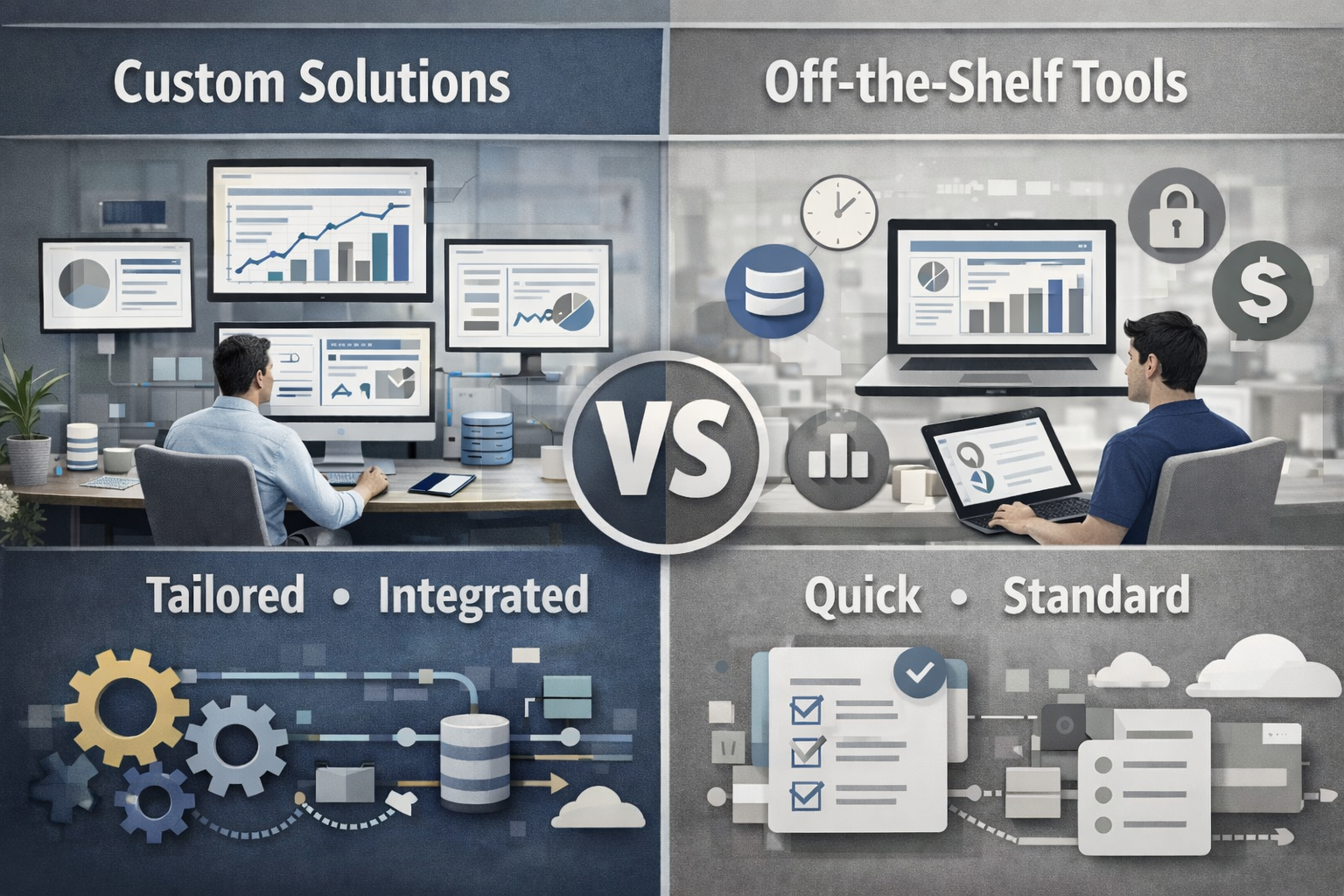
Custom Market Research Solutions vs Off-the-Shelf Tools is not a feature comparison.
It is a workflow, governance, and long-term cost decision.
If you choose wrong, you inherit:
- Data silos
- SaaS sprawl
- Compliance risk
- Manual panel operations
- Expensive workarounds
If you choose right, your Market Research Software becomes an operational advantage.
This guide breaks down when to use:
- Survey Software Tools
- Online Survey Platforms
- Panel Management Software
- Enterprise Market Research Platforms
- Or invest in Custom Market Research Software Development
We’ll also cover Emerging Trends in Market Research that are reshaping this decision.
What “Off-the-Shelf” Means in Market Research Software?
Off-the-shelf typically refers to SaaS-based:
- Online Survey Platforms
- Survey Software Tools
- Insight dashboards
- Enterprise Market Research Platforms with bundled features
These tools are optimized for standard research workflows:
- NPS
- CSAT
- Employee pulse
- Concept testing
- Basic segmentation
They reduce setup time.
Minimize technical overhead.
They allow small teams to launch quickly.
Where They Work Best
Off-the-shelf tools are ideal when:
- Your studies follow repeatable templates
- You do not manage your own panel
- Don’t need complex incentive logic
- Integrations are limited to pre-built connectors
- You can accept vendor-defined data models
In early-stage or mid-size teams, this can be the right decision.
But speed comes with structural trade-offs.
Build the Right Market Research Platform — Not Just Another Tool
The Hidden Cost of SaaS-First Research Stacks
In practice, we’ve seen enterprises accumulate multiple Survey Software Tools over time:
- One for product research
- One for HR pulse
- 1 for customer feedback
- One inherited from an acquisition
The result?
- Fragmented respondent IDs
- Duplicate incentive tracking
- Inconsistent metadata
- Manual data reconciliation
According to Flexera, enterprises regularly add new SaaS apps each month. Over time, this increases integration overhead and security surface area.
Cloud spending continues rising as well. Gartner forecasts public cloud spending at $675.4B in 2024 and $723.4B in 2025. More research stacks are cloud-based — and more dependent on vendors.
Speed is easy to buy.
Governance is not.
What Custom Market Research Software Development Actually Means?
Custom does not mean building everything from scratch.
It means designing the workflow and data architecture around your business — then integrating best-in-class tools where appropriate.
Custom Market Research Software Development typically includes:
- Custom survey standards and validation logic
- Full Panel Management Software workflows
- Sampling rules and fraud controls
- Incentive automation and tax logic
- Unified respondent ID architecture
- Data pipelines to BI and data warehouses
- Role-based access for agencies and enterprise teams
Instead of adapting to vendor constraints, you design the system around your operational reality.
This is why demand for tailored software continues to grow. Grand View Research estimates the global custom software development market at $43.16B in 2024.
Organizations increasingly need differentiated workflows — not generic dashboards.
Direct Comparison: Off-the-Shelf vs Custom vs Hybrid
| Factor | Off-the-Shelf Tools | Custom Market Research Solutions | Hybrid Approach |
| Time to launch | Fast | Moderate upfront | Fast core, custom layers |
| Workflow fit | Limited | Exact match | High where it matters |
| Panel operations | Basic or add-on | Fully controlled | Custom core |
| Data model control | Vendor-defined | You define | Shared |
| Integrations | Pre-built | Unlimited (planned) | Flexible |
| Governance | Vendor-dependent | Designed internally | Component-based |
| Long-term cost | Subscription growth | Build + optimization | Balanced |
| Differentiation | Low | High | Medium–High |
In practice, a hybrid often wins.
Keep standard survey authoring SaaS.
Build custom data and panel operations where you compete.
When Off-the-Shelf Survey Software Tools Are the Right Choice?
Choose Online Survey Platforms when:
1. You Need Immediate Deployment
Campaign launches, product testing deadlines, or internal pulse surveys often require speed.
Off-the-shelf wins.
2. Research Is Standardized
If 80% of your studies follow the same template and reporting structure, the efficiency gain is real.
3. Panel Ownership Is Not Core
If you rely on external panels and don’t manage respondent lifecycle internally, complexity is lower.
4. Governance Can Be Vendor-Led
If compliance, residency, and security requirements are met by vendor certifications, SaaS may suffice.
But once panel operations grow or integration needs deepen, friction increases.
When do Custom Market Research Solutions Win?
Custom becomes strategic when constraints turn into operational costs.
1. You Operate Your Own Panel
Panel Management Software is not just survey logic. It includes:
- Identity validation
- Profiling updates
- Fraud detection
- Quota balancing
- Incentive fulfillment
- Tax documentation
- Duplicate response controls
In one enterprise case we reviewed, incentive reconciliation was handled manually in spreadsheets. At scale, this created accounting exposure and delayed payouts by weeks.
Off-the-shelf survey tools were never designed for that operational burden.
Custom solves it by design.
2. You Need Deep System Integrations
Modern research connects to:
- CRM systems
- CDPs
- Product analytics
- BI tools
- Data warehouses
Pre-built connectors rarely match your internal data contracts.
In hybrid builds we’ve seen succeed, teams keep Online Survey Platforms for authoring but implement a custom orchestration layer to enforce consistent respondent IDs and schema governance.
This eliminates reconciliation work across studies.
3. You Require Compliance by Architecture
Research data includes personal data.
According to IBM, the average data breach cost reached $4.88M in 2024.
Security is not a checkbox.
It is an architectural decision.
Custom platforms allow:
- Data residency enforcement
- Consent tracking
- Role-based access
- Audit logging
- Automated retention policies
Enterprise Market Research Platforms often provide security — but rarely tailored governance models.
4. You Want Differentiation
If you are an agency or enterprise research team offering proprietary insight workflows, generic tools limit your positioning.
Custom infrastructure becomes a competitive moat.
Hybrid or Custom? Let’s Architect the Right Research Stack
Emerging Trends in Market Research That Change This Decision
Understanding Emerging Trends in Market Research clarifies why hybrid and custom models are increasing.
1. Automation With Oversight
Market Research Automation Tools are growing rapidly.
Automation now covers:
- Survey distribution
- Fraud detection
- Incentive payouts
- Reporting dashboards
- Data cleaning
However, over-automation reduces response quality if not governed properly.
The winning pattern:
Automate repeatable risk-heavy processes.
Keep interpretation human.
2. Hybrid Cloud Adoption
Gartner expects continued hybrid cloud growth through 2027.
Research platforms increasingly combine:
- SaaS authoring tools
- Custom APIs
- Private data warehouses
Hybrid architectures mirror hybrid infrastructure trends.
3. Cost Optimization Pressure
Cloud cost growth and SaaS waste are forcing stricter TCO analysis.
Subscription-based Survey Software Tools scale with:
- Seats
- Responses
- Modules
- Panel usage
Custom builds require upfront investment but may optimize long-term cost at scale.
A Practical Framework to Decide
Use this operational scorecard.
1st Step: Define Non-Negotiables
- Data residency requirements
- Incentive compliance needs
- Required integrations
- Panel governance rules
2nd Step: Map Workflow End-to-End
From sampling to reporting.
Include manual steps.
3rd Step: Calculate Workaround Cost
Track:
- Manual hours per study
- Reconciliation time
- Duplicate handling effort
In one audit scenario, reconciliation across three survey systems added 5–7 hours per study cycle. That scaled into thousands of annual labor hours.
4th Step: Choose a Pattern
You have three strategic models:
Buy-First – Speed prioritized
Build-First – Differentiation prioritized
Hybrid-by-Design – Standardize surveys, customize operations
Most Enterprise Market Research Platforms evolve into hybrid ecosystems.
Blueprint for a Modern Research Stack
If you pursue Custom Market Research Software Development, structure it in layers:
1st Layer: Unified Data Layer
- Central respondent ID
- Consent and audit metadata
- Study versioning
- Quality flags
2nd Layer: Workflow Services
- Panel onboarding
- Fraud detection
- Incentive automation
- Quota routing
- Approval workflows
3rd Layer: Tool Integrations
- Survey Software Tools
- Messaging systems
- BI dashboards
- CRM connectors
This reduces SaaS chaos while preserving agility.
The Role of a Market Research Software Development Company
Custom builds fail when the architecture is rushed.
A qualified Market Research Software Development Company should:
- Conduct discovery before coding
- Define extensible data models
- Design for compliance early
- Plan migration and exit strategies
- Document maintainability standards
Custom without governance becomes tech debt.
Custom with architecture becomes an asset.
Launch a Custom Market Research Solution That Scales
From panel management software to automation tools, we develop research systems built for enterprise performance.
Final Verdict: What Actually Works?
Custom Market Research Solutions vs Off-the-Shelf Tools is not binary.
Off-the-shelf tools win when:
- Research is standardized
- Speed is critical
- Panel ownership is minimal
Custom wins when:
- Panel operations are core
- Integrations are deep
- Governance is strict
- Differentiation matters
FAQs
The main difference lies in workflow ownership and data control.
Off-the-shelf tools (such as Online Survey Platforms and Survey Software Tools) provide standardized features, predefined data models, and vendor-controlled roadmaps. They are fast to deploy and ideal for common research use cases like NPS or CSAT.
Custom Market Research Solutions are built around your specific workflows. They allow full control over:
- Panel Management Software operations
- Data architecture and respondent IDs
- Incentive logic and compliance workflows
- Deep integrations with CRM, CDP, and BI systems
In short:
- Off-the-shelf = speed and convenience
- Custom = flexibility, governance, and differentiation
Most enterprises adopt a hybrid approach.
You should consider Custom Market Research Software Development when:
- You manage your own research panel
- Incentive automation is complex
- Data must integrate deeply with enterprise systems
- Compliance and data residency are strict
- You need proprietary workflows as a competitive advantage
If manual workarounds are increasing or reconciliation across tools takes hours per study, custom development often becomes cost-effective long-term.
Enterprise Market Research Platforms are powerful but not always sufficient.
They work well for:
- Centralized survey management
- Standardized reporting
- Organization-wide feedback programs
However, they may struggle with:
- Custom panel lifecycle management
- Unique incentive models
- Complex quota routing
- Highly customized governance rules
Large organizations often extend enterprise platforms with custom services to avoid vendor lock-in and workflow constraints.
Relying solely on Online Survey Platforms can create:
- Data silos
- Duplicate respondent records
- Inconsistent metadata
- Limited control over integrations
- Vendor dependency risks
As cloud adoption rises (per Gartner forecasts), dependency on SaaS ecosystems increases. Without architectural planning, research stacks can become fragmented and costly.
The risk isn’t the platform itself — it’s unmanaged expansion.
Market Research Automation Tools automate:
- Survey distribution
- Panel routing
- Fraud detection
- Incentive payouts
- Reporting dashboards
Automation improves efficiency and reduces human error. However, over-automation without governance can reduce response quality.
The best practice:
Automate operational friction.
Keep insight interpretation human-led.
Automation should support your research process — not define it.
Short-term: yes.
Long-term: not always.
SaaS subscription costs grow with:
- Seats
- Responses
- Modules
- Panel size
Custom Market Research Solutions require upfront investment but may reduce:
- License overlap
- Reconciliation labor
- Integration inefficiencies
- Vendor dependency costs
Total Cost of Ownership (TCO) should include:
- Manual hours per study
- Data cleanup effort
- Compliance risk exposure
- Exit strategy complexity
At scale, custom or hybrid models often become economically rational.
Choosing a Market Research Software Development Company requires evaluating:
1. Discovery process before development
2. Experience with panel workflows and incentive systems
3. Knowledge of compliance and data governance
4. Integration expertise (CRM, BI, CDP)
5. Architectural planning capability
6. Post-launch support and documentation
Avoid vendors who jump straight into coding.
The right partner designs architecture first — features second.
About the Author

Let’s Create Something Great Together!
Latest Blog


Let’s have a conversation today!


India
ONGRAPH TECHNOLOGIES PRIVATE LIMITED,
SDF L-1, NSEZ,
Sector 81, Block L, Phase-2,
Noida, Uttar Pradesh-201305

USA
OnGraph Technologies,
120 Bethpage Rd, Suite 304,
Hicksville, NY 11801, USA

Canada
7-1039 CEDARGLEN GATE,
Mississauga, Ontario,
Canada L5C 3A7

UK
89 Banstead Road South,
Sutton, Surrey, SM2 5LH
United Kingdom

Malaysia
G-3A, Amaya Maluri, Jalan
Jejaka 2, Taman Maluri,
KL–55100, Malaysia

Singapore
10 Anson Road,#26-04
International Plaza,
Singapore (079903)