


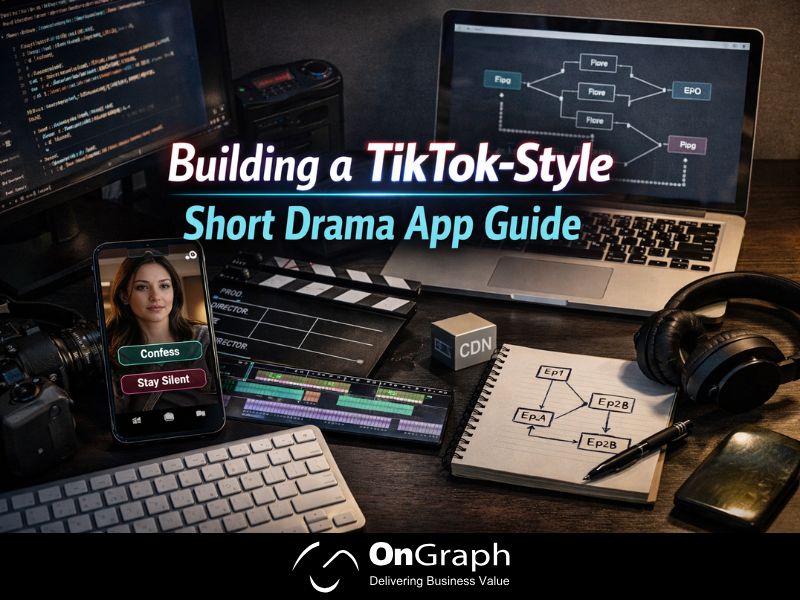
Building a TikTok-style short-drama platform is not conventional OTT app development services work.
It is interactive, low-latency media engineering with a completely different performance threshold:
- Instant swipe playback
- Near-zero buffering tolerance
- Secure content delivery
- Branching episode logic
- Batch publishing workflows
- Event-level behavioral analytics
Many founders approach this as a variation of Netflix-style OTT platforms. That assumption leads to architectural mistakes, under-scoped budgets, and incorrect expectations about OTT app development cost.
In this consultation, a media startup wanted:
- Platform-owned content (no user uploads)
- TikTok-style immersive vertical feed
- Subscription-led monetization
- 100–200+ batch uploads
- Branching story trees (“choose the next episode”)
What initially looks like a “simple feed app” quickly becomes a scalable backend architecture challenge.
Below is the production-grade approach we recommended — engineered for performance, security, and long-term growth.
Ready to Launch Your Own OTT App?
Why This Is Not “Just Another OTT App
Many founders compare vertical drama platforms to traditional streaming services when evaluating the cost to develop an app like Netflix.
That comparison breaks down immediately.
1. Swipe Feeds Have Far Lower Latency Tolerance
In traditional OTT environments, users accept initial buffering.
In swipe-first products, they do not.
Mobile performance research consistently shows that even a one-second delay significantly reduces engagement and conversion rates. In swipe environments, the effect compounds because:
- Users swipe every few seconds
- Every swipe is a new loading event
- Latency is perceived repeatedly
In production environments, we’ve seen:
- 200–300ms startup improvements increase completion rates
- Poor edge delivery causes measurable retention drops within 48 hours post-launch
Swipe-first architecture requires:
- Aggressive preload strategies
- Edge-optimized delivery
- Payload discipline
- Tight player lifecycle management
This is not standard OTT behavior — and it directly impacts OTT app development cost, because performance engineering must be prioritized early.
2. Content-Owned Platforms Require Enterprise-Grade Security
Unlike UGC platforms, this model relies on platform-owned IP.
That shifts the risk profile dramatically.
Security requirements include:
- Signed playback URLs
- Tokenized access control
- Restricted API exposure
- Strict admin RBAC
- Publishing audit logs
When founders plan to launch your own OTT app with original IP, security is not optional — it protects revenue-generating assets.
Treating security as a post-MVP add-on leads to costly re-architecture later.
3. Branching Episodes Transform the Data Model
Traditional OTT series are linear:
Episode 1 → 2 → 3 → 4
Branching narratives are graph structures:
Episode 1
→ Choice A → Episode 2A
→ Choice B → Episode 2B
Which may branch further.
This impacts:
- Database schema
- Admin UI
- Player state handling
- Deep linking
- Analytics modeling
Recommended Data Model
Entities:
| Entity | Purpose |
| Drama | Series container |
| Episode | Individual playable unit |
| Branch Rule | Directed edge with labeled choice |
Example structure:
episode_id → [
{ label: “Confess”, next_episode_id: 12 },
{ label: “Stay Silent”, next_episode_id: 13 }
]
Production safeguards should include:
- Loop validation
- Orphan node detection
- Leaf node tagging
- Pre-publish integrity checks
Without these controls, content teams accidentally break story trees.
This is why interactive drama apps cannot be scoped like basic OTT app development services projects.
Turn Your Content Into a Scalable OTT Business
Production Architecture Blueprint
1. Mobile Client: Flutter for Speed + Consistency
For cross-platform efficiency, we recommend Flutter.
Benefits:
- Single codebase (Android + iOS)
- High-performance rendering
- Smooth feed animations
- Faster iteration cycles
However, cross-platform does not eliminate:
- iOS certificate management
- Store compliance preparation
- Platform-specific media optimization
Teams evaluating OTT app development cost often underestimate platform-specific overhead.
2. CDN-First Streaming Strategy
A vertical drama app must be architected CDN-first.
Core principles:
- HLS or adaptive streaming formats
- Multiple bitrate profiles
- Edge caching
- Signed playback URLs
- Lightweight feed APIs
Skipping CDN-first design results in:
- Buffering complaints
- App store rating drops
- High origin bandwidth costs
- Poor retention
When founders ask about the cost to develop an app like Netflix, they often overlook CDN engineering — which is essential for swipe-based platforms.
3. The Admin Panel Is the Real Product
In every large-scale media build, the real bottleneck was content operations.
Required admin capabilities:
- Dynamic homepage widgets
- Hero banner configuration
- Content flags (Exclusive, New, Pre-cache)
- Metadata validation
- Bulk upload tools
- Publishing state control
Content merchandising drives:
- Subscription conversions
- Discoverability
- Retention
- Upgrade behavior
If you’re planning to launch your own OTT app, your admin backend must scale as aggressively as your consumer UI.
4. Bulk Uploading for 100–200+ Episodes
High-volume content requires:
- Structured CSV/JSON imports
- File naming conventions
- Server-side processing queues
- Error dashboards
- Retry mechanisms
In practice, we’ve seen launch timelines slip by 4–6 weeks when batch upload tooling is ignored during early scoping.
Bulk workflows directly influence OTT app development cost — because retrofitting them later is expensive.
5. Analytics as a Growth Engine
Analytics is not optional.
It determines:
- Which genres convert
- Where users drop off
- Which branch paths improve retention
- Subscription funnel leaks
Core Event Instrumentation
- feed_impression
- video_start
- video_complete
- episode_choice_selected
- branch_path_depth
- subscription_viewed
- subscription_purchased
Event definitions must be finalized before development begins.
Teams that treat analytics as a post-launch addition struggle to optimize monetization.
For interactive drama platforms, analytics is monetization intelligence.
Common Architecture Mistakes in Short Drama Platforms
- Treating branching logic as a UI feature instead of a data architecture problem
- Skipping CDN edge optimization during MVP
- Ignoring content operations tooling
- Overexposing content APIs
- Tracking vanity metrics instead of retention drivers
Avoiding these mistakes protects long-term scalability and reduces unexpected increases in OTT app development cost.
Realistic Delivery Roadmap
A production-grade launch typically requires:
- Discovery + UX mapping (2–3 weeks)
- Interactive flow prototyping
- Backend schema + branch validation
- Flutter development sprint
- CDN integration + media pipeline setup
- Analytics instrumentation
- Scroll stress performance testing
- Store deployment support
Realistic timeline: 12–16 weeks
Anything significantly shorter often sacrifices scalability or security.
Build a TikTok-Style Drama App That Performs
Get low-latency playback, secure content delivery, and seamless branching stories—engineered for growth.
Final Takeaway
If you’re evaluating OTT app development services, understand this:
A vertical short-drama app with branching episodes is not:
- A simple feed UI
- A Netflix clone
- A lightweight MVP
It is:
- A low-latency system
- A graph-driven backend
- An analytics-powered monetization engine
- A security-sensitive IP platform
When planning to launch your own OTT app, especially an interactive one, the real differentiators are:
- Performance = retention
- Admin workflows = growth
- Analytics = revenue intelligence
- Security = long-term value protection
The true cost to develop an app like Netflix is not just development hours.
It is architectural decisions made on day one.
Ship fast — but engineer for scale from the start.
FAQs
The cost of building a TikTok-style short drama app depends on:
- Video streaming architecture (CDN, transcoding, storage)
- Branching episode logic complexity
- Admin panel sophistication
- Subscription and payment integration
- Analytics implementation depth
For a production-grade platform (Flutter app + backend + admin + CDN + analytics), budgets typically range from:
- $80,000 – $200,000+ for initial launch
- Ongoing costs for CDN bandwidth, storage, and infrastructure scale with usage
The largest cost drivers are:
- Media delivery bandwidth
- Interactive branching complexity
- Content operations tooling
Cutting architecture early often leads to expensive rebuilds later.
Yes — when engineered correctly.
Flutter itself is not the bottleneck. The real performance factors are:
- Proper video player lifecycle management
- Preloading strategy for next-in-feed content
- Memory optimization
- CDN edge latency
With a well-architected backend and CDN-first delivery, Flutter performs reliably for vertical swipe feeds on both Android and iOS.
The biggest performance failures usually stem from backend design, not Flutter.
Branching episodes allow viewers to choose what happens next in a story.
Technically, this is implemented as a graph structure, not a linear sequence.
Each episode node connects to multiple possible next episodes:
Episode 1
├── Choice A → Episode 2A
└── Choice B → Episode 2B
Implementation requires:
- Graph-based database relationships
- Admin-defined choice mappings
- Loop validation rules
- Playback state management
- Event tracking for branch selection
Without structural validation, story trees can break during publishing.
Vertical swipe apps require extremely low startup latency.
A Content Delivery Network (CDN):
- Delivers video from edge servers close to users
- Reduces buffering
- Improves startup speed
- Decreases the origin server load
- Reduces churn caused by delays
Without CDN-first architecture, buffering increases under traffic spikes — which directly impacts retention and store ratings.
For swipe feeds, CDN is not optional — it is foundational.
Most platforms use a subscription-first model.
Common monetization methods:
- Monthly or yearly subscriptions
- Tiered access (free episodes → paywalled content)
- Ad-supported hybrid models
- Early-access premium content
- Pay-per-branch or special endings
Subscription-led growth works best when:
- Analytics tracks drop-off points
- Premium gates are placed strategically
- Retention signals inform pricing strategy
Monetization should be integrated into the architecture from day one.
Content protection strategies include:
- Signed, time-limited playback URLs
- Tokenized CDN access
- Encrypted streaming formats
- DRM integration when required
- Backend permission controls
- Admin audit logs
Exposing open video endpoints significantly increases piracy risk.
Security decisions directly protect long-term IP value.
A realistic timeline for a production-ready platform is:
- 2–3 weeks: Discovery + UX mapping
- 3–4 weeks: Backend architecture + branching logic
- 4–6 weeks: Flutter app development
- 2–3 weeks: Testing, CDN optimization, analytics instrumentation
Total: 12–16 weeks for a stable launch.
Anything significantly shorter typically sacrifices scalability or stability.
About the Author

Let’s Create Something Great Together!
Latest Blog

Let’s have a conversation today!


India
ONGRAPH TECHNOLOGIES PRIVATE LIMITED,
SDF L-1, NSEZ,
Sector 81, Block L, Phase-2,
Noida, Uttar Pradesh-201305

USA
OnGraph Technologies,
120 Bethpage Rd, Suite 304,
Hicksville, NY 11801, USA

Canada
7-1039 CEDARGLEN GATE,
Mississauga, Ontario,
Canada L5C 3A7

UK
89 Banstead Road South,
Sutton, Surrey, SM2 5LH
United Kingdom

Malaysia
G-3A, Amaya Maluri, Jalan
Jejaka 2, Taman Maluri,
KL–55100, Malaysia

Singapore
10 Anson Road,#26-04
International Plaza,
Singapore (079903)