


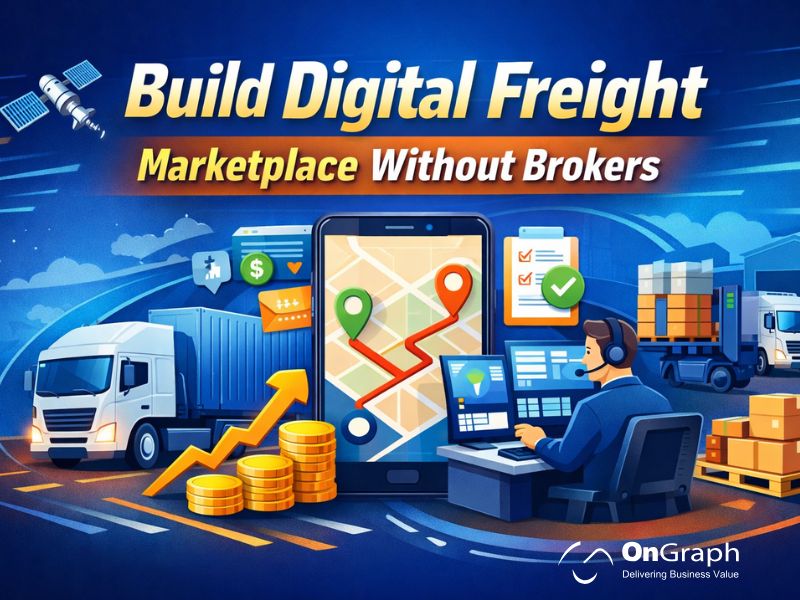
A growing logistics business needed to eliminate broker dependency and build digital freight marketplace without brokers, similar to Uber—but designed specifically for trucks and commercial loads. Through our Custom App Development Services, we proposed a white-label, scalable dispatch platform with driver onboarding, geofencing, commission management, and real-time tracking. The result was a monetizable freight ecosystem, reduced operational friction, and a significantly faster go-to-market strategy.
In this article
- From Broker Dependency to Digital Freight Platform: A Real Logistics Transformation Story
- The Scenario: Fragmented Freight Discovery in a Growing Logistics Market
- Why Off-the-Shelf Solutions Wouldn’t Work?
- Our Expert Diagnosis: Build a Load Aggregation Platform with Taxi-Like Dispatch Logic
- The Technical Solution: A Scalable Freight Dispatch Ecosystem
- Scalable Backend Architecture
- What About Payments?
- Taxi App vs Freight Marketplace: Key Differences
- Estimated Taxi App Development Cost vs Freight Customization
- Projected Commercial Outcomes
- Why Custom App Development Services Matter Here?
- What This Means for Freight & Transport Entrepreneurs?
- The Bigger Opportunity: Digital Freight in Emerging Markets
- Final Thoughts: From Operational Problem to Platform Business
- Facing Similar Logistics or Mobility Challenges?
- Ready to Build Your Freight or Mobility Platform?
From Broker Dependency to Digital Freight Platform: A Real Logistics Transformation Story
In today’s on-demand economy, industries are rapidly shifting toward digital platforms. We’ve seen The Evolution of Taxi Apps reshape urban mobility. But what happens when similar inefficiencies exist in logistics and freight?
A recent West African logistics entrepreneur approached us with a challenge. He owned a trucking and commodity movement business. His biggest problem was not trucks. It was load discovery.
Truck owners and drivers struggled to find loads. They depended heavily on brokers and middlemen. Every load required multiple calls. Commissions ate into margins. Time was lost daily.
He asked a simple but powerful question:
“Can we build an Uber-like system—but for trucks and freight?”
This is where our expertise in Custom App Development Services and Scalable Backend Architecture came into play.
Turn Your Logistics Problem into a Profitable Digital Platform
The Scenario: Fragmented Freight Discovery in a Growing Logistics Market
The client operated a logistics and commodity transport business. His trucks moved goods from one region to another. But the system was inefficient.
The Core Problems:
- Drivers had to call multiple agents to find loads.
- Brokers controlled load information.
- Commission costs reduced profit margins.
- There was no centralized load marketplace.
- Scaling beyond local networks was difficult.
The opportunity was clear: create a digital platform where:
- Truck owners register vehicles.
- Drivers search and accept loads.
- Shippers post loads.
- Dispatchers manage operations.
- The platform owner earns commission per transaction.
Essentially, a two-sided freight marketplace.
But building such a system requires more than copying a taxi app model.
Why Off-the-Shelf Solutions Wouldn’t Work?
At first glance, it may seem easy to modify a taxi solution. However, logistics introduces structural differences.
A simple ride-hailing clone cannot support:
- Load capacity variations (1-ton, 2-ton, multi-axle trucks)
- Fleet ownership structures
- Commercial documentation verification
- Commission models per vehicle category
- Manual dispatcher overrides
- Region-wise operational controls
A freight system is not just transport—it is commercial logistics infrastructure.
This is where Enterprise Mobile App Solutions must go beyond standard templates.
Our Expert Diagnosis: Build a Load Aggregation Platform with Taxi-Like Dispatch Logic
We proposed a hybrid approach:
Instead of building from scratch, we leveraged our tested ride-hailing core framework and re-architected it for logistics.
This reduced:
- Development time by nearly 60%
- Initial infrastructure cost
- Testing cycles
- Deployment risk
But the customization was critical.
The Technical Solution: A Scalable Freight Dispatch Ecosystem
Here’s how we architected the system.
1. Multi-Role Platform Architecture
The solution included three core modules:
A. Admin Panel (Control Center)
The admin dashboard provides complete operational control.
Key capabilities:
- Total driver and fleet registration management
- Document verification workflow
- Daily, monthly, and lifetime revenue tracking
- Region-based service activation
- Commission percentage configuration
- Ride/load analytics and reporting
- Coupon and promotion management
- Load request lifecycle tracking
This creates centralized governance over decentralized operations.
2. Driver & Fleet Management Module
Unlike taxi drivers, truck drivers often operate fleets.
We designed:
- Fleet owner account creation
- Multiple vehicle registration under one profile
- Document uploads (license, registration, insurance, fitness certificate)
- Mandatory vs optional documentation logic
- Approval workflow automation
This prevents unauthorized vehicle onboarding and reduces operational risk.
3. Load Booking & Dispatcher Module
A critical requirement was manual dispatch capability.
In logistics, many bookings still come via phone calls.
We implemented:
- “Book Now” manual dispatch panel
- Admin-based load assignment
- Start and destination input
- Vehicle category selection
- Real-time notification to driver and shipper
This bridges offline demand with digital dispatch.
4. Region-Based Geofencing
Freight markets differ regionally.
We enabled:
- Custom region creation
- Geofenced service areas
- Controlled expansion strategy
- Region-wise pricing management
This allows phased rollout without overextending operations.
Geofencing logic mirrors advanced implementations used in modern mobility platforms.
5. Service Categories Based on Truck Capacity
Unlike passenger vehicles, trucks vary by tonnage.
We customized service categories:
- 1-ton truck
- 2-ton truck
- Heavy-duty transport
- Custom fleet types
Each category supports:
- Separate pricing rules
- Commission percentages
- Descriptive load capacity details
- Dynamic rate calculation
This is crucial in commercial freight systems.
6. Commission-Based Revenue Engine
Previously, the client paid commission to brokers.
Now, the platform owner earns commission.
We designed:
- Commission configuration at service level
- Transparent earnings breakdown
- Commission visibility in load summary
- Automated settlement logic
Revenue streams begin from day one.
7. Real-Time Tracking and GPS Monitoring
Borrowing from AI in Taxi App innovations, we integrated:
- Real-time GPS tracking
- Load progress visibility
- Driver status monitoring
- Trip lifecycle updates
- Activity logs
This increases trust and operational transparency.
8. Ratings and Review System
Trust drives marketplace growth.
We implemented:
- Two-way ratings (shipper and driver)
- Feedback loop
- Service quality tracking
Reputation systems are essential for scaling freight networks.
9. Analytics & Revenue Dashboard
The admin can monitor:
- Total load requests
- Completed vs cancelled jobs
- Daily earnings
- Monthly earnings
- Commission totals
- Operational KPIs
This transforms the app into a data-driven logistics platform.
Ready to Build Your Broker-Free Freight Marketplace?
Scalable Backend Architecture
Behind the interface, we recommended a robust technical stack.
Backend:
- Laravel or Node.js for scalable APIs
- REST-based service architecture
- Modular microservices readiness
Database:
- MySQL or PostgreSQL
- Optimized indexing for route queries
Mobile Apps:
- Flutter for cross-platform deployment
- Native GPS integration
- Push notification services
Infrastructure:
- AWS cloud hosting
- Auto-scaling environment
- Load balancers
- Secure file storage for document uploads
This ensures the platform can scale from one region to nationwide expansion.
What About Payments?
In taxi systems, Taxi App Payment Gateway Integration is critical.
For freight, we recommended:
- Escrow-style payment options
- Wallet integration
- COD configuration if required
- Commission auto-deduction logic
Future expansion can integrate multi-currency gateways.
Taxi App vs Freight Marketplace: Key Differences
While inspired by The Evolution of Taxi Apps, this freight platform differs in:
- Fleet ownership structure
- Tonnage-based pricing
- Commercial documentation
- Dispatcher override logic
- Load category-based revenue modeling
This is why choosing a professional Taxi App Development Company with customization capability matters.
Estimated Taxi App Development Cost vs Freight Customization
Many entrepreneurs ask about Taxi App Development Cost or Taxi Dispatch Software Cost.
Here’s the truth:
Building from scratch:
- High timeline
- Higher engineering effort
- Higher QA cycles
Customizing a proven white-label framework:
- 40–60% cost savings
- Faster deployment
- Lower risk
- Faster monetization
For logistics startups entering digital freight, speed matters more than perfecting every feature.
Projected Commercial Outcomes
If implemented strategically, the platform enables:
1. Broker Elimination
Drivers directly discover loads.
2. Commission Revenue
Platform earns per transaction.
3. Market Expansion
Geofencing allows region-wise growth.
4. Fleet Network Growth
Fleet owners onboard multiple vehicles.
5. Data-Driven Pricing
Analytics optimize commission and service rates.
6. Digital Brand Authority
First-mover advantage in local freight digitization.
Why Custom App Development Services Matter Here?
Not every development firm understands logistics workflows.
This solution required:
- Marketplace thinking
- Dispatch logic engineering
- Revenue model alignment
- Backend scalability planning
- Compliance documentation workflow
That’s the difference between coders and architects.
When you Hire Dedicated Developers who understand operational business models, you build systems—not just apps.
What This Means for Freight & Transport Entrepreneurs?
The same innovation wave that transformed taxis can transform logistics.
Modern freight platforms combine:
- Marketplace economics
- Real-time tracking
- AI-powered dispatch logic
- Commission automation
- Fleet scalability
Many businesses already understand the Top 10 Modern Taxi App Features, but freight marketplaces require deeper structural adaptation.
The Bigger Opportunity: Digital Freight in Emerging Markets
In many growing economies:
- Freight discovery is still manual.
- Brokers dominate load visibility.
- Digital platforms are underdeveloped.
This creates an enormous opportunity.
By leveraging proven dispatch technology and adapting it through Custom App Development Services, entrepreneurs can build profitable ecosystems.
Final Thoughts: From Operational Problem to Platform Business
The client approached us to solve a personal operational issue.
But the real outcome was larger.
He moved from:
Truck owner struggling to find loads
To:
Platform owner earning commission from multiple truck owners.
That is the power of scalable digital architecture.
Don’t Just Move Loads. Own the Platform.
Transform your transport business into a digital freight ecosystem with custom app development and scalable backend systems.
Facing Similar Logistics or Mobility Challenges?
If you are:
- A logistics entrepreneur
- A regional transport operator
- A dispatch company
- Or planning a freight marketplace
Don’t just hire coders.
Hire architects who understand revenue mechanics, scalability, and marketplace dynamics.
As a leading Taxi App Development Company with deep expertise in dispatch systems, geofencing, commission engines, and scalable cloud infrastructure, we build platforms that generate revenue—not just apps that function.
Ready to Build Your Freight or Mobility Platform?
Whether you need:
- Custom App Development Services
- Enterprise Mobile App Solutions
- Taxi Dispatch Software
- AI in Taxi App integration
- Or a fully customized freight marketplace
Our engineering team can audit your idea and design a scalable backend architecture tailored to your business model.
Facing similar operational inefficiencies? Let’s design your platform strategy before your competitors do.
Contact our engineering team for a free architecture consultation.
FAQs
To build digital freight marketplace without brokers, you need a two-sided platform connecting shippers and truck owners directly. The system should include driver onboarding, fleet registration, load posting, real-time GPS tracking, commission automation, and admin control. A scalable backend architecture ensures high performance as users grow. Using a customizable dispatch framework reduces cost and speeds up launch.
A modern freight marketplace requires:
- Driver and fleet management
- Load posting and booking system
- Capacity-based truck categories
- Real-time GPS tracking
- Commission management
- Document verification workflow
- Geofencing by region
- Dispatcher override panel
- Ratings and reviews
- Analytics dashboard
These features ensure operational transparency and revenue generation.
The cost depends on complexity, features, and scalability requirements. A customized white-label foundation significantly reduces development time and cost compared to building from scratch. Factors affecting cost include:
- Mobile apps (Android & iOS)
- Backend infrastructure
- Payment gateway integration
- Real-time tracking APIs
- Custom dispatch workflows
Using a scalable architecture reduces long-term infrastructure expenses.
Instead of paying brokers, the platform earns commission from each completed load. Revenue models include:
- Percentage-based commission per trip
- Subscription plans for fleet owners
- Featured listing fees
- Premium load access
- In-app advertising
This creates predictable recurring revenue from day one.
While both use dispatch logic, freight platforms differ in:
- Load capacity management
- Fleet ownership structures
- Commercial document verification
- Multi-vehicle accounts
- Manual dispatcher modules
- Commission structures
Freight systems require deeper backend customization.
Yes. Geofencing allows you to launch in a specific city or region and expand gradually. You can:
- Activate service zones
- Configure region-specific pricing
- Manage localized fleet onboarding
This phased rollout reduces risk and ensures operational control.
Generic platforms lack freight-specific logic. Custom App Development Services provide:
- Revenue model alignment
- Capacity-based pricing
- Fleet document workflows
- Commission automation
- Scalable cloud infrastructure
This ensures long-term sustainability and competitive advantage.
About the Author

Let’s Create Something Great Together!
Latest Blog


Let’s have a conversation today!


India
ONGRAPH TECHNOLOGIES PRIVATE LIMITED,
SDF L-1, NSEZ,
Sector 81, Block L, Phase-2,
Noida, Uttar Pradesh-201305

USA
OnGraph Technologies,
120 Bethpage Rd, Suite 304,
Hicksville, NY 11801, USA

Canada
7-1039 CEDARGLEN GATE,
Mississauga, Ontario,
Canada L5C 3A7

UK
89 Banstead Road South,
Sutton, Surrey, SM2 5LH
United Kingdom

Malaysia
G-3A, Amaya Maluri, Jalan
Jejaka 2, Taman Maluri,
KL–55100, Malaysia

Singapore
10 Anson Road,#26-04
International Plaza,
Singapore (079903)