


In this article
- What Are Application Management Services in 2026?
- Why Choose Application Management Services in 2026?
- Market Trends Driving Managed Application Services in 2026
- Core Benefits of Application Management Services
- AMS vs Traditional IT Support in 2026
- Industries Accelerating AMS Adoption in 2026
- Case Study: OnGraph Application Managed Service Success
- Custom & Cloud-Based Application Management Services
- How to Choose the Right Application Management Service Provider?
- Why OnGraph for Application Management Services?
- Final Thoughts: AMS as a Strategic Advantage in 2026
- Ready to Future-Proof Your Applications?
Application Management Services (AMS) have evolved from reactive IT support into strategic growth enablers. Enterprises now rely on structured managed application services to ensure scalability, security, compliance, and continuous innovation across cloud-native ecosystems.
The global Application Management Services market, valued at over $34 billion in 2023, is projected to surpass $120+ billion by 2030, growing at over 20% CAGR. By 2026, enterprises will be accelerating AMS adoption to manage AI-driven systems, hybrid infrastructure, and high-availability applications.
This updated 2026 guide explores:
- What Application Management Services include today
- Why enterprises are prioritizing AMS in 2026
- Current market growth trends
- Measurable business benefits
- Industry-specific adoption
- How to choose the right AMS partner
What Are Application Management Services in 2026?
Application Management Services refer to the structured monitoring, maintenance, optimization, modernization, and governance of enterprise applications across their lifecycle.
In 2026, an effective application managed service includes:
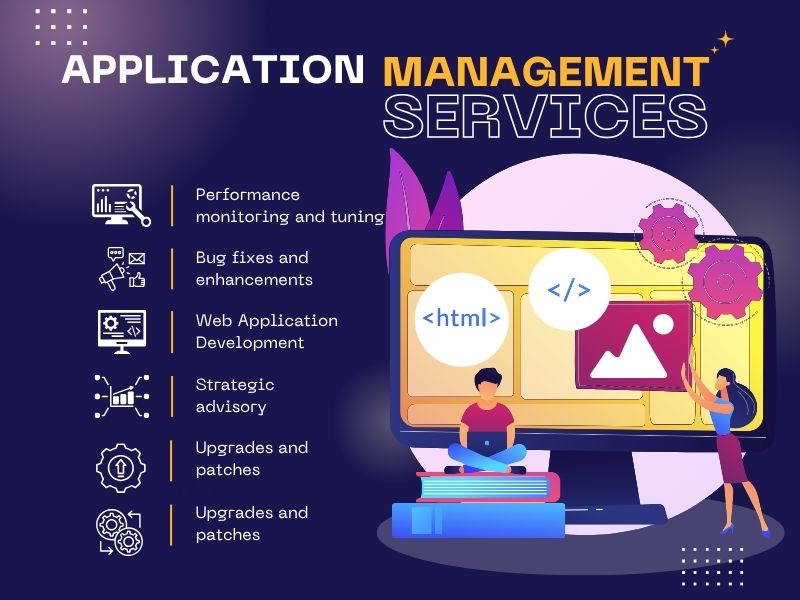
- 24×7 performance monitoring
- AI-driven incident detection
- Automated patch management
- DevSecOps pipelines
- Cloud-native optimization
- Security hardening and compliance audits
- Continuous performance engineering
AMS today is proactive, predictive, and automation-first.
Why Choose Application Management Services in 2026?
Digital ecosystems are more complex than ever.
Organizations operate across:
- Multi-cloud environments
- Mobile-first applications
- AI-powered systems
- Microservices architectures
- Global regulatory frameworks
IT spending has surpassed $5 trillion globally, with enterprises increasing investments in modernization and automation. More than 65% of organizations continue expanding AMS budgets to support hybrid cloud and transformation initiatives.
Businesses choose Application Management Services to:
- Reduce downtime and service disruption
- Improve digital customer experience
- Strengthen cybersecurity posture
- Accelerate feature delivery
- Optimize infrastructure costs
- Enable innovation without operational risk
AMS in 2026 is about business continuity and growth acceleration.
Future-Proof Your Applications with Expert AMS
Also read- Why Choose Application Management Services (AMS) in 2026
Market Trends Driving Managed Application Services in 2026
1. AI-Powered Operations (AIOps)
Next-generation AMS integrates:
- Predictive analytics
- Automated root-cause analysis
- Self-healing scripts
- Intelligent alert prioritization
This reduces incident response times and improves uptime reliability.
2. Cloud-Native & Kubernetes Management
Enterprises are shifting from monolithic systems to containerized, scalable architectures. AMS providers now support:
- Kubernetes orchestration
- Serverless optimization
- Infrastructure-as-Code
- Cost governance in multi-cloud environments
3. Security-First Application Governance
With stricter global compliance regulations and rising cyber threats, AMS includes:
- Continuous vulnerability scanning
- Zero-trust architecture support
- Automated compliance reporting
- Threat intelligence integration
Security is embedded, not bolted on.
Core Benefits of Application Management Services
1. Cost Optimization Through Automation
Modern AMS reduces manual intervention through AI and automation, lowering operational overhead by up to 30–45% in optimized environments.
Predictable pricing models also improve budget planning.
2. Access to Specialized Technical Expertise
Partnering with a reliable Web App Development Company offering AMS ensures access to experts in:
- Cloud-native development
- Microservices and APIs
- DevSecOps
- AI integration
- Performance engineering
This eliminates skill gaps internally.
3. Enhanced Application Performance Management
AMS providers proactively monitor:
- Load performance
- Database health
- API latency
- Infrastructure bottlenecks
Optimized applications directly improve retention, engagement, and revenue outcomes.
4. 24×7 SLA-Based Support
AMS includes structured SLAs with defined:
- Response times
- Resolution times
- Escalation matrices
This ensures mission-critical applications remain stable during peak loads.
5. Compliance & Risk Mitigation
Industries such as healthcare and finance rely on AMS for:
- HIPAA compliance
- PCI-DSS adherence
- GDPR governance
- Secure audit trails
Risk management is built into operational workflows.
6. Scalability for Growth
Whether launching new digital products or expanding globally, AMS frameworks scale seamlessly alongside business growth.
Secure Your Applications with Proactive AMS
AMS vs Traditional IT Support in 2026
| Aspect | Application Management Services | Traditional IT Support |
| Approach | Predictive & automated | Reactive |
| Scope | Full lifecycle management | Incident-based |
| Innovation | Enables modernization | Limited |
| Business Impact | Strategic growth driver | Technical maintenance |
| Automation | AI & DevOps enabled | Manual |
AMS supports transformation. Traditional IT support maintains the status quo.
Industries Accelerating AMS Adoption in 2026
Healthcare
- AI-driven diagnostics platforms
- Secure telehealth ecosystems
- HIPAA-compliant cloud systems
Financial Services
- Real-time fraud detection
- RegTech compliance systems
- AI-powered investment analytics
Retail & E-Commerce
- High-volume transaction systems
- Omnichannel platforms
- Real-time personalization engines
Retail enterprises leveraging AMS report 99.9% uptime during peak demand periods.
Case Study: OnGraph Application Managed Service Success
Client: US-based HealthTech SaaS provider
Challenge: Downtime, slow feature rollouts, compliance gaps
Solution Delivered:
- 24×7 monitoring
- Cloud-native optimization
- Automated incident workflows
- HIPAA compliance integration
Results Achieved:
- 70% reduction in downtime
- Full regulatory compliance
- 40% faster deployment cycles
This demonstrates how structured managed application services drive measurable impact.
Custom & Cloud-Based Application Management Services
In 2026, AMS includes:
- DevSecOps automation
- Site Reliability Engineering (SRE)
- AI-driven monitoring
- Kubernetes & container lifecycle management
- Multi-cloud governance (AWS, Azure, GCP)
Organizations working with a Mobile App Development Company in the USA or an enterprise-grade Web App Development Services provider benefit from integrated AMS and development capabilities.
How to Choose the Right Application Management Service Provider?
When selecting an AMS partner, evaluate:
- Proven enterprise experience
- Domain expertise
- Transparent SLAs
- Cloud-native capabilities
- Automation maturity
- Integration flexibility
- Long-term scalability
A pilot engagement is recommended before full-scale implementation.
From Development to Ongoing Management — We’ve Got You
As a leading Web App Development Company, we combine development and Application Management Services for total control.
Why OnGraph for Application Management Services?
With 16+ years of digital engineering excellence, OnGraph delivers:
- Application Management Services
- Enterprise Web App Development Services
- Custom mobile and cloud solutions
- Modernization of legacy systems
Key Highlights:
- 250+ developers
- 1000+ projects delivered
- 96% success rate
- 4.7 average client rating
We combine innovation, automation, and operational resilience to future-proof your applications.
Final Thoughts: AMS as a Strategic Advantage in 2026
Application Management Services are no longer just operational support — they are strategic infrastructure.
Organizations investing in structured AMS frameworks gain:
- Faster innovation cycles
- Lower operational risk
- Stronger cybersecurity posture
- Sustainable scalability
- Competitive differentiation
In 2026, digital agility defines market leaders.
If your business relies on software, Application Management Services are essential.
Ready to Future-Proof Your Applications?
- 24×7 SLA-Based Support
- Certified Engineers
- AI-Driven Monitoring
- Cloud-Native Optimization
FAQs
Application Management Services (AMS) are ongoing services that support, monitor, optimize, and modernize enterprise applications throughout their lifecycle.
They typically include:
- 24/7 monitoring
- Performance optimization
- Bug fixes and enhancements
- Patch management
- Security updates
- DevOps automation
- Cloud and infrastructure support
Unlike traditional IT support, AMS focuses on proactive improvement, scalability, and business alignment — not just fixing issues when they occur.
In 2026, digital ecosystems are more complex due to AI integration, hybrid cloud environments, and stricter compliance regulations.
Organizations choose Application Management Services to:
- Reduce downtime
- Improve security posture
- Accelerate feature releases
- Lower operational costs
- Maintain compliance (HIPAA, GDPR, PCI-DSS)
- Enable digital transformation
AMS allows businesses to innovate without operational disruption.
AMS pricing depends on:
- Application complexity
- Cloud infrastructure usage
- Security and compliance requirements
- SLA level (response & resolution time)
- Integration and modernization needs
Pricing models typically include:
- Fixed monthly retainers
- SLA-based pricing
- Consumption-based cloud models
- Hybrid pricing structures
The right provider ensures cost predictability and ROI.
Managed application services enhance performance through:
- Real-time monitoring
- Bottleneck identification
- Database optimization
- Load balancing
- Code refactoring
- Infrastructure tuning
Proactive monitoring reduces outages and improves uptime — often achieving 99.9% or higher reliability.
Yes — especially for SaaS startups and digital-first companies.
AMS helps startups:
- Avoid hiring large in-house support teams
- Scale infrastructure quickly
- Ensure security compliance
- Release features faster
- Focus internal teams on innovation
For startups partnering with a Mobile App Development Company in the USA, combining development and AMS ensures smoother long-term growth.
Look for:
- Proven enterprise experience
- Strong SLA commitments
- Cloud-native expertise
- DevSecOps maturity
- Transparent pricing
- Positive client reviews
- Scalability capability
Choose a provider that aligns with your business goals — not just technical needs.
About the Author

Let’s Create Something Great Together!
Latest Blog
Let’s have a conversation today!


India
ONGRAPH TECHNOLOGIES PRIVATE LIMITED,
SDF L-1, NSEZ,
Sector 81, Block L, Phase-2,
Noida, Uttar Pradesh-201305

USA
OnGraph Technologies,
120 Bethpage Rd, Suite 304,
Hicksville, NY 11801, USA

Canada
7-1039 CEDARGLEN GATE,
Mississauga, Ontario,
Canada L5C 3A7

UK
89 Banstead Road South,
Sutton, Surrey, SM2 5LH
United Kingdom

Malaysia
G-3A, Amaya Maluri, Jalan
Jejaka 2, Taman Maluri,
KL–55100, Malaysia

Singapore
10 Anson Road,#26-04
International Plaza,
Singapore (079903)