

In this article
- What Is a Python Framework?
- Python Framework vs Python Library (Quick Difference)
- Why Use a Python Framework for App Development?
- Types of Python Frameworks
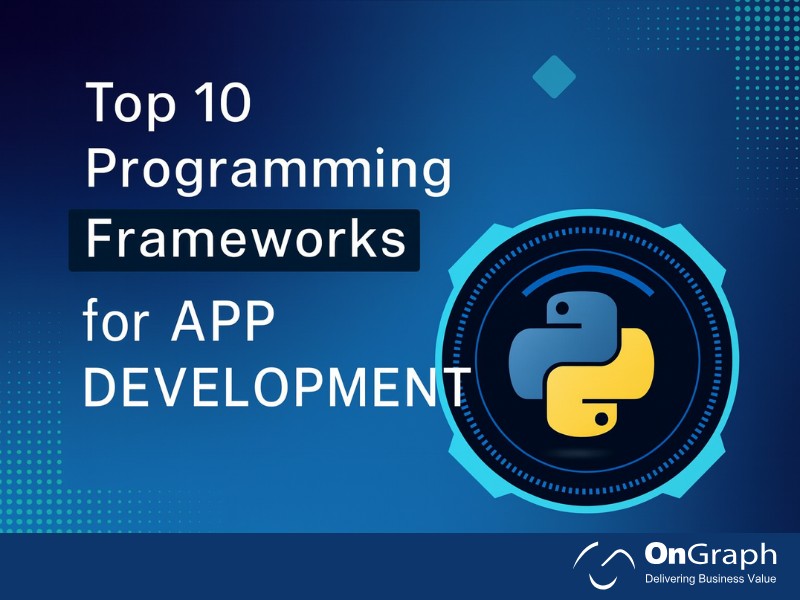
- Top 10 Programming Frameworks for App Development (Full Breakdown)
- Comparison Table: Top 10 Programming Frameworks for App Development
- Best Apps Built with Python Frameworks
- How to Choose the Right Framework (Quick Guide)
- How Python Frameworks Transform App Development?
- Why OnGraph Is the Best Choice for Python Development Services
- Conclusion
Python remains one of the most popular and versatile languages for mobile and web development. Known for its simplicity, scalability, and large ecosystem, Python helps developers build powerful applications faster — making it a top choice for startups, enterprises, and leading Python development companies worldwide. Whether you’re exploring Python Development Outsourcing or planning a new project, understanding the best frameworks is essential. In this Guide, we break down the Top 10 Programming Frameworks for App Development, their features, use cases, and why businesses prefer them.
What Is a Python Framework?
A Python framework is a collection of pre-built modules that simplify development by handling repetitive tasks like routing, database operations, caching, and authentication. They help developers:
- Build apps faster
- Improve code quality
- Ensure scalability
- Reduce development effort
This makes frameworks essential for efficient Python development services.
Python Framework vs Python Library (Quick Difference)
A framework is the skeleton of your app that you build around, while a library is a toolbox you pick tools from.
| Python Framework | Python Library |
| Defines structure of the entire application; provides tools for routing, templates, database handling | Provides specific functions for solving a narrow problem (e.g., data manipulation, plotting) |
| Example: Django, Flask | Example: NumPy, Requests |
Why Use a Python Framework for App Development?
Python stands out because of:
- Easy learning curve
- Large ecosystem
- Flexible cross-platform development
- Strong community support
- Fast prototyping
- Cost-effective development
This is why many global brands partner with a Python development company for scalable solutions.
Types of Python Frameworks
There are 3 major types:
1. Micro Frameworks
Lightweight, minimal, and ideal for small applications.
Examples: Bottle, CherryPy, Falcon, Dash.
2. Full-Stack Frameworks
Feature-rich frameworks handling front-end + back-end.
Examples: Django, Web2Py, TurboGears.
3. Asynchronous Frameworks
Designed for high-performance, real-time apps with massive concurrency.
Examples: AIOHTTP, Sanic, Tornado.
Build High-Performance Apps with Expert Python Developers
Top 10 Programming Frameworks for App Development (Full Breakdown)
Below are the best frameworks powering thousands of apps across industries.
1. Django – The #1 Python Framework for Scalable App Development
Django is a full-stack framework built for rapid, secure, enterprise-grade applications. Companies like Instagram and Spotify rely on it for performance and scalability.
Key Features
- Built-in admin panel
- Powerful ORM
- Authentication system
- Excellent documentation
- DRY architecture
Perfect for:
- Large applications
- Enterprise systems
- E-commerce, social networks
2. Flask – Lightweight & Flexible Micro Framework
Flask is ideal for developers wanting flexibility. It’s minimal yet powerful, making it a top choice for prototypes, APIs, and microservices.
Features:
- Built-in development server
- Easy routing
- Jinja2 templating
- Scales with extensions
Perfect for:
- Startups
- REST APIs
- Lightweight applications
3. Web2Py – Full-Stack Framework with Built-in IDE
Web2Py simplifies development with its own browser-based IDE, debugger, and deployment tools.
Highlights:
- No installation required
- Ticketing system for debugging
- MVC architecture
- Supports NoSQL & SQL databases
Ideal for rapid Python development outsourcing projects.
4. TurboGears – Flexible for Both Small & Large Applications
TurboGears supports multi-database applications with strong modularity.
Features:
- ORM support
- Command-line tools
- MVC architecture
- ToscaWidgets for UI building
Great for enterprise-grade applications.
5. Falcon – High-Performance API Framework
Falcon is perfect for building fast, reliable backend services that handle high traffic.
Features:
- Clean routing
- Native HTTP error responses
- Cython support
- DRY request processing
Used by LinkedIn, Rackspace, and large tech companies.
6. CherryPy – Clean & Minimalistic Framework
CherryPy is one of the oldest Python frameworks and is still a developer favorite.
Features:
- Built-in tools for caching, sessions
- Multi-threaded server
- Flexible plugin system
- Runs on Android
Great for embedded apps & small-scale tools.
7. Tornado – For Real-Time, High-Concurrency Applications
Tornado is an asynchronous framework ideal for apps requiring thousands of active connections.
Features:
- Real-time updates
- Non-blocking network I/O
- WebSockets support
- Highly scalable
Perfect for:
- Chat apps
- Gaming apps
- Live dashboards
8. AIOHTTP – Async Framework for Modern Web Apps
Built on asyncio, AIOHTTP is perfect for high-performance async applications.
Features:
- Pluggable routing
- Supports WebSockets
- Middleware support
- Async server & client
Ideal for fast APIs & microservices.
9. Kivy – Cross-Platform Python Framework for Mobile Apps
Kivy allows developers to build native-feel mobile apps for Android, iOS, Windows, and Linux.
Features:
- Multi-touch support
- GPU-accelerated graphics
- Great for mobile UI development
Perfect for cross-platform development.
10. BeeWare – Native Mobile Apps in Python
BeeWare allows you to write apps in Python and deploy them natively on iOS, Android, Windows, macOS, and Linux.
Features:
- Native look & feel
- Tools like Toga & Briefcase
- Code reusability
- Strong community support
A top pick for mobile app projects using Python.
Transform Your App Idea Into Reality With Python Experts
Comparison Table: Top 10 Programming Frameworks for App Development
| Framework | Best For | Type | Difficulty | Why It’s in the Top 10 |
| Django | Enterprise apps | Full-stack | Medium | Secure, scalable, feature-rich |
| Flask | APIs & microservices | Micro | Easy | Lightweight, flexible |
| Web2Py | Rapid development | Full-stack | Easy | Built-in IDE + MVC |
| TurboGears | Database apps | Full-stack | Medium | Multi-database support |
| Falcon | High-speed APIs | Micro | Medium | Ultra-fast performance |
| CherryPy | Microservices | Micro | Easy | Minimalistic + powerful |
| Tornado | Real-time apps | Async | Hard | Handles 10k+ connections |
| AIOHTTP | Async APIs | Async | Medium | Excellent async performance |
| Kivy | Mobile apps | Cross-platform | Medium | GPU accelerated |
| BeeWare | Native apps | Cross-platform | Medium | Write once, deploy anywhere |
Best Apps Built with Python Frameworks
Some globally recognized apps include:
- Instagram – Django
- Spotify – Django
- Dropbox – Custom Python framework
- YouTube – Flask
- Quora – Django
Proving Python’s unbeatable reliability.
How to Choose the Right Framework (Quick Guide)?
Choose based on:
- Project complexity
- Scalability needs
- Developer expertise
- Performance requirements
- Documentation & community
If unsure, consult a trusted Python development company to guide your technical decisions.
How Python Frameworks Transform App Development?
Python transforms app development by offering:
- Rapid prototyping
- Clean code structure
- Strong support for AI/ML, data engineering & DevOps
- Seamless API integration
- Swift development with reusable components
This is why most businesses prefer Python development services for scalable and future-ready apps.
Why OnGraph Is the Best Choice for Python Development Services
Choosing the right partner matters. OnGraph is a leading Python development company offering:
- Custom Python development
- Mobile app development
- Web app development
- Python development outsourcing
- Expertise in Django, Flask, TurboGears, Kivy, Tornado
- End-to-end support from ideation to deployment
Let us build scalable, high-performing applications tailored to your business needs.
Planning a Python app? Hire our expert Python developers today.
From startup MVPs to enterprise platforms, our Python developers build scalable, secure, and future-ready applications tailored to your business vision.
Conclusion
Python offers some of the best frameworks for building modern, scalable, and high-performing applications. Whether you’re creating mobile apps, enterprise platforms, APIs, or full-stack solutions, choosing the right framework is crucial.
With this updated Python App Development Guide, you now have a clear understanding of the Top 10 Programming Frameworks for App Development and how to use them effectively.
Partner with OnGraph to bring your vision to life with expert Python development services.
FAQs
Programming frameworks provide pre-built tools, libraries, and structures that speed up development, reduce repetitive coding, improve code quality, and ensure scalability. They help developers focus more on core features rather than reinventing the wheel.
There is no single “best” framework—choices vary by project. Flutter, React Native, and SwiftUI (for iOS) are leading options in 2025 due to performance, community support, and cross-platform capabilities.
Key factors include: project size, performance needs, team expertise, community support, cross-platform requirements, scalability, budget, and long-term maintenance expectations.
Cross-platform frameworks like Flutter and React Native allow faster development and reduced cost, but native frameworks like Swift and Kotlin offer better performance and deeper device integration. The choice depends on app goals and complexity.
Top web frameworks for 2025 include Angular, React, Vue.js, Django, and Laravel, each offering strengths in speed, security, and scalability.
Frameworks influence load speed, stability, memory usage, and responsiveness. Lightweight frameworks typically offer better performance, while heavier ones may provide more built-in features but require optimization.
GUI framework is an open-source Python package that allows you to quickly build a demo or web application for your machine learning model, API, or any arbitrary Python function. Below are the top 10 GUI frameworks.
- Gradio
- Streamlit
- Kivy
- Tkinter
- PyQt
- PySide
- wxPython
- PyGTK
- wxPython
- PySimpleGUI
Yes, If you want to develop a project that involves web development, data analysis, AI, machine learning, or automation then you should hire a Python developer. Python has versatility, strong community support, and vast libraries that make it an excellent choice for scalable and efficient solutions by developers. A highly skilled Python development team can help you build robust applications, streamline workflows, and tackle complicated data-driven goals.
The cost to hire a Python developer can vary and it depends on several factors such as work experience, location, and the complexity of your project. See the below charges of a Python developer.
1. Work Experience Based Cost:
- Junior-level Python developers (1-3 years of experience) typically charge $25 to $50 per hour.
- Mid-level developers (3-6 years) range from $60 to $100 per hour.
- Senior-level Python developers (6+ years) can charge $100 to $250 per hour or more, especially for specialized roles in fields like machine learning or data science.
2. Location Based Cost:
- If you hire Developers from the US, UK, and Australia locations then they have higher rates, averaging between $80 to $150 per hour.
- The developers are in Eastern Europe, India, and Southeast Asia regions, rates can be lower, ranging from $25 to $50 per hour for highly qualified developers.
3. Project Range:
- The cost may be less for short-term or small projects but long-term or complex projects requiring deep expertise in Python Frameworks for App Development like Django, Flask, or data science libraries will increase costs.
About the Author

Let’s Create Something Great Together!
Latest Blog

Let’s have a conversation today!


India
ONGRAPH TECHNOLOGIES PRIVATE LIMITED,
SDF L-1, NSEZ,
Sector 81, Block L, Phase-2,
Noida, Uttar Pradesh-201305

USA
OnGraph Technologies,
120 Bethpage Rd, Suite 304,
Hicksville, NY 11801, USA

Canada
7-1039 CEDARGLEN GATE,
Mississauga, Ontario,
Canada L5C 3A7

UK
89 Banstead Road South,
Sutton, Surrey, SM2 5LH
United Kingdom

Malaysia
G-3A, Amaya Maluri, Jalan
Jejaka 2, Taman Maluri,
KL–55100, Malaysia

Singapore
10 Anson Road,#26-04
International Plaza,
Singapore (079903)