Corporate Events
Town halls, kickoffs and product launches — invite-only access, headcount control and a private feed.
- SSO invites
- RSVP tracking
- Internal feed
Registration, offline check-in, live agendas, attendee matchmaking and sponsor tools in one white-label platform — iOS, Android and your organizer console. Branded to you, live in weeks, source code yours.
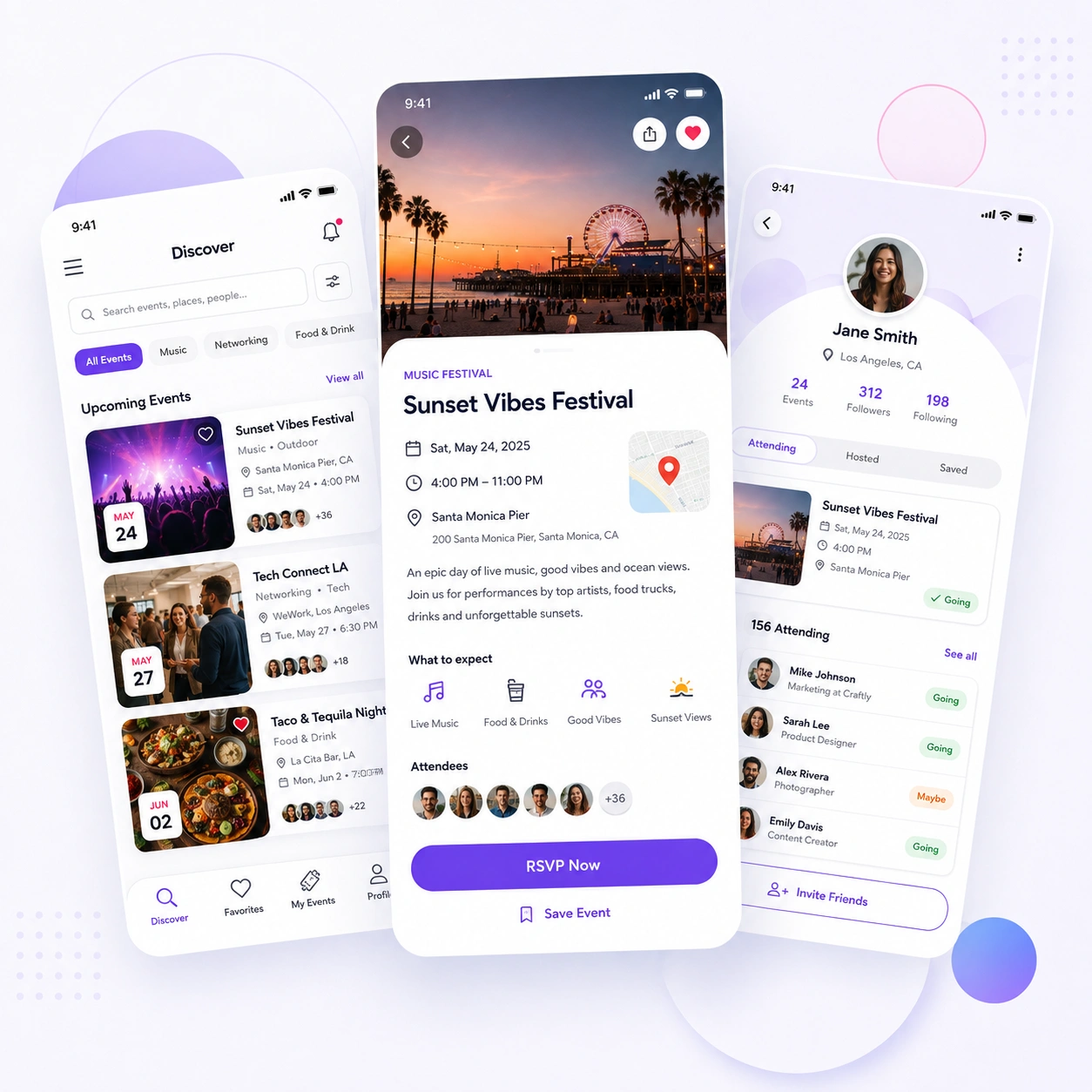
An event app is an extension of your brand, not a utility bolted on the week before doors open. Ticketing, badges, agendas, wayfinding, networking and payments run on one system, designed together — not stitched from five vendors.
Ten people in a room or a hundred thousand on a festival ground — the platform stays the same.
Town halls, kickoffs and product launches — invite-only access, headcount control and a private feed.
Multi-track agendas, speaker profiles and session ratings, with clash warnings on saved talks.
Floor plans, booth discovery, badge scanning and lead capture that survives a single walk-past.
Multi-stage lineups, timed entry, cashless wallets and merch drops — for phones that lose signal in the pit.
Seat-level ticketing, gate access, in-seat ordering and fan engagement, sized for a 40,000-person arrival.
Guest lists, RSVPs, seating plans, menus and a shared photo wall — private, for the weeks around the day.
Recurring local events, chapters, host tools and paid memberships — the product that runs between events.
Live streams, replays, virtual booths and breakouts — remote and on-site attendees on one shared list.
Strategy, design, engineering, launch and event-day support — all from one team.
We scope from your attendee journeys, ticketing model and revenue plan — not a feature list. You leave with an MVP, a timeline anchored to your event date and a real budget.
Event apps get used one-handed, in a crowd, in a hurry. Thumb-reach navigation, high-contrast agendas, a ticket two taps away — and a clickable prototype before any code.
Native or cross-platform builds plus the organizer console and APIs behind them — two-week sprints, a working build and a live demo at the end of each.
Ticketing, check-in, agendas and the console are already built and load-tested. We rebrand, configure and add only what you need — live in weeks, still yours to own.
Tiered pricing, group bookings, promo codes, waitlists, refunds and multi-currency payouts — with reconciliation your finance team can actually audit.
Salesforce, HubSpot, Eventbrite, Cvent, Zoom, Stripe, badge printers and scanners — plus migration off a platform you have outgrown, with old links kept alive.
Free consultation — NDA signed before you share anything.
Each audience gets a surface built for their job, on one shared data layer.
What is on near you by date, category, price or distance, with saved searches.
Multi-ticket checkout, group bookings, promo codes and waitlists.
Save sessions across tracks, get clash warnings and sync to Google or Outlook.
QR and NFC passes in Apple and Google Wallet that scan with no signal.
Venue maps with beacon-assisted indoor navigation to your next room or booth.
AI ranks who is worth meeting, then suggests a time and a place to do it.
One-to-one and group chat, digital cards and invites that land in both calendars.
Upvoted questions, live polls on the stage screen and one-tap session ratings.
Drag-and-drop tracks, rooms and sessions, with double-booking flagged as you go.
Early bird, VIP and group tickets, capacity caps and automatic waitlist release.
Multi-gate scanning, zone-level rules and duplicate protection, fully offline.
Segment by ticket, track or check-in status — or fire an instant room-change alert.
Invites, bios, deck uploads, call-for-papers review and automated confirmations.
Who is inside, which rooms are filling and which gates are backing up, live.
Sell packages, place booths on the floor plan and give sponsors a self-serve portal.
Attendance, ratings, engagement, revenue and sponsor ROI in one export.
Logo, video, brochures, offers and a team roster attendees can message directly.
Scan, add a note and a score — the lead is in the CRM before you finish talking.
Promoted agenda slots, banners and permission-based push to the right segments.
Attendees book a booth slot; both sides get the calendar invite and a reminder.
Time-boxed or beacon-triggered offers, shown when someone is near the stand.
Booth traffic, dwell time, leads by seniority and content downloads.
A season of events, or many independent organizers, with isolated data per tenant.
Granular rights for staff, speakers, sponsors and volunteers, with SSO and 2FA.
Split payouts, refund and transfer rules, chargebacks and reconciliation exports.
Verification, reporting, block lists, keyword filters and an incident queue.
RTL layouts, per-region content, local tax rules and multi-currency pricing.
Product analytics, an immutable audit log and a documented API with webhooks.
Most event apps go quiet the moment the doors close. Ours keep running between events — directories, chapters, year-round content, renewals — so your next event opens to a crowd that never left.
Not slide-deck technology — each one solves a real problem: fake tickets, gate queues, lost attendees, unprovable sponsor ROI.
Models rank sessions, exhibitors and people per attendee from goals and on-the-day behaviour — sharpening by the hour.
Verifiable tokens make counterfeits worthless and resale traceable, with your price caps and a royalty on every transfer.
One tap moves attendees through gates, into sessions and onto lead lists — with room-level attendance nobody has to count.
Turn-by-turn guidance where GPS fails, proximity offers near a stand, and live heat maps of where the crowd is.
AR venue overlays, walk-around product demos and virtual booths for the audience that could not travel.
Low-latency streams, instant replays, breakouts and synced chat put remote attendees in the same conversation as the room.
Ticket sales alone rarely justify a platform. The event businesses that compound stack three or more.
A percentage of face value plus a flat per-order fee, absorbed by the organizer or passed to the buyer. It is the most predictable line in event software because it scales with volume rather than with your headcount. We build tiered rates by organizer size, automatic tax handling and split payouts, so money reaches venues, promoters and artists without a spreadsheet in the middle.
Monthly or annual SaaS tiers gated on the things organizers grow into — number of events, attendee volume, custom branding, API access, advanced analytics and dedicated support. Subscriptions smooth the seasonality that makes pure ticketing revenue lumpy, and they turn a one-off event into an account with a renewal date.
Digital sponsorship sells because it is measurable. Booth listings, sponsored sessions, splash screens, push drops and lead-capture licences are sold as tiered packages inside the console, and each comes with a report showing scans, dwell time and lead seniority — which is exactly what gets a package renewed at a higher tier next year.
Once discovery traffic is meaningful, organizers will pay to rank higher in search and category feeds, and brands will pay for native placements in the feed and agenda. We keep ad density low and clearly labelled — an event app that feels like a billboard loses the attendees the advertisers are paying to reach.
Attendees pay for access and for time: VIP entry, front-of-queue, priority networking, unlimited meeting requests, session replays after the event and early access to the next one. Sold in-app at the moment of intent — usually right after someone is turned away from a full session — these convert far better than an upsell in a pre-event email.
A prepaid wallet inside the app takes a cut of every drink, meal and T-shirt — and reliably lifts on-site spend, because tapping a phone hurts less than counting cash. Add in-seat ordering, collection-point pickup and top-up bonuses, and the wallet also gives you per-attendee spend data that no cash bar will ever produce.
Your deadline cannot move — so we schedule in reverse, freeze code early and rehearse on site.
Workshops with your event, marketing and operations teams. We map attendee journeys, ticketing rules, sponsor commitments and the systems already in place, then agree what ships for release one and what waits.
Information architecture, wireframes, then a full visual system in your brand. You get a clickable prototype of the attendee app and the organizer console to walk through before any code is written.
Data model, API contracts, offline strategy, a scaling plan for the check-in spike and the integration list. You sign off a sprint-by-sprint plan with the demo dates already in your calendar.
Two-week sprints across mobile, backend and console, with a working build and a live demo at the end of each. Your team tests real builds from sprint two, not screenshots at the end.
Functional, device, accessibility and security testing, plus a load test at your peak arrival rate — then a full dry run on site with real scanners, real badges and the venue's actual network.
Store submission, staff training and a monitored war room on event day with engineers on call. Afterwards you get the analytics review, the backlog for release two and a scaling plan.
Scoped feature list and a fixed-price estimate in two working days.
One test for every choice: does it hold up when everybody arrives at once?
Event software is judged in a few hours. These decide how those hours go.
Building consumer and enterprise software since 2008, with a deep bench in social, ticketing and marketplace products.
Strategy, design, mobile, backend, QA and DevOps on one team — no handover in the middle, no gap in responsibility.
Engineers on call with live monitoring on check-in throughput, API latency and crashes — problems surface on a dashboard, not at the gate.
Check-in, scanning, tickets and agendas keep working when the venue network does not, then reconcile the moment it returns.
GDPR-ready data handling, PCI-DSS payment flows, encrypted attendee data and audit logging — reviewed before launch, not after.
Source code, design files, docs, cloud accounts and IP transfer at handover. Stay because the work is good, not because leaving is costly.
Straight answers on cost, timelines, ownership and venue Wi-Fi. Anything else, just ask.
Event app development starts from $5,000 — a white-label build rebranded and configured for your event. A custom platform with ticketing, matchmaking, sponsor tools and a full organizer console costs more, depending on how many platforms you launch on, the depth of your ticketing and payment logic, how much of the organizer console you need on day one, and the third-party systems you integrate with. You get a fixed-price breakdown after the discovery call — not a range that moves once work starts.
A rebranded white-label launch goes live in 6–8 weeks. A custom platform across iOS, Android and an organizer web console usually takes 4–6 months, delivered in two-week sprints so you test working builds throughout. We plan the schedule backwards from your event date, lock a code freeze before it and run a full on-site dry run — because a launch date in event software is a fact, not a target.
At minimum, on the attendee side: event discovery and search, registration and ticket booking, a personal agenda, a QR or NFC ticket that works offline, venue maps and wayfinding, push notifications, in-app chat or networking, and live polls or Q&A. On the organizer side: check-in and access control, ticket tiers and promo codes, speaker and session management, a live attendance dashboard, sponsor and exhibitor tools, and post-event reporting.
Yes. Our white-label event platform ships with ticketing, check-in, agendas, networking and the organizer console already built and load-tested. We rebrand it, configure your event structure and add only the custom modules you actually need — which is why it launches in weeks rather than months, while still leaving you with the source code at handover.
Yes. Check-in, badge scanning, ticket validation and the agenda are built offline-first: scans validate against a locally cached ticket list and queue, then reconcile the moment connectivity returns, with duplicate-scan protection so nobody gets in twice. Venue connectivity fails often enough that we treat it as an expected condition rather than an edge case.
Yes. Hybrid events run on one attendee list, one agenda and one networking graph. Remote attendees get live streams, on-demand replays, virtual booths and breakout rooms; on-site attendees get maps, badge scanning and physical check-in. Sponsors see leads from both audiences in a single report, which is usually what makes a hybrid package sellable in the first place.
The proven mix is ticketing commission and booking fees, SaaS subscriptions for organizers, sponsor and exhibitor packages, in-app advertising and promoted listings, premium attendee upgrades such as VIP access or priority networking, and cashless wallet revenue from food, beverage and merchandise. Most profitable event platforms stack three or more of these — see the monetization models above for how each one is built.
Yes. You receive complete ownership of the source code, design files, documentation and cloud infrastructure, along with all intellectual property rights, at handover. There are no recurring licence fees and no vendor lock-in — you can take the codebase to any team you like, though most clients stay with us for the next release.
Tell us about your event. You get a scoped feature list, a timeline and a fixed-price estimate within two working days — free, no strings.

Ticketing, offline check-in, live agendas, attendee matchmaking, sponsor tools and an organizer console — branded to you and built by a team that has shipped 120+ event and community apps. Full source-code ownership included.